Credit: Nicole Santo/UPMC
PITTSBURGH, Feb. 22, 2017 – A product of digesting a micronutrient found in soy may hold the key to why some people seem to derive a heart-protective benefit from eating soy foods, while others do not, a University of Pittsburgh Graduate School of Public Health-led study discovered.
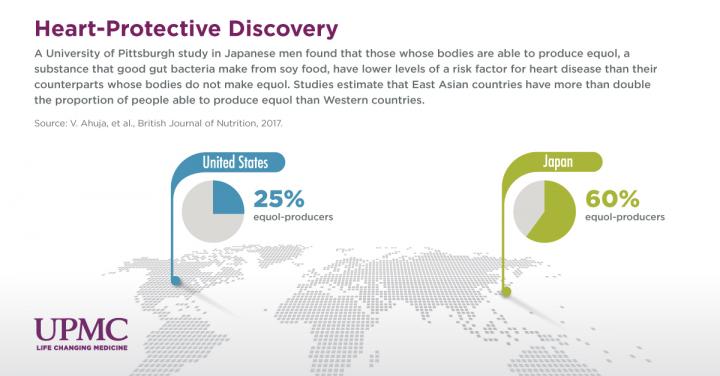
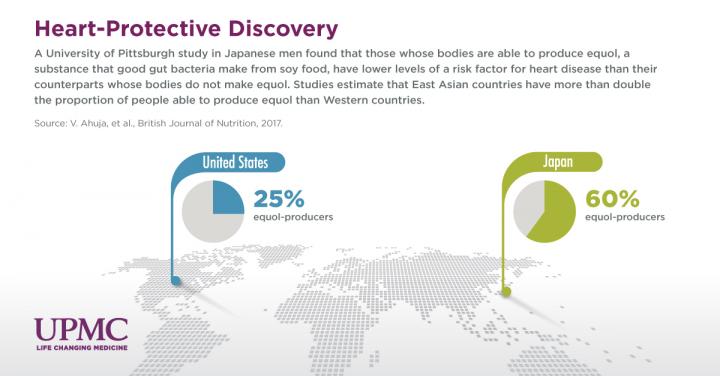
Japanese men who are able to produce equol — a substance made by some types of "good" gut bacteria when they metabolize isoflavones (micronutrients found in dietary soy)–have lower levels of a risk factor for heart disease than their counterparts who cannot produce it, according to the research published in the British Journal of Nutrition.
"Scientists have known for some time that isoflavones protect against the buildup of plaque in arteries, known as atherosclerosis, in monkeys, and are associated with lower rates of heart disease in people in Asian countries," said senior author Akira Sekikawa, M.D., Ph.D., an associate professor of epidemiology at Pitt Public Health. "We were surprised when a large trial of isoflavones in the U.S. didn't show the beneficial effects among people with atherosclerosis in Western countries. Now, we think we know why."
All monkeys can produce equol, as can 50 to 60 percent of people in Asian countries. However, only 20 to 30 percent of people in Western countries can.
Sekikawa and his colleagues, who include scientists in Japan, recruited 272 Japanese men aged 40 to 49 and performed blood tests to find out if they were producing equol. After adjusting for other heart disease risk factors such as high blood pressure, cholesterol, smoking and obesity, the team found that the equol-producers had 90-percent lower odds of coronary artery calcification, a predictor of heart disease, than the equol non-producers.
The daily intake of dietary isoflavones — found in traditional soy foods such as tofu, miso and soymilk–is 25 to 50 milligrams in China and Japan, while it is less than 2 milligrams in Western countries. Equol is available as a supplement–bypassing the need for gut bacteria to produce it–though no clinical trials have been performed to determine a safe dosage for heart protective effects, or if it even does provide such protection.
"I do not recommend that people start taking equol to improve their heart health or for any other reason unless advised by their doctor," said Sekikawa. "Much more study is needed."
Sekikawa and his team are pursuing funding for a much larger observational study to expand on their findings and eventually a randomized clinical trial to examine the effect of taking equol on various medical conditions and diseases.
"Our discovery about equol may have applications far beyond heart disease," said Sekikawa. "We know that isoflavones may be associated with protecting against many other medical conditions, including osteoporosis, dementia, menopausal hot flashes, and prostate and breast cancers. Equol may have an even stronger effect on these diseases."
###
Additional authors on this research include lead author Vasudha Ahuja, Ph.D., of Pitt Public Health; and co-authors Katsuyuki Miura, M.D., Ph.D., Akira Fujiyoshi, M.D., Ph.D., Maryam Zaid, Ph.D., Naoko Miyagawa, M.D., Ph.D., Aya Kadota, M.D., Ph.D., and Hirotsuga Ueshima, M.D., Ph.D., all of Shiga University of Medical Science in Japan; Abhishek Vishnu, M.D., Ph.D., and Rhobert Evans, Ph.D., both of Pitt Public Health; Takashi Hisamatsu, M.D., Ph.D., of Shiga University of Medical Science and Shimane University in Japan; and Tomonori Okamura, M.D., Ph.D., of Keio University in Japan.
This research was funded by National Institutes of Health grant R01 HL68200, Japanese Ministry of Education, Culture, Sports, Science and Technology grants B16790335 and A13307016, and a small grant from Pitt Public Health's Department of Epidemiology.
About the University of Pittsburgh Graduate School of Public Health
The University of Pittsburgh Graduate School of Public Health, founded in 1948 and now one of the top-ranked schools of public health in the United States, conducts research on public health and medical care that improves the lives of millions of people around the world. Pitt Public Health is a leader in devising new methods to prevent and treat cardiovascular diseases, HIV/AIDS, cancer and other important public health problems. For more information about Pitt Public Health, visit the school's Web site at http://www.publichealth.pitt.edu.
http://www.upmc.com/media
Media Contact
Allison Hydzik
Office: 412-647-9975
Mobile: 412-559-2431
E-mail: [email protected]
Lawerence Synett
Phone: 412-647-9816
Mobile: 412-302-4127
E-mail: [email protected]
############
Story Source: Materials provided by Scienmag