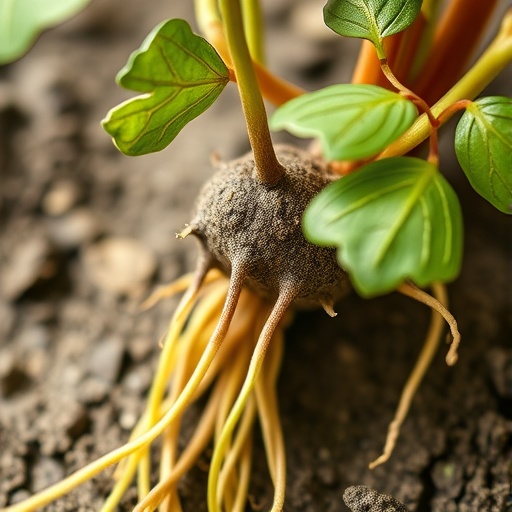
In a remarkable advancement in the field of agricultural genetics, a groundbreaking genome-wide association study (GWAS) has unveiled critical insights into the root-related traits of soybean plants, specifically during their vegetative growth phases. This pioneering research, led by Kumawat, Agrawal, and Raghuvanshi, along with their colleagues, focuses on the prominent species Glycine max, known for its agricultural significance and economic value. The study delineates the intricate connections between genetic markers and root development, which is essential for enhancing soybean cultivation strategies.
Soybean, a pivotal crop globally, serves as a fundamental source of protein and oil. With the increasing demand for plant-based food sources, understanding the genetic foundations that govern root traits becomes paramount. Root development plays a vital role in the overall health and productivity of the plant, influencing nutrient uptake and resilience against abiotic stresses. This research not only contributes to the scientific understanding of plant genetics but also lays the groundwork for future innovation in crop breeding practices.
The researchers employed advanced genomic techniques to analyze the genetic diversity within a large population of soybean plants. By utilizing high-throughput sequencing technologies, they were able to identify single nucleotide polymorphisms (SNPs) associated with critical root traits. The data gleaned from this study reveal how specific genetic variations can lead to variations in root architecture and functionality, thereby directly impacting the soybean’s overall growth and yield.
One of the significant findings of this GWAS is the identification of several quantitative trait loci (QTLs) linked to root depth, lateral root formation, and root hair density. These traits are crucial, especially in varying environmental conditions where drought tolerance and nutrient acquisition are key to successful cultivation. The implications of these findings are profound; breeders can now target these QTLs to enhance root systems in soybean lines, potentially leading to improved performance in unfavorable conditions.
Moreover, the study’s authors address the importance of phenotyping, stating that traditional methods of evaluating plant traits can be limiting. The integration of modern imaging technologies, coupled with sophisticated software for data analysis, allows for a more comprehensive understanding of root traits. This progression toward precision phenotyping signifies a shift in how researchers can validate genetic associations and enhance breeding methodologies.
Additionally, the research explores how root-related traits can interact with other plant physiological processes. For instance, the study emphasizes the connection between root development and flowering time, which could be critical for optimizing planting schedules in different climates. Such findings underscore the complexity of plant growth and the necessity of a holistic approach to genetic research and agricultural practices.
In examining the potential applications of this research, it becomes evident that enhancing root traits is just one part of a larger equation. The ability to improve soil health and plant resilience through genetic advancements could lead to sustainable agricultural practices that minimize the reliance on chemical fertilizers and pesticides. The environmental impact of soybean production could thus be significantly reduced, aligning with global efforts toward more eco-friendly agriculture.
The implications of this study extend beyond just genetic improvement; they touch upon socio-economic factors as well. By breeding soybean varieties with superior root traits, farmers may experience increased productivity, potentially translating to higher income and improved food security in regions dependent on soybean cultivation. This research thus stands to benefit not only the scientific community but also farmers and consumers alike.
The findings also contribute to the broader scientific realm of phytogenetics. Understanding the genetic mechanisms that govern root architecture could have far-reaching consequences, potentially influencing research in other crop species. The methodologies and findings from this study may thus become a template for exploring root traits in other economically significant plants, enhancing global food systems.
As the researchers look toward future studies, they emphasize the importance of collaboration across disciplines. The integration of genomics, phenomics, and agronomy is highlighted as crucial for translating genetic discoveries into practical applications in the field. The advancement of interdisciplinary research will play a pivotal role in addressing current and future challenges in agriculture.
In conclusion, this comprehensive genome-wide association study sheds light on the intricate genetic underpinnings of root traits in soybeans. The revelations from this research not only enhance our understanding of plant genetics but also provide a framework for future agricultural innovations. As the world grapples with the challenges posed by climate change, food security, and sustainable agriculture, studies like this offer hope for creating resilient crops capable of thriving in diverse environments.
The ongoing commitment of researchers to understand and manipulate the genetic frameworks that influence crop traits is essential. This study serves as a reminder of the power of scientific inquiry to shape the future of agriculture, food production, and sustainability. By unraveling the complexities of plant genetics, researchers are paving the way for a more resilient and productive agricultural landscape.
This GWAS on soybean root traits serves not only as a momentous contribution to agrigenomics but also as an inspiring call to action for scientists, agronomists, and policymakers to work collaboratively in pursuit of innovations that support both farmers and the environment.
Subject of Research:
The genetic basis of root-related traits in soybean plants during vegetative growth stages.
Article Title:
Genome-wide association study for root-related traits at vegetative growth stages of soybean (Glycine max L. Merrill).
Article References:
Kumawat, G., Agrawal, N., Raghuvanshi, R. et al. Genome-wide association study for root-related traits at vegetative growth stages of soybean (Glycine max L. Merrill).
BMC Genomics (2026). https://doi.org/10.1186/s12864-026-12533-0
Image Credits: AI Generated
DOI:
Keywords:
Genome-wide association study, soybean, root traits, genetic markers, Glycine max, QTL, sustainable agriculture, phenotyping, crop improvement.
Tags: abiotic stress resilienceagricultural genetics advancementscrop breeding innovationgenetic diversity in soybeangenome-wide association studyGlycine max geneticshigh-throughput sequencing in agriculturenutrient uptake in soybeansplant-based food sourcesroot development in plantsSNPs in root traitssoybean root traits