In a groundbreaking fusion of plant biology and human medicine, researchers at the University of California, Davis, have meticulously mapped the structure of a pivotal protein complex known as augmin. This discovery not only bridges the gap between plant and animal cellular mechanisms but also opens promising avenues for tackling human health issues such as cancer and infertility, while simultaneously advancing agricultural biotechnology.
At the heart of this research lies augmin, a protein complex integral to the formation of microtubule branches within cells. Microtubules are dynamic, tubular structures that compose part of the cell’s cytoskeleton—the internal scaffold that maintains cell shape and facilitates key intracellular processes. During cell division, the cytoskeleton must organize into a spindle apparatus, a sophisticated structure that aligns and segregates chromosomes to daughter cells, ensuring genetic fidelity. Augmin plays an essential role in nucleating new microtubules from existing ones, creating a branched network that stabilizes the spindle and allows efficient chromosome separation.
Although augmin’s significance in animal cells has been recognized since 2007, its presence and function in plants have remained comparatively enigmatic until recent years. In 2011, researchers at UC Davis discovered eight genes encoding the augmin complex in Arabidopsis thaliana, a model organism central to plant genetic studies. Remarkably, these plant augmin proteins share extensive structural similarity with their human counterparts, underscoring a conserved evolutionary strategy for spindle assembly across kingdoms.
One of the most striking revelations from this work is the dual role of augmin in plants. Beyond its canonical function in cell division, plant augmin orchestrates the microtubule scaffold that directs the architecture and expansion of the plant cell wall. This is particularly significant because plant cells are encased in a rigid cellulose wall that must grow precisely to shape entire organs and ultimately influence crop yield and quality. The cytoskeletal scaffold dictates where enzymatic machinery deposits cellulose, making augmin critical not only for cell proliferation but also for morphogenesis.
Intriguingly, experimental reduction of augmin levels in plant cells results in a disorganized and fragile microtubule network. This fragility translates into malformed cells and stunted growth, visible even at the whole-plant level. For example, Arabidopsis plants with defective augmin are dwarfed compared to healthy controls. Such defects illustrate why certain herbicides, like oryzalin, which disrupt microtubule dynamics, exert their phytotoxic effects by targeting this cytoskeletal infrastructure.
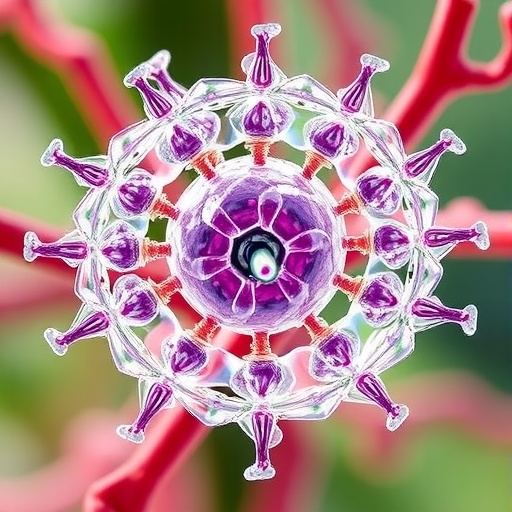
The study’s technological tour de force involved applying cryogenic electron microscopy (Cryo-EM) to capture thousands of detailed images of the extracted plant augmin complex. By flash-freezing samples to nearly -196°C, the researchers preserved the protein’s native conformation long enough to reconstruct a high-resolution three-dimensional structure. These images revealed that augmin resembles a pitchfork, with distinct domains that mediate its assembly and its interaction with microtubules, including regions responsible for binding the nucleation factor NEDD1.
Elucidating the coiled-coil assembly and antiparallel dimerization characteristic of the plant augmin complex provides critical insights into how microtubule branching is initiated and stabilized. Such structural understanding transcends botanical relevance, as aberrations in human augmin subunits have been linked to various malignancies, including aggressive forms of liver and brain cancers, and to infertility. Deciphering augmin’s architecture could therefore fuel the development of novel therapeutic strategies targeting spindle assembly defects in diseased human cells.
Furthermore, the discovery carries implications for agricultural innovation. Microtubule scaffolding guided by augmin influences key agricultural traits, such as cell elongation in rice grains and fiber expansion in cotton. The dramatic cellular elongation involved—sometimes thousands of times the original size—is vital for crop quality and yield. By manipulating augmin activity, scientists may be able to breed novel plant varieties with optimized shapes, sizes, and resilience, thus enhancing food security.
The realization that a common protein complex underpins such diverse biological phenomena—from the growth of banana bends to the proliferation of cancer cells—highlights the interconnectedness of life’s molecular machinery. According to the lead structural biologist involved in the study, Jawdat Al-Bassam, this research exemplifies a “labor of love” that required an interdisciplinary team working at the frontier of molecular and cellular biology.
The comprehensive study also represents a successful example of collaborative science. Postdoctoral fellow Md Ashaduzzaman spearheaded the Cryo-EM imaging while combing through the immense data to assemble the protein’s complex structure. The project benefited from UC Davis’s state-of-the-art Biological Electron Microscopy Campus Core, enabling the high-resolution observations that were previously unattainable.
Additionally, the research draws upon the expertise of other contributors spanning institutions, including Johns Hopkins University and the University of Texas at Dallas. Their combined efforts deliver a unified picture of augmin’s function and form across biological systems, setting a new benchmark for integrative structural biology.
Looking forward, the elucidation of augmin’s architecture offers fertile ground for medical and agricultural research. In medicine, it propels the quest to understand how spindle assembly defects contribute to infertility and oncogenesis, presenting new biomarkers and drug targets. In agriculture, it informs genetic engineering approaches aimed at tailoring plant shapes and improving stress tolerance, ultimately benefiting farmers and consumers worldwide.
This pioneering research not only deepens our fundamental understanding of cellular scaffolds but also illuminates the profound evolutionary conservation that links plant physiology with human health. As the molecular mysteries of augmin are unraveled, the promise of transforming biological insights into tangible therapies and crops edges closer to reality.
Subject of Research:
Not applicable
Article Title:
Cryo-EM structures of plant Augmin reveal coiled-coil assembly, antiparallel dimerization, and NEDD1 binding.
News Publication Date:
12-Dec-2025
Web References:
https://www.nature.com/articles/s41467-025-66332-4
Image Credits:
Liu lab, UC Davis
Keywords:
Structural biology, Plant sciences, Cell biology, Cell division
Tags: agricultural biotechnology innovationsArabidopsis thaliana genetic studiesaugmin protein complexcancer therapy researchchromosome segregation mechanismscytoskeleton and cell divisioninfertility treatment advancementsmicrotubule branching in cellsmicrotubule nucleation in plantsplant and animal cellular biologyplant cell structurespindle apparatus formation