• HOME
  • NEWS
  • EXPLORE
    • CAREER
      • Companies
      • Jobs
    • EVENTS
    • iGEM
      • News
      • Team
    • PHOTOS
    • VIDEO
    • WIKI
  • BLOG
  • COMMUNITY
    • FACEBOOK
    • INSTAGRAM
    • TWITTER
Monday, January 5, 2026
BIOENGINEER.ORG
No Result
View All Result
  • Login
  • HOME
  • NEWS
  • EXPLORE
    • CAREER
      • Companies
      • Jobs
        • Lecturer
        • PhD Studentship
        • Postdoc
        • Research Assistant
    • EVENTS
    • iGEM
      • News
      • Team
    • PHOTOS
    • VIDEO
    • WIKI
  • BLOG
  • COMMUNITY
    • FACEBOOK
    • INSTAGRAM
    • TWITTER
  • HOME
  • NEWS
  • EXPLORE
    • CAREER
      • Companies
      • Jobs
        • Lecturer
        • PhD Studentship
        • Postdoc
        • Research Assistant
    • EVENTS
    • iGEM
      • News
      • Team
    • PHOTOS
    • VIDEO
    • WIKI
  • BLOG
  • COMMUNITY
    • FACEBOOK
    • INSTAGRAM
    • TWITTER
No Result
View All Result
Bioengineer.org
No Result
View All Result
Home NEWS Science News Biology

Unlocking a cure for carbon monoxide poisoning

Bioengineer by Bioengineer
April 29, 2022
in Biology
Reading Time: 3 mins read
0
Putative carbon monoxide poisoning antidote
Share on FacebookShare on TwitterShare on LinkedinShare on RedditShare on Telegram

Carbon monoxide is an odorless and colorless gas made when fossil fuels burn incompletely. It’s also a silent killer.
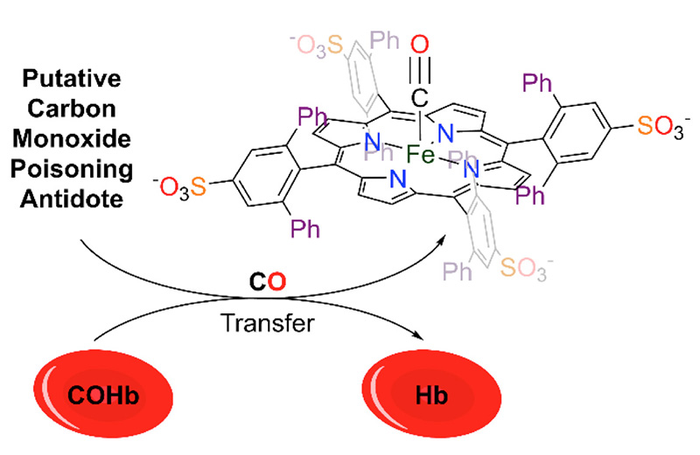
Putative carbon monoxide poisoning antidote

Credit: Droege & Johnstone

Carbon monoxide is an odorless and colorless gas made when fossil fuels burn incompletely. It’s also a silent killer.

According to the Centers for Disease Control (CDC), more than 400 deaths and 20,000 emergency room visits can be attributed to carbon monoxide (CO) poisoning every year. While CO detectors and making sure your fireplace and heaters work correctly can help prevent exposure, treatment options are limited for those suffering from CO poisoning.

That’s why Tim Johnstone, an assistant professor of chemistry and biochemistry at UC Santa Cruz, has been working to develop an easy-to-administer antidote.

“If you are exposed to carbon monoxide, the primary treatment right now is fresh air,” said Johnstone. “It is a question of time. In fresh air, you need four to six hours for the level of CO in your blood to be cut in half. With 100 percent oxygen or hyperbaric oxygen, the half-life shortens further. Even then, the high blood levels of CO can persist long enough to lead to long-term deficits and neurological problems.”

Johnstone has been studying the chemistry of carbon monoxide, which is made of one oxygen atom and one carbon atom joined by a triple bond. In a biological context, CO binds to metal centers like the iron in hemoglobin, which then prevents this protein from functioning as it normally would, transporting oxygen from the lungs to tissues in the rest of the body.

To mitigate this, Johnstone has designed small molecules that possess many of the features of the active site of hemoglobin but can bind CO much more tightly than the protein. In a recent paper published in Chemical Communications, his group described the ability of one such molecule to bind CO, sequester CO that is already bonded to hemoglobin, and rescue red blood cells exposed to CO, all promising signs for a future antidote.

Johnstone says these are early results, but the hope is to create a point-of-care treatment that can be administered quickly. The most common carbon monoxide poisoning symptoms are headache, dizziness, weakness, upset stomach, vomiting, chest pain, and confusion. Because it mimics the flu, people may experience symptoms without realizing the danger and delay seeking treatment.

Graduate student Daniel Droege has been the point person on this project and is first author of the paper.

In addition to the research on carbon monoxide poisoning, Johnstone’s Lab is also working on antimony-containing drugs used to treat the neglected tropical disease Leishmaniasis, developing novel arsenic-based anticancer agents, and discovering new main-group bonding motifs. His work has been supported by the Hellman Foundation, the National Science Foundation, and the University of California Cancer Research Coordinating Committee.


Journal

Chemical Communications

DOI

10.1039/D1CC05542A

Article Title

A water-soluble iron-porphyrin complex capable of rescuing CO-poisoned red blood cells

Article Publication Date

28-Jan-2022

COI Statement

The authors declare no conflicts of interest.

Share12Tweet8Share2ShareShareShare2

Related Posts

Male Arachnids Show Same-Sex Behavior, Questioning Mimicry

Male Arachnids Show Same-Sex Behavior, Questioning Mimicry

January 5, 2026
Tadpole Geophagy: Insights from Thoropa Miliaris

Tadpole Geophagy: Insights from Thoropa Miliaris

January 5, 2026

Unveiling OsFBN5’s Role in OsSPS3 Catalysis

January 5, 2026

Key Genes Discovered in Drake Testicular Development

January 5, 2026

POPULAR NEWS

  • blank

    PTSD, Depression, Anxiety in Childhood Cancer Survivors, Parents

    140 shares
    Share 56 Tweet 35
  • Exploring Audiology Accessibility in Johannesburg, South Africa

    52 shares
    Share 21 Tweet 13
  • SARS-CoV-2 Subvariants Affect Outcomes in Elderly Hip Fractures

    44 shares
    Share 18 Tweet 11
  • AI Regulation: Fintech Cybersecurity and Privacy in EU vs. Qatar

    44 shares
    Share 18 Tweet 11

About

We bring you the latest biotechnology news from best research centers and universities around the world. Check our website.

Follow us

Recent News

SIGNET: Advancing Skin Care for Extreme Preterms

Immune Checkpoint Blockade Boosts Cervical Cancer Treatment

Sunyaev–Zeldovich Reveals Hot Gas at Redshift 4.3

Subscribe to Blog via Email

Success! An email was just sent to confirm your subscription. Please find the email now and click 'Confirm' to start subscribing.

Join 71 other subscribers
  • Contact Us

Bioengineer.org © Copyright 2023 All Rights Reserved.

Welcome Back!

Login to your account below

Forgotten Password?

Retrieve your password

Please enter your username or email address to reset your password.

Log In
No Result
View All Result
  • Homepages
    • Home Page 1
    • Home Page 2
  • News
  • National
  • Business
  • Health
  • Lifestyle
  • Science

Bioengineer.org © Copyright 2023 All Rights Reserved.