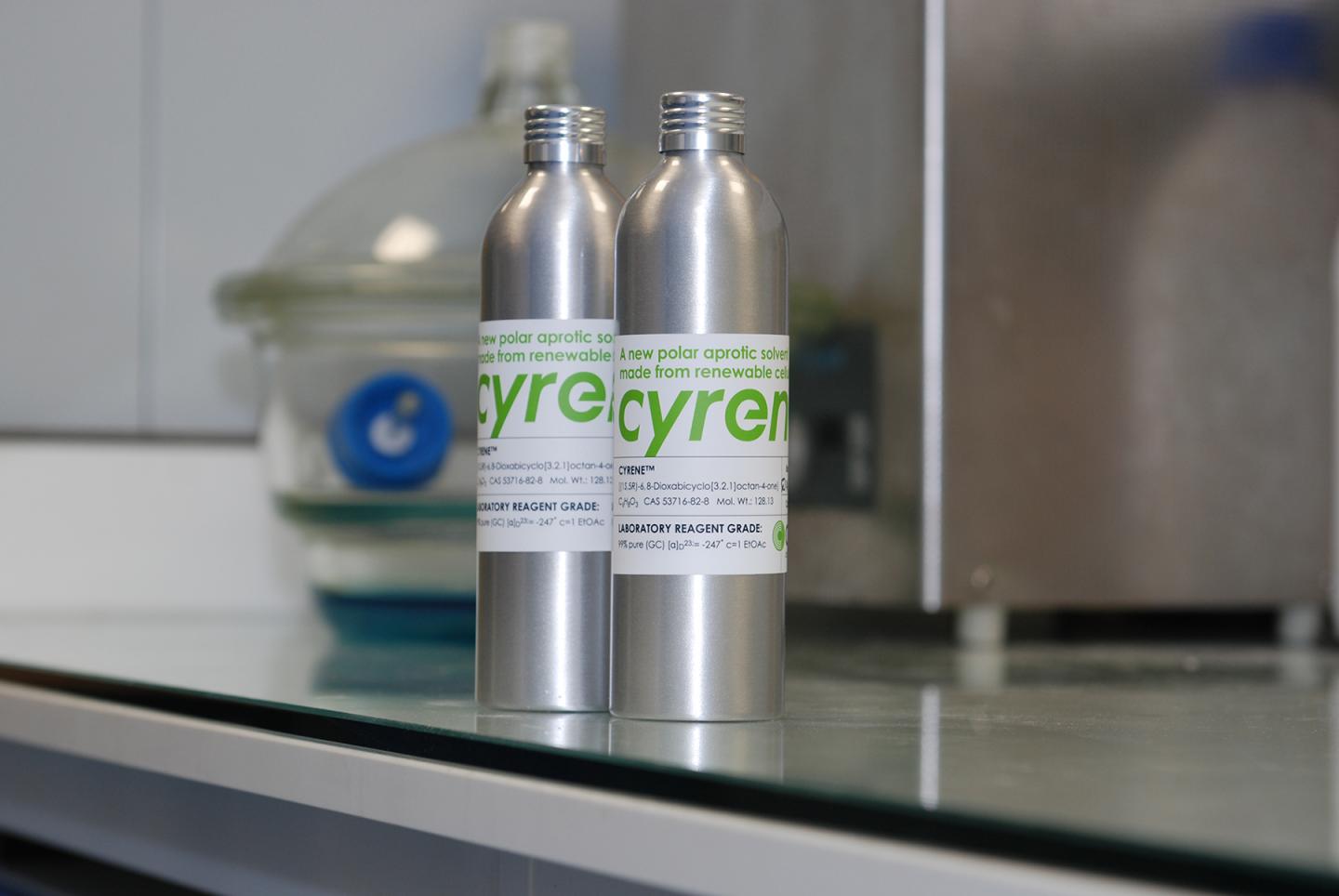
Credit: University of Huddersfield
UNIVERSITY of Huddersfield scientist Dr Jason Camp is investigating the potential of a non-toxic, environmentally sustainable solvent produced from waste cellulose that promises to be a greener way to produce a wide range of medicines and other products. The project has also offered an exceptional opportunity for some of his most talented students to take part in cutting edge, published research.
Dr Camp – a Senior Lecturer in the University's Department of Chemical Sciences – has been collaborating with Australian-based firm Circa Group, which produces the solvent that it has named Cyrene ™. Production of Cyrene is a joint venture between Circa and Norske Skog, the Norwegian pulp and paper manufacturer.
Many of the solvents currently used in chemical processes are problematic because they are toxic or pose environmental risks. In the search for more sustainable, safer processes, cellulose-based Cyrene has emerged as a strong candidate and is proving to be a viable replacement for the more toxic polar aprotic solvents (NMP, DCM, DMAC). The recent work undertaken by Dr Camp and his team has shown it can be used as a solvent in the synthesis of ureas – chemical compounds that are highly important in fields such as pharmaceuticals and agrochemicals.
"The work Dr Camp and his team are doing is an important step towards further "greening" the chemicals supply chain." commented Circa CEO, Tony Duncan, "These are important markets, and with the ongoing demand from society for safer products and processes, work like this from talented researchers is practical and highly valued. These initial results have shown very promising results and we will now work with the team to take the research to a developmental stage"
At his University of Huddersfield lab, Dr Camp has achieved impressive results that are described in a new article (DOI: 10.1039/C7GC00908A) published by the leading journal Green Chemistry, described as "the home of cutting-edge research on the development of alternative sustainable technologies".
The article describes the experiments conducted by Dr Camp and his team, and the results obtained. It concludes that "a green, mild and efficient approach towards the synthesis of ureas from aryl isocyanates and secondary amines in the bio-alternative solvent Cyrene was developed".
The method eliminated the need for the use of toxic solvents or any non-bioderived organic solvent. Also, traces of Cyrene can be removed from the product by simple water treatment.
This phase of the Cyrene research was part-funded by the University of Huddersfield's Collaborative Ventures Fund. Dr Camp is currently planning to take the work further with a Knowledge Transfer Partnership in conjunction with Circa's UK subsidiary and is currently seeking backing from Innovate UK.
Co-authors of the Green Chemistry article are Tom Bousfield, a PhD researcher supervised by Dr Camp, plus Liam Mistry and Kopano Mapesa, who were chemistry undergraduates offered the opportunity to take part in the project, during which they carried out a large proportion of the lab work. Both now aim to move on to doctoral research.
Kopano presented the work at a Posters In Parliament event and the 2017 British Conference of Undergraduate Research.
###
Media Contact
Nicola Werritt
[email protected]
01-484-473-315
@HudUniPR
http://www.hud.ac.uk/
Original Source
https://www.hud.ac.uk/news/2017/june/unicollaborateswithaustralianfirmforscientificresearch.php http://dx.doi.org/10.1039/C7GC00908A
############
Story Source: Materials provided by Scienmag