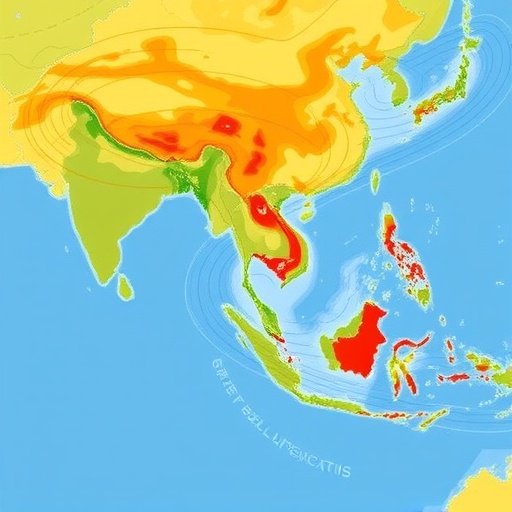
In the face of increasing global vulnerability to natural disasters, the quest to accurately measure their impact has become paramount for governments, humanitarian organizations, and policymakers alike. A groundbreaking study by researcher O.L.L. de Moraes, published in the International Journal of Disaster Risk Science in 2026, presents an innovative method to synthesize disparate indicators of disaster impact into a single, comprehensive index. This novel approach, designed specifically with the support of the World Meteorological Organization’s EW4All (Early Warnings for All) initiative, promises to revolutionize how the international community evaluates and responds to the multifaceted consequences of natural catastrophes.
Disasters such as hurricanes, earthquakes, floods, and droughts inflict damage on multiple levels: social, economic, environmental, and infrastructural. Traditionally, impact assessments have relied on separate quantitative and qualitative indicators, which, while informative, can provide fragmented pictures of overall disaster severity. This compartmentalization complicates comparative analyses across regions and timeframes, and often hampers efficient decision-making. The newly proposed combined index offers a way forward by integrating these varied metrics into a singular scale, delivering a holistic and interpretable representation of disaster consequences.
At the core of de Moraes’ methodology lies a sophisticated algorithmic framework that assigns weighted values to various disaster impact indicators, such as mortality rates, economic losses, population displacement numbers, and environmental degradation indices. By standardizing these disparate measures, the framework facilitates their aggregation without losing the granularity or contextual significance of individual indicators. This approach is particularly vital in the context of the EW4All initiative, which seeks to bolster early warning systems in vulnerable countries by enabling precise and actionable risk assessments.
The research elucidates how the composite index performs in real-world scenarios. Applying the model to datasets from countries participating in the WMO’s EW4All program, the author demonstrates enhanced accuracy in capturing the true scale of disaster impacts compared to classical isolated measurements. This advantage allows nations with limited resources to prioritize interventions more effectively, allocate aid more judiciously, and ultimately, save lives and reduce suffering. Moreover, by providing a dynamic, single-value representation, the index streamlines communication between scientists, government officials, and the public—a crucial aspect in disaster risk reduction.
One of the key technical challenges in combining diverse indicators is ensuring the comparability of data whose units, scales, and sources vary significantly. To address this, the study employs normalization techniques coupled with principal component analysis to reduce dimensionality and isolate principal factors contributing to disaster impact. This statistically robust process eliminates redundant information and sharpens focus on the indicators with the greatest explanatory power, thereby enhancing the precision of the overall index.
De Moraes also contemplates the temporal dynamics of disaster impacts, acknowledging that the severity and consequences evolve over days, months, or even years post-event. The proposed index incorporates time-weighted factors, which allows it to reflect not just immediate destruction but also prolonged societal and ecological disruptions. This temporal sensitivity ensures that recovery and resilience-building programs can be tailored to both urgent and long-term needs, providing a more nuanced understanding of disaster trajectories.
The flexibility of the index is another noteworthy innovation. Designed as a modular tool, it permits customization based on regional priorities or data availability. For example, countries with more substantial environmental concerns can emphasize ecological damage indicators, whereas densely populated urban areas might weigh displacement and mortality more heavily. This adaptability is crucial given that disaster risks and vulnerabilities manifest distinctly across geographies and socio-economic contexts.
From a policy perspective, the capacity to rank and benchmark disaster impacts across countries introduces new possibilities for international cooperation and funding allocation. The index offers a transparent mechanism to identify high-risk zones and track the effectiveness of mitigation strategies over time. Such standardized comparison can incentivize governments to invest in resilience mechanisms and facilitate donor agencies in targeting assistance where it is most urgently needed.
Beyond practical applications, the research opens intriguing avenues for integrating emerging data sources, including satellite imagery, social media analytics, and real-time sensor networks. These technological enhancements could feed into the index, ensuring continuous updates and more granular spatial resolution. This potential convergence of big data and disaster science is poised to redefine early warning systems and post-disaster assessments in the coming years.
Critically, the study also addresses the limitations and ethical considerations inherent in aggregating disaster data. The author highlights the dangers of oversimplification and potential misinterpretation if the composite index is used without context or as a sole decision-making tool. Transparency in the weighting process and clear communication of the index’s scope and limitations are essential to maintain trust and efficacy.
The integration of disaster risk markers into a unified metric holds special promise for under-resourced nations where fragmented data infrastructures impede comprehensive analysis. By facilitating streamlined reporting and simplifying complex datasets, the index leverages existing capabilities and empowers these countries to participate more effectively in global risk reduction frameworks.
Furthermore, the synergy between the proposed composite index and the goals of the WMO’s EW4All initiative underlines a broader paradigm shift in disaster risk management. Early warning systems increasingly aim to be more inclusive, data-driven, and actionable, and tools like this single-impact index are indispensable parts of that transformation. They help translate early warnings into meaningful preparations and targeted responses.
As climate change accelerates the frequency and intensity of natural disasters worldwide, innovations in impact assessment become ever more critical. The study by de Moraes offers an essential contribution to this emerging field, combining methodological rigor with practical utility. Its adoption could pave the way for a new generation of disaster risk tools capable of fostering more resilient societies globally.
In conclusion, the proposed composite disaster impact index stands as a milestone in how humanity confronts the growing challenges posed by natural hazards. By weaving together multiple dimensions of impact into a single, coherent framework, it not only enhances scientific understanding but also bridges the gap to operational policy and humanitarian actions. In an era where timely and accurate information saves lives, such integrative approaches are not just academically interesting—they are urgently needed catalysts for change.
Subject of Research: Disaster impact assessment and composite index development in the context of early warning systems.
Article Title: A Proposal to Combine Different Disaster Impact Indicators into a Single Index and Its Application for Countries Supported by the WMO EW4All Initiative.
Article References:
de Moraes, O.L.L. A Proposal to Combine Different Disaster Impact Indicators into a Single Index and Its Application for Countries Supported by the WMO EW4All Initiative. Int J Disaster Risk Sci (2026). https://doi.org/10.1007/s13753-026-00690-5
Image Credits: AI Generated
Tags: algorithmic framework for disaster analysiscomprehensive disaster indexdisaster impact measurementdisaster response strategiesEarly Warnings for All programglobal disaster vulnerabilityintegrated disaster risk managementmulti-dimensional disaster evaluationnatural disaster assessment methodssocio-economic disaster effectsunified disaster indicatorsWorld Meteorological Organization initiatives