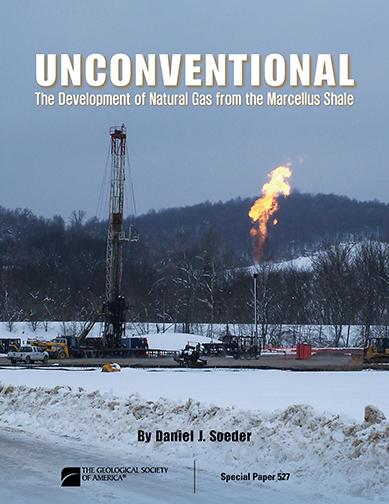
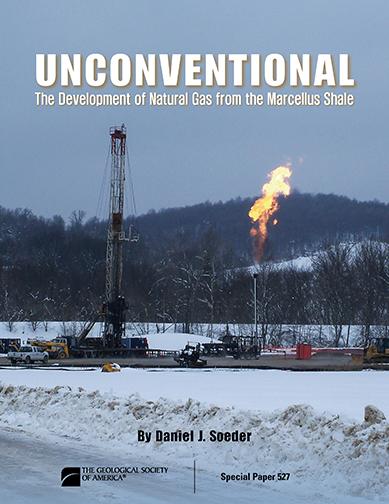
Credit: Photo taken in 2010 by Tom Mroz, US Department of Energy (retired).
Boulder, Colo., USA: Shale gas has changed thinking about fossil energy supplies worldwide, but the development of these resources has been controversial. Activists have made claims that hydraulic fracturing may contribute to climate change, threaten groundwater resources, and pose risks to terrestrial and aquatic ecosystems, and human health.
Shale gas had its origins in the oil embargos and energy crises of the 1970s, which led to government research to increase domestic energy supplies. The first large-scale shale gas production was successful on the Barnett Shale in Texas in the late 1990s, followed a few years later by the Marcellus Shale in Pennsylvania.
This carefully researched volume provides background into the history of U.S. shale gas studies, examines the production of Marcellus Shale gas and risks to the environment, and addresses questions about and investigations into the effects of using this resource. It also provides insight into how to limit risks, and describes the potential of this unconventional energy source for meeting U.S. energy needs.
Author Daniel J. Soeder explains, "The total shale gas resource is potentially large enough to replace all of America's oil imports, making the United States energy independent for the first time in decades and finally ending the so-called energy crisis of the 1970s."
Soeder performed scientific research on gas shale and other unconventional fossil energy resources at the U.S. Department of Energy (DOE) National Energy Technology Laboratory in Morgantown, West Virginia, from 2009 to 2017. He came to DOE with 18 years of experience as a hydrologist with the U.S. Geological Survey, where his work included assessing the water resource impacts of shale gas development. Prior to that, he spent a decade performing production research on tight sandstone and shale at the Gas Technology Institute in Chicago, and he worked as a DOE contractor for two years on the Eastern Gas Shales Project, recovering and characterizing drill core.
Andrew Stone, executive director for American Ground Water Trust, describes this volume as "An excellent objective explanation of the history, science, technology, politics, environmental concerns, and economics of the shale gas boom. The author clearly has great practical experience of the science and technology of shale gas development and shows a deep understanding of the environmental and economic issues."
###
Individual copies of this well-illustrated, accessible volume may be purchased through The Geological Society of America online store, http://rock.geosociety.org/Store/detail.aspx?id=SPE527, or by contacting GSA Sales and Service, [email protected].
Book editors of earth science journals/publications may request a review copy by contacting April Leo, [email protected].
Unconventional: The Development of Natural Gas from the Marcellus Shale
http://rock.geosociety.org/Store/detail.aspx?id=SPE527
By Daniel J. Soeder
Geological Society of America Special Paper 527
SPE527, 143 p., $55.00; GSA member price $38.00
ISBN 978-0-8137-2527-7
View the table of contents: http://rock.geosociety.org/store/TOC/SPE527.pdf
http://www.geosociety.org
Media Contact
April Leo
[email protected]
@geosociety
http://www.geosociety.org
############
Story Source: Materials provided by Scienmag