Credit: National Science Foundation/Kenneth Dunton
AMHERST, Mass. – University of Massachusetts Amherst climate scientist Michael Rawlins has received a five-year, $370,000 grant from the National Science Foundation as part of a multi-institution effort to better understand biological processes and land-ocean interactions controlling the structure and function of coastal lagoons in northern Alaska.
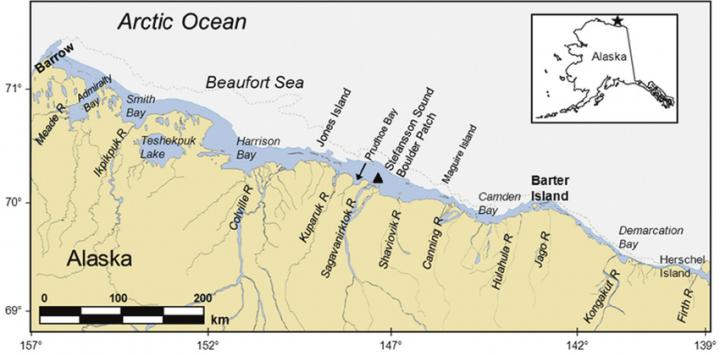
The team led by scientists at the University of Texas at Austin will receive $5.6 million grant from NSF's Long-term Ecological Research (LTER) program and Office of Polar Programs (OPP) for the study to begin later this year. They will collect data and create models to track and predict seasonal dynamics and possible climate change effects on the ecology of the lagoon complexes and rivers along the Beaufort Sea coast in northern Alaska.
As Rawlins explains, "We believe that under continued warming there will be large changes in the makeup – the quality and quantity – of carbon and nutrient contents of these rivers and streams flowing from the mountains of the North Slope to the coastal lagoons. At present it's highly unknown how much material is carried by rivers to the Arctic ocean."
"Six years of gathering data in this remote region will help us to better understand how both natural variations and climate change influence the food web structure and other ecosystem dynamics of these lagoons. The flows of water and carbon into the lagoons strongly affect nutrient availability and biological productivity of food resources that native communities in the region rely on," he adds.
The researchers point out that the Beaufort Lagoons are refuges for many species of migratory fish and waterfowl essential to the subsistence culture of Inupiat communities in northern Alaska. In particular, Barrow, Nuiqsut and Kaktvik hunters and residents rely on the high productivity of these lagoon systems to support fish and bird populations they live on.
With warming and thawing Arctic permafrost, Rawlins says, organic matter stored for thousands of years in soils is mobilized and released into streams and rivers. "Much of this organic matter, primarily dissolved organic carbon, is transported to coastal estuaries. Sunlight and microbes also convert some of the river carbon to carbon dioxide, which leads to additional warming. Unfortunately, field measurements of riverborne carbon and other nutrients are sparse. There is very little known about these fluxes of freshwater and carbon in Arctic streams and rivers."
As an expert in climate modeling, Rawlins will use field measurements and data collected by the team on river and stream discharges, dissolved and particulate matter, other nutrients, temperature and other variables over several years and seasons to build databases and develop numerical hydrological and biogeochemical models. The models will not only estimate these flows into the Beaufort Lagoons in the recent past, but also how project permafrost thaw and water cycle intensification will impact lagoon ecosystem dynamics in the future. Water cycle intensification is a known manifestation of a warming climate, he points out.
The researchers say that Arctic lagoons provide a very special opportunity to study the interactions between variables such as land-based carbon and nitrogen cycles, microbial and aquatic life and the food chain over seasons and across many years. Models may also take into account barrier island geomorphology that can have a strong influence on water exchanges between lagoons and the open ocean.
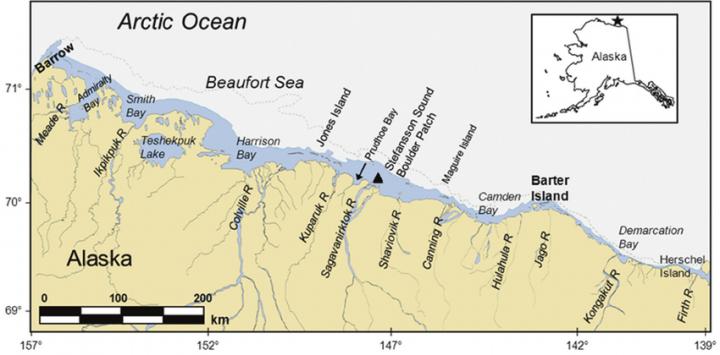
Anticipating impacts of future changes are "of great interest and concern to local communities," the investigators point out. Specific study sites will include Elson Lagoon, Admiralty Bay, Simpson Lagoon, Stefansson Sound and Kaktovik, Jago, Angun and Nuvagapuk Lagoons. The LTER will operate in partnership with the local Inupiat government and other federal agencies such as the U.S. Fish and Wildlife Service and the Arctic National Wildlife Refuge.
The researchers also plan to include a strong education component in their research that involves not only undergraduate and graduate students, but will continue a successful K-12 summer science program in Kaktovik and expand it to Barrow and Nuiqsut. Local high school seniors and recent high school grads will be recruited as field research assistants to work directly with visiting researchers in data collection. Study results, photos, videos and other products will be shared freely with local residents and the North Slope community at large, they add.
###
Media Contact
Janet Lathrop
[email protected]
413-545-0444
@umassscience
http://www.umass.edu
############
Story Source: Materials provided by Scienmag