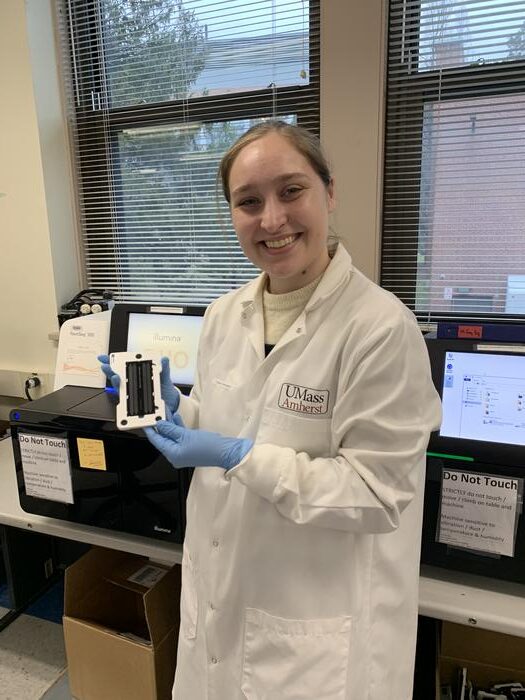
AMHERST, Mass. – An interdisciplinary team of researchers led by biologists at the University of Massachusetts Amherst recently published the results of a first-of-its-kind study investigating the links between gene expression and brain evolution across 18 primate species. The team collected samples of brain tissue sourced from zoos whose animals had died naturally, as well as from people who had donated their bodies to science, and then sequenced the RNA transcripts from each sample to generate a map of every one of the 17,000 genes expressed in each primate’s brain. The team then compared each species’ fully-sequenced RNA transcriptomes to better understand the links between genomics and evolution and possibly provide insight into the nuances of brain activity as well as neurodegenerative disease.
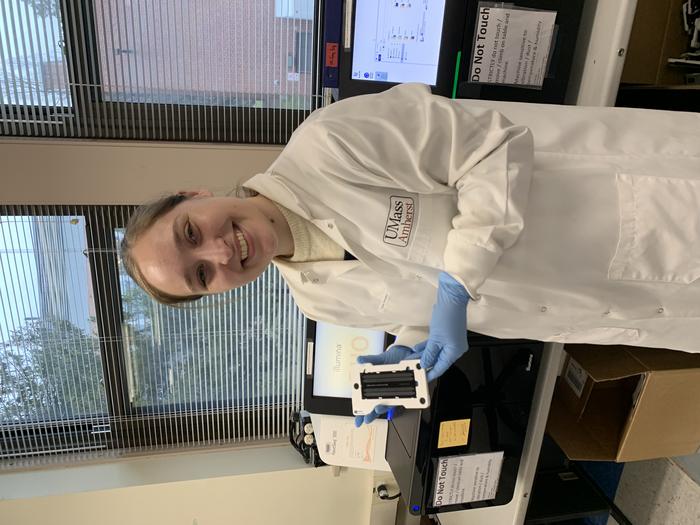
Credit: UMass Amherst
AMHERST, Mass. – An interdisciplinary team of researchers led by biologists at the University of Massachusetts Amherst recently published the results of a first-of-its-kind study investigating the links between gene expression and brain evolution across 18 primate species. The team collected samples of brain tissue sourced from zoos whose animals had died naturally, as well as from people who had donated their bodies to science, and then sequenced the RNA transcripts from each sample to generate a map of every one of the 17,000 genes expressed in each primate’s brain. The team then compared each species’ fully-sequenced RNA transcriptomes to better understand the links between genomics and evolution and possibly provide insight into the nuances of brain activity as well as neurodegenerative disease.
“We study primate brain evolution,” says Katie Rickelton, lead author of the paper, published in eLife, and doctoral candidate in molecular and cellular biology at UMass Amherst. “Primates, and especially humans, are defined by having very large brains compared to their body size—and yet, humans, chimpanzees and lemurs are all very different, despite having similar DNA sequences. We think that difference can be partly explained by which genes are expressed at higher or lower levels.”
Other researchers have sequenced the RNA in primate brains, but in a much more limited scope. “If we are going to figure out what makes human unique among primates,” says senior author Courtney Babbitt, associate professor of biology at UMass Amherst, “we’re going to have to study a wider selection of primates, and no one has looked at such a large sample before.”
To conduct their research, Rickelton, Babbitt and their colleagues worked with the National Institute for Child Health and Human Development Brain and Tissue Bank for Developmental Disorders at the University of Maryland, the National Chimpanzee Brain Resource, and a nearly a dozen other institutions that are widely respected for their ethical sourcing of brain tissue. The team obtain samples from four different brain regions—including the prefrontal cortex, primary visual cortex, hippocampus and cerebellum—in each of the 18 species under investigation, and used the genomics core at UMass Amherst’s Institute for Applied Life Sciences to conduct the RNA sequencing.
RNA is the intermediate step between DNA—each species’ master-plan—and the proteins that actually build an individual body. The number and kinds of proteins that can be produced are determined by the amount of RNA, which is mapped with the transcriptomes that Rickelton, Babbitt and their colleagues have generated. And it is an immense task.
“We sequenced every single one of the 17,000 genes expressed in each of the four regions across the 18 species,” says Babbitt. “And we were able to sample them at very high resolution,” adds Rickelton. “This is the best series of transcriptomes that we have for these 18 species’ brains.”
The team was looking for differences related to a host of brain functions related to both cognition and metabolism, because the big and complex brains that we humans share with our primate kin demand a lot of energy. They found a remarkable degree of variation across the species range, from human to pygmy slow loris.
For instance, humans and chimpanzees exhibit a remarkable level of variation compared to the other 16 species, even though humans and chimps branched out from the rest of the great apes relatively recently, leaving little time for natural selection to act. And though there are differences in the four regions of the brain the team sampled, the majority of the variation seems to be primarily explainable by species evolution. The exception, Rickelton points out, is the cerebellum. “It’s evolutionarily the oldest part of the brain,” says Rickelton, “and so has had the most time to evolve in different ways for each of the species.”
Finally, the team’s findings identify particular genes for further study that may help explain the evolution of particular primate’s brains. These genes may help to better understand the nuances of brain activity across each of the four regions, as well as provide insight into various human neurodegenerative disorders, such as Alzheimer’s Disease.
“It’s one of the great evolutionary paradoxes: humans and chimps have pretty much the same genes, and yet we’re so different,” says Babbitt. “To figure out what makes us human, we’re going to have to look at the genetic expression of a wide range of our evolutionary cousins, and that’s exactly what we’ve begun to do with this study.”
This research was supported by the U.S. National Science Foundation, the Wenner Gren Foundation, the James S. McDonnell Foundation, and the National Institutes of Health.
Contacts: Courtney Babbitt, [email protected]
Daegan Miller, [email protected]
Journal
eLife
DOI
10.7554/eLife.70276
Article Title
Tempo and mode of gene expression evolution in the brain across primates