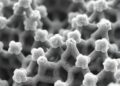
As electronics steadily evolve towards increased functionality and decreased size, the demand for highly integrated stretchable devices has surged. These ultraminiaturized components, including transistors and capacitors, are setting new performance benchmarks and opening frontiers for wearable, implantable, and flexible technologies. Nonetheless, a persistent challenge has thwarted further advancements: the lack of elastomeric dielectrics that can be thinned down proportionally to device footprint without compromising their electrical robustness and mechanical integrity. This bottleneck has impeded the capacity to produce stretchable electronics with high pixel density and reliable operation at nanoscale dimensions.
A groundbreaking study published in Nature Electronics in 2026 presents a novel solution to this problem through a crosslinking-assisted trap creation method that dramatically boosts the breakdown strength of traditional elastomeric dielectrics. The research team, led by Zhong, Z., Cui, Z., Zhang, Z., and colleagues, devised an innovative approach employing tailored multiarmed crosslinkers designed to simultaneously shrink the free volume within the elastomer network and induce chemical heterogeneity. This structural alteration acts dualistically: by physically constricting the space through which charge carriers might accelerate, and chemically trapping those charges by creating deep energy wells that inhibit their mobility.
Applying this method to nitrile rubber — a commonly used elastomer — yielded a dielectric material with a remarkable breakdown strength of 589 kilovolts per millimeter, tested at ultrathin dimensions down to 84 nanometers. This performance is unprecedented when compared to conventional elastomer dielectrics, which experience a steep decline in dielectric strength as thickness decreases. The success lies in how reducing free volume minimizes the risk of local electric field concentration, while the chemically induced traps capture charge carriers, preventing premature dielectric failure under high electric stress.
The implications of this dielectric breakthrough extend far beyond material science. By integrating this enhanced elastomer dielectric into device architectures, the team fabricated an array of ultraminiaturized, stretchy capacitors boasting high areal capacitance. These capacitors maintain consistent electrical properties even when subjected to mechanical strain, a critical feature for flexible electronic circuits intended for body-conformal applications or robotics. The capacitors’ thin dielectric layers contribute to an elevated capacitance density, rivaling or surpassing those made with rigid counterparts.
Parallelly, the researchers constructed stretchable transistors incorporating the crosslinking-assisted trap dielectric. The resulting transistors operate at low voltages, an essential parameter for safety and energy efficiency, especially in wearable and implantable electronics. These devices demonstrated reliable switching behavior and mechanical resilience under repeated stretching cycles, further validating the dielectric’s suitability for real-world applications.
Combining these advancements, the team designed and realized a one-transistor–one-capacitor (1T1C) charge storage array with over a hundredfold reduction in footprint compared to arrays fabricated using common elastomer dielectrics. This monumental scale reduction not only boosts integration density but also reduces power consumption and latency, enhancing performance for complex stretchable circuits. Such miniaturization embodies a significant leap towards practical, high-resolution stretchable displays, sensors, and interactive interfaces.
In a compelling demonstration of the dielectric’s versatility, the researchers fabricated a high-frequency stretchable rectifier capable of operating at frequencies up to 6.78 MHz even under 100% biaxial strain. This component’s frequency performance under extensive deformation represents a critical milestone in stretchable high-speed electronics, supporting applications in real-time signal processing and communication within flexible platforms. Strikingly, this rectifier served as a wireless electronic switch in a prototype implantable muscle stimulation system, underscoring the material’s biocompatibility and functional integration potential in medical devices.
The study’s success is rooted in the intricate chemistry and tailored physical structuring of elastomer networks. The multiarmed crosslinkers not only connect polymer chains but also engender heterogeneities that form energetically favorable sites for carrier trapping. This trap creation mitigates the deleterious effect of charge accumulation, which frequently leads to early dielectric breakdown in ultrathin films. Moreover, by constraining free volume, carrier acceleration — often a precursor to dielectric failure — is inhibited. This synergistic mechanism is elegantly simple, scalable, and compatible with existing elastomer processing, facilitating widespread adoption.
Beyond the immediate improvements in breakdown strength and dielectric stability, the method opens avenues for diverse tuning of elastomer properties by varying crosslinker chemistry and architecture. This adaptability enables bespoke dielectric behavior tailored for specific devices, frequency ranges, or mechanical demands. Furthermore, the approach could reconcile the tradeoff between stretchability and electrical performance that has limited past elastomer dielectrics, heralding a new generation of multifunctional polymers.
From a broader perspective, the intersection of molecular design and macroscopic device engineering exemplified by this work illustrates the evolving landscape of materials science in electronics. It highlights how deep understanding at the nanoscale informs practical solutions that advance entire technological sectors. The ability to sustain ultrathin, mechanically robust dielectric layers under strain and electric stress is indispensable for future compact and flexible systems, ranging from health monitoring patches and soft robotics to neural interfaces and beyond.
The research also represents a significant stride in miniaturized stretchable electronics, a field characterized by complex trade-offs between robustness, flexibility, and electrical performance. By transcending the limitations of traditional elastomer dielectrics, this crosslinking-assisted trap creation strategy facilitates the realization of unprecedented integration density and operational stability in stretchable circuits. Such advancements are expected to catalyze new applications and inspire subsequent innovations across academia and industry.
In conclusion, Zhong and colleagues have unveiled a transformative dielectric technology that circumvents longstanding barriers in elastomeric device miniaturization and durability. Their crosslinking-assisted trap creation method fosters ultrathin elastomer dielectrics combining exceptional breakdown strength with mechanical stretchability. The resulting improvements manifest in high-performance capacitors, low-voltage transistors, compact integrated arrays, and high-frequency rectifiers operable under extreme deformation. This research ushers in a new era for intrinsically stretchable electronics poised to revolutionize wearable, implantable, and flexible devices worldwide.
Subject of Research: Development of ultrathin and robust elastomeric dielectrics for miniaturized stretchable electronics using a crosslinking-assisted trap creation method.
Article Title: Ultrathin and robust elastomeric dielectrics using a crosslinking-assisted trap creation method for miniaturized stretchable electronics.
Article References:
Zhong, Z., Cui, Z., Zhang, Z. et al. Ultrathin and robust elastomeric dielectrics using a crosslinking-assisted trap creation method for miniaturized stretchable electronics. Nat Electron (2026). https://doi.org/10.1038/s41928-026-01579-3
Image Credits: AI Generated
DOI: https://doi.org/10.1038/s41928-026-01579-3
Tags: chemical heterogeneity in elastomerscrosslinking-assisted trap creationelectrical robustness in stretchable deviceshigh breakdown strength elastomershigh pixel density stretchable circuitsmechanical integrity of elastomeric materialsmultiarmed crosslinkers in dielectricsnanoscale flexible electronic componentsnitrile rubber dielectric enhancementstretchable electronics technologyultrathin elastomeric dielectricswearable and implantable electronics