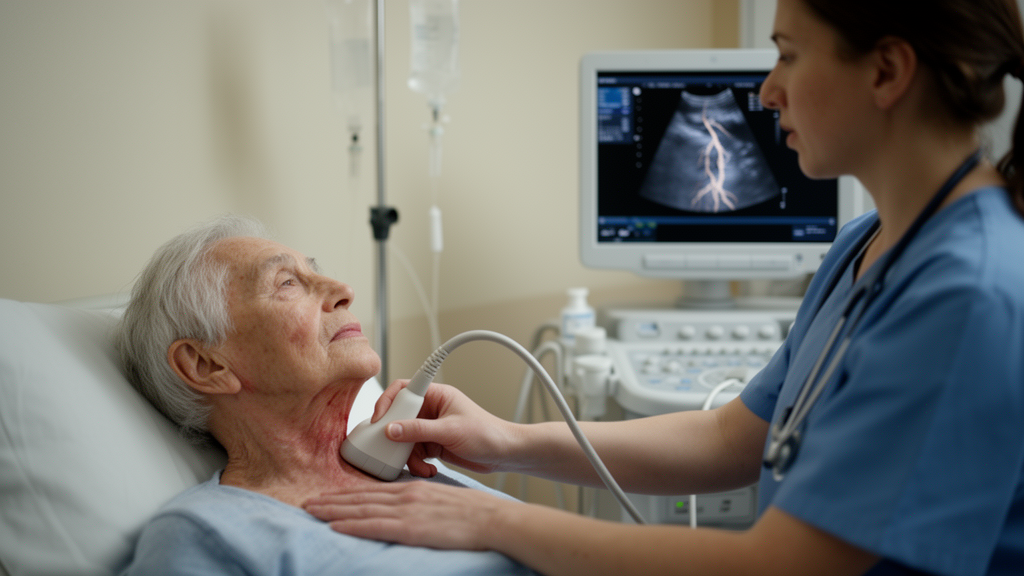
A bedside ultrasound protocol designed to detect venous congestion has spread rapidly through intensive care units, but a new scoping review finds it has barely reached the geriatric wards where older, frail patients might benefit most. The review, published in Aging Clinical and Experimental Research, maps how the Venous Excess Ultrasound (VExUS) protocol has actually been used in research up to November 2025, and its conclusions are a caution against assuming that popularity in one setting translates into evidence everywhere else.
The technique has gained considerable attention in recent years, but its diffusion across different care settings remained uncertain, which is precisely what the review set out to establish.
They extracted data following a standardized approach and categorized each eligible study by clinical setting, distinguishing inpatient from outpatient care, ward type and specialty. For every study they recorded the design, sample size, mean age of participants, indications for using VExUS, the outcomes assessed and the key findings. In total, 65 studies were included in the review.
The headline result is a striking imbalance. Thirty-seven of the 65 studies came from intensive care, making critical care by far the dominant arena for VExUS research. By contrast, only six studies were conducted in internal medicine wards, and not a single study came from a geriatric ward. The mean age of participants exceeded 65 years in only 22 of the included studies, meaning that even where older adults were represented, they were a minority of the overall evidence base.
The most frequent indications for applying the protocol were congestive heart failure, monitoring after cardiothoracic surgery, and acute kidney injury. Yet the review found that study designs were exploratory in many cases, and the outcomes assessed were highly heterogeneous across studies. The authors describe the findings on prognostic performance and clinical effectiveness as inconclusive, meaning that the accumulated literature has not yet demonstrated that using VExUS improves patient outcomes or reliably predicts them.
For older patients the gap is particularly consequential. The review’s authors note that older frail multimorbid patients, who often have multifactorial causes of venous congestion, may theoretically benefit from the protocol, since congestion in this population frequently arises from overlapping cardiac, renal and vascular problems. But theory is not evidence: with zero geriatric-ward studies and mean ages above 65 in only a third of the included research, the population in which the protocol is arguably most attractive is the one in which it has been least evaluated.
The authors’ conclusion is measured rather than dismissive. They describe VExUS as a feasible and potentially useful method of estimating venous congestion in critically ill patients, while emphasizing that the evidence in acute geriatric patients remains scarce. As a scoping review, the study maps the landscape of existing research rather than pooling effect estimates, so it cannot say how well the protocol performs diagnostically or prognostically; it can only show where that performance has and has not been tested.
The practical takeaway is a research agenda. The authors call for studies assessing the feasibility, reliability, diagnostic value and prognostic value of VExUS in older patients before the protocol can be implemented into clinical practice for this group. Until such studies exist, the rapid uptake of VExUS in intensive care should not be read as validation for its use in geriatric medicine, where the evidence remains scarce.
For clinicians and researchers, the review serves as a reminder that a technique’s popularity is not the same as its evidence base. VExUS has clearly captured the interest of critical care researchers, with dozens of exploratory studies accumulating in that setting. The protocol’s future in geriatric care depends on generating the evidence that, so far, the literature lacks.
Subject of Research: A scoping review mapping the clinical settings and evidence base of the VExUS ultrasound protocol for venous congestion assessment, with a focus on older patients.
Article Title: Venous congestion assessment with Venous Excess Ultrasound (VExUS) protocol: A scoping review with a focus on geriatric patients
Article References: Ticinesi, A., Vece, F. D., Finazzi, A., Okoye, C., & Passaro, A. (2026). Venous congestion assessment with Venous Excess Ultrasound (VExUS) protocol: A scoping review with a focus on geriatric patients. Aging Clinical and Experimental Research. https://doi.org/10.1007/s40520-026-03549-3
Image Credits: AI Generated
DOI: 10.1007/s40520-026-03549-3
Keywords: VExUS, venous congestion, ultrasound, scoping review, geriatrics, intensive care, heart failure, acute kidney injury, older patients, point-of-care ultrasound, clinical evidence, Venous
News Source: Beatrice Stafford. (October 28, 2026). Ultrasound Protocol for Venous Congestion Reaches Intensive Care but Rarely Geriatric Wards. Scienmag.