


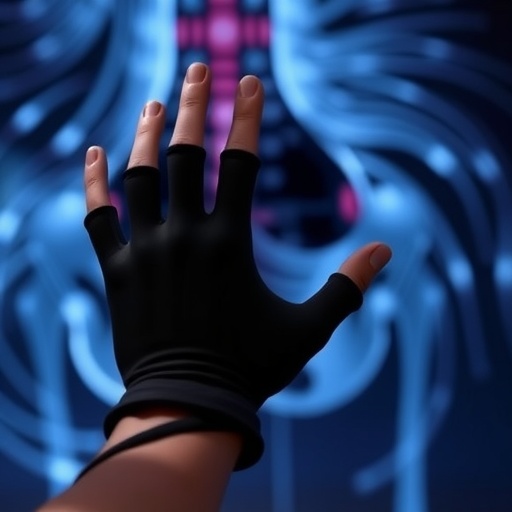
In the ever-evolving landscape of virtual reality (VR) technology, the demand for more natural and intuitive human-machine interfaces has never been higher. A groundbreaking study led by Grandi Sgambato, B., Hodossy, B.K., Barsakcioglu, D.Y., and their collaborators, recently published in Nature Communications, introduces a pioneering solution that leverages user-generic ultrasound sensing to revolutionize wrist and hand tracking within VR environments. This novel approach not only enhances the immersive experience but also overcomes the limitations of conventional tracking methods, marking a significant leap toward seamless virtual interaction.
Traditional VR systems often rely on optical cameras and inertial measurement units (IMUs) to monitor hand and wrist movements. While these technologies have made significant strides, they frequently encounter challenges such as occlusions, line-of-sight requirements, and susceptibility to environmental lighting conditions. Such constraints hinder both accuracy and reliability, detracting from the user experience. The innovative ultrasound-based human-machine interface presented in this research circumvents these issues by directly sensing the biomechanical activity of the wrist and hand, thereby offering real-time, robust tracking unaffected by external visual obstructions.
At the core of this technology is an array of miniaturized ultrasound transducers strategically placed on the forearm. These transducers emit high-frequency sound waves that penetrate the soft tissue, capturing subtle morphological changes as muscles contract and relax during hand and wrist movements. By analyzing these ultrasound echoes with advanced signal processing algorithms, the system reconstructs precise kinematic data, mapping muscular activity to corresponding gestures and positions in three-dimensional space.
What sets this approach apart is its user-generic nature. Unlike prior systems that require extensive calibration or are tailored to individual anatomical variations, this ultrasound interface is designed to be universally applicable without necessitating personalized adjustments. This is achieved through machine learning models trained on diverse datasets encompassing a wide range of forearm morphologies and movement patterns, enabling the system to accurately interpret ultrasound signals from new users with minimal setup.
The implications of this innovation for VR applications are profound. Immersive experiences demand intuitive and unhindered interaction, and this ultrasound interface facilitates just that by providing fluid, low-latency control of virtual hands. Users can perform complex gestures such as pinching, grabbing, and wrist rotations with exceptional fidelity, thereby enhancing the sense of presence and agency within virtual realms. This technology is particularly promising for gaming, remote collaboration, rehabilitation therapy, and even intricate surgical simulations.
Furthermore, the hardware employed in this interface boasts a lightweight and compact design, enabling integration into wearable devices without compromising user comfort or mobility. The system’s energy efficiency ensures prolonged operation, a critical factor for untethered VR experiences. The research team also highlights the scalability of their approach, envisioning that future iterations could extend to tracking other joints or even full-body movements by employing similar ultrasound arrays.
The study’s experimental validation involved comprehensive user trials demonstrating the system’s superior accuracy compared to conventional optical and inertial-based methods. Participants reported heightened immersion and reduced fatigue, underscoring the interface’s practical benefits. Importantly, the real-time processing capabilities maintained sub-100 millisecond latency, vital for preserving the natural feel of interactions within VR spaces.
Beyond entertainment and professional training, the ultrasound interface holds promise for medical and assistive technologies. For individuals with mobility impairments, this system could provide an intuitive means of controlling prosthetic limbs or computer interfaces. Its non-invasive nature and adaptability make it a safe and accessible option across diverse user populations.
The methodology underpinning this breakthrough integrates interdisciplinary expertise spanning biomedical engineering, computer science, and human-computer interaction. Sophisticated ultrasound imaging principles merge with cutting-edge neural network architectures to decode the complex biomechanical signals into actionable input for VR systems. This fusion not only advances the technical capabilities of VR interfaces but also paves the way for future innovations that harness physiological data for digital control.
The researchers acknowledge limitations related to the influence of external pressure on the ultrasound sensors and potential variability introduced by sweat or skin conditions. To address these, ongoing efforts focus on refining sensor materials and robustifying algorithmic models to ensure consistent performance across varied scenarios and prolonged usage.
Looking ahead, the team envisions integrating haptic feedback mechanisms synchronized with the ultrasound tracking to provide tactile sensations corresponding to virtual objects. Such developments would further blur the boundaries between physical and virtual experiences, delivering unprecedented levels of immersion.
Moreover, expanding data acquisition to capture dynamic muscle fatigue and force exertion could enrich VR interactions, enabling applications that respond to user strength or endurance in real-time. Incorporating biofeedback within the interface also opens avenues for health monitoring and personalized wellness programs embedded in VR ecosystems.
In conclusion, this user-generic ultrasound human-machine interface represents a landmark advancement in VR technology. By overcoming the shortcomings of existing tracking methods and delivering accurate, robust, and ergonomic wrist and hand motion capture, it brings us closer to truly natural and immersive virtual interactions. As this technology matures and integrates with emerging VR platforms, it holds the potential to redefine how humans connect with digital worlds, unlocking new frontiers in entertainment, education, healthcare, and beyond.
With ongoing research and development, the ultrasound interface will likely become a cornerstone technology, setting new standards for sensor-based interaction in virtual environments. Its seamless fusion of physiological sensing with computational intelligence exemplifies the transformative possibilities that lie at the intersection of human biology and machine augmentation. The future of VR is, quite literally, in our hands.
Subject of Research: Virtual reality interaction and human-machine interface for wrist and hand tracking using user-generic ultrasound sensing.
Article Title: Virtual reality interactions via a user-generic ultrasound human-machine interface for wrist and hand tracking.
Article References:
Grandi Sgambato, B., Hodossy, B.K., Barsakcioglu, D.Y. et al. Virtual reality interactions via a user-generic ultrasound human-machine interface for wrist and hand tracking. Nature Communications 16, 11062 (2025). https://doi.org/10.1038/s41467-025-66001-6
Image Credits: AI Generated
DOI: https://doi.org/10.1038/s41467-025-66001-6
Tags: conventional VR tracking challengesenhancing virtual interactionhuman-machine interface advancementsimmersive VR user experienceinertial measurement units in virtual realityminiaturized ultrasound transducersNature Communications research studyoptical cameras in VR systemsovercoming VR tracking limitationsreal-time biomechanical activity sensingultrasound technology in virtual realitywrist and hand tracking innovations



