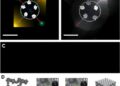
In a landmark advancement for organic light-emitting diode (OLED) technology, researchers Zhao, Mao, Liu, and colleagues have unveiled a new ultrahigh-radiance OLED device leveraging triplet-triplet annihilation (TTA) mechanisms that can sustain a staggering 13,000 amperes per square centimeter (kA cm^−2) current injection. Published in the prestigious journal Light: Science & Applications in early 2026, this work pushes the boundaries of OLED performance and opens unprecedented avenues for high-brightness display and lighting applications that could revolutionize the field.
At the heart of this breakthrough is the innovative utilization of TTA, a photophysical process whereby two triplet excitons interact to form a higher-energy singlet state capable of efficient light emission. This approach addresses a long-standing limitation in OLEDs, namely the quenching of triplet excitons, which traditionally limits luminance at high current densities. By ingeniously engineering the organic emissive layer to optimize TTA dynamics, the researchers have achieved a device architecture that not only tolerates but thrives under extreme electrical stress.
The ultrahigh current injection density of 13 kA cm^−2 reported by Zhao et al. is an order of magnitude higher than what conventional fluorescent or phosphorescent OLEDs can sustain. This exceptional current density translates directly into unprecedented luminance levels that could catalyze the development of ultra-bright OLED panels, ideal for outdoor displays, automotive headlamps, and next-generation augmented reality headsets where visible brightness and clarity under direct sunlight are non-negotiable.
Achieving such remarkable operational metrics required meticulous material design and a deep understanding of exciton dynamics. The team optimized host-guest molecular systems within the emissive layer to facilitate efficient triplet diffusion and promote TTA, all while minimizing detrimental processes such as triplet-polaron quenching and singlet-triplet annihilation losses. This delicate balance was key to stabilizing device performance under the harsh conditions imposed by ultrahigh current injection.
Moreover, the device fabrication techniques employed involved precise control over layer thickness, interface engineering, and encapsulation to ensure robust charge injection and extraction, minimal resistive losses, and enhanced thermal stability. Such engineering feats are critical as the intense current densities generate significant localized heating, which could otherwise accelerate degradation pathways and compromise long-term device operation.
The implications of this research extend beyond just brightness enhancements. The TTA mechanism harnessed can improve device efficiency by converting non-radiative triplet excitons into usable singlet excitons, thereby elevating the external quantum efficiency (EQE) and internal quantum efficiency (IQE) metrics simultaneously. This dual benefit means that ultrahigh luminance can be attained without the steep energy penalties that typically plague OLEDs at high currents.
Furthermore, the study reveals insights into the complex interplay between excitonic states and electrical driving conditions, challenging existing theoretical models. By demonstrating stable operation at 13 kA cm^−2 injection currents, the findings provoke a re-examination of device physics under extreme regimes, with potential spin-offs in OLED modeling, materials science, and device design heuristics.
The ultrahigh-radiance TTA-based OLEDs also promise to impact the broader optoelectronics ecosystem. Their enhanced brightness and efficiency profiles could complement emerging semiconductor laser technologies in emerging photonic devices, photodynamic therapy tools, and high-contrast imaging systems. This cross-pollination of technology underscores the transformative potential embodied in Zhao and team’s work.
Beyond practical applications, this breakthrough opens exciting research frontiers in understanding triplet exciton interactions in organic materials. The finely controlled experiments and characterization techniques applied set new benchmarks for exploring exciton kinetics, diffusion lengths, and annihilation rates under practically relevant operational stresses, information crucial for next-generation organic optoelectronics.
While this achievement marks a giant leap, challenges remain in scaling the technology for mass production, ensuring reliability over prolonged usage, and integrating these devices seamlessly with existing electronics. Nonetheless, the robustness demonstrated under such intense driving conditions offers a promising outlook for commercialization and widespread adoption.
The study’s comprehensive approach combining theoretical modeling, advanced material synthesis, meticulous device engineering, and rigorous performance evaluation provides a valuable roadmap for researchers globally striving to push OLEDs towards their ultimate performance limits. By shining light on high-current exciton dynamics, Zhao et al. have fundamentally expanded the knowledge base of OLED science.
In conclusion, the introduction of an ultrahigh-radiance TTA-based OLED that operates reliably at 13 kA cm^−2 current injection epitomizes a major milestone in organic electronics. This work not only redefines the upper bounds of OLED luminance but also heralds a new era where OLEDs can challenge inorganic technologies in brightness-intensive applications. As the demand for brighter, more efficient, and flexible light-emitting devices escalates, breakthroughs like this will be crucial enablers driving future innovation.
The paper’s detailed elucidation of molecular engineering strategies to harness TTA under high current densities promises to inspire a wave of research focused on novel organic semiconductors tailored for extreme operating environments. It stands as a testament to the power of fundamental science allied with precision engineering.
As OLED technology continues to evolve, the framework and findings presented by Zhao and colleagues may soon underpin the next generation of display and lighting devices, blending unrivaled brightness with operational flexibility. The ultrahigh-radiance OLED paradigm is poised to reshape our interaction with light-emitting surfaces, offering richer visual experiences and transformative functionality across consumer electronics and industrial sectors alike.
Subject of Research: Organic Light-Emitting Diodes, Triplet-Triplet Annihilation, High Current Density Devices
Article Title: Ultrahigh-radiance TTA-based OLED with 13 kA cm−2 current injection
Article References:
Zhao, J., Mao, Y., Liu, W. et al. Ultrahigh-radiance TTA-based OLED with 13 kA cm−2 current injection. Light Sci Appl 15, 89 (2026). https://doi.org/10.1038/s41377-025-02134-z
DOI: 10.1038/s41377-025-02134-z
Tags: advanced organic light-emitting diodesEfficient Light Emission in OLEDsExtreme Electrical Stress ToleranceHigh-Brightness Display TechnologyHigh-Current Density OLEDInnovative OLED Device ArchitectureNext-Generation Lighting ApplicationsOLED Luminance LimitationsOLED Performance BreakthroughPhotophysical Processes in OLEDsTriplet-Triplet Annihilation MechanismUltrahigh-Radiance OLED