• HOME
  • NEWS
  • EXPLORE
    • CAREER
      • Companies
      • Jobs
    • EVENTS
    • iGEM
      • News
      • Team
    • PHOTOS
    • VIDEO
    • WIKI
  • BLOG
  • COMMUNITY
    • FACEBOOK
    • INSTAGRAM
    • TWITTER
Saturday, February 7, 2026
BIOENGINEER.ORG
No Result
View All Result
  • Login
  • HOME
  • NEWS
  • EXPLORE
    • CAREER
      • Companies
      • Jobs
        • Lecturer
        • PhD Studentship
        • Postdoc
        • Research Assistant
    • EVENTS
    • iGEM
      • News
      • Team
    • PHOTOS
    • VIDEO
    • WIKI
  • BLOG
  • COMMUNITY
    • FACEBOOK
    • INSTAGRAM
    • TWITTER
  • HOME
  • NEWS
  • EXPLORE
    • CAREER
      • Companies
      • Jobs
        • Lecturer
        • PhD Studentship
        • Postdoc
        • Research Assistant
    • EVENTS
    • iGEM
      • News
      • Team
    • PHOTOS
    • VIDEO
    • WIKI
  • BLOG
  • COMMUNITY
    • FACEBOOK
    • INSTAGRAM
    • TWITTER
No Result
View All Result
Bioengineer.org
No Result
View All Result
Home NEWS Science News

Ultra-stable perovskite solar cell remains stable for more than a year

Bioengineer by Bioengineer
June 1, 2017
in Science News
Reading Time: 2 mins read
0
Share on FacebookShare on TwitterShare on LinkedinShare on RedditShare on Telegram
IMAGE

Credit: MK Nazeeruddin/EPFL

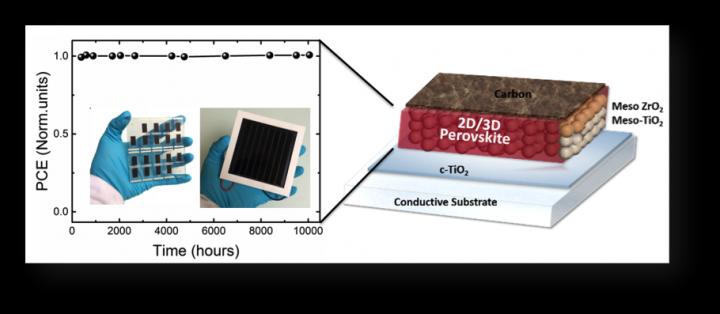
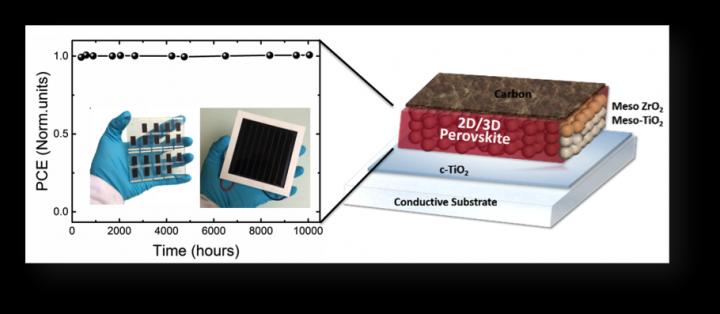
Perovskite solar cells promise cheaper and efficient solar energy, with enormous potential for commercialization. But even though they have been shown to achieve over 22% power-conversion efficiency, their operational stability still fails market requirements. Despite a number of proposed solutions in fabrication technology, this issue has continued to undercut whatever incremental increases in efficiency have been achieved. EPFL scientists have now built a low-cost, ultra-stable perovskite solar cell that has operated for more than a year without loss in performance (11.2%). The work is published in Nature Communications.

The lab of Mohammad Khaja Nazeeruddin at EPFL in collaboration with Michael Grätzel and Solaronix company has engineered what is known as 2D/3D hybrid perovskite solar cell. This combines the enhanced stability of 2D perovskites with 3D forms, which efficiently absorb light across the entire visible spectrum and transport electrical charges. In this way, the scientists were able to fabricate of efficient and ultra-stable solar cells, which is a crucial step for upscaling to a commercial level. The 2D/3D perovskite yields efficiencies of 12.9% (carbon-based architecture), and 14.6% (standard mesoporous solar cells).

The scientists built 10×10 cm2 solar panels using a fully printable industrial-scale process. The resulting solar cells have now delivered a constant 11.2% efficiency for more than 10,000 hours, while showing zero loss in performance as measured under standard conditions.

The breakthrough resolves the problem of perovskite solar-cell stability, and can viably move the technology into the commercial sphere.

###

This work was funded by the Marie Curie Institute, the Horizon 2020 program, the European Union Seventh Framework Programme (FP7/2007-2013) and Solaronix.

Reference

G. Grancini, C. Roldán-Carmona, I. Zimmermann, E. Mosconi, X. Lee, D. Martineau, S. Narbey, F. Oswald, F. De Angelis, M. Graetzel, M.K. Nazeeruddin. One-Year stable perovskite solar cells by 2D/3D interface engineering. Nature Communications 01 June 2017. DOI: 10.1038/ncomms15684

Media Contact

Nik Papageorgiou
[email protected]
41-216-932-105
@EPFL_en

http://www.epfl.ch/index.en.html

############

Story Source: Materials provided by Scienmag

Share12Tweet8Share2ShareShareShare2

Related Posts

Succinate Receptor 1 Limits Blood Cell Formation, Leukemia

February 7, 2026

Palmitoylation of Tfr1 Drives Platelet Ferroptosis and Exacerbates Liver Damage in Heat Stroke

February 7, 2026

Oxygen-Enhanced Dual-Section Microneedle Patch Improves Drug Delivery and Boosts Photodynamic and Anti-Inflammatory Treatment for Psoriasis

February 7, 2026

Scientists Identify SARS-CoV-2 PLpro and RIPK1 Inhibitors Showing Potent Synergistic Antiviral Effects in Mouse COVID-19 Model

February 7, 2026
Please login to join discussion

POPULAR NEWS

  • Robotic Ureteral Reconstruction: A Novel Approach

    Robotic Ureteral Reconstruction: A Novel Approach

    82 shares
    Share 33 Tweet 21
  • Digital Privacy: Health Data Control in Incarceration

    63 shares
    Share 25 Tweet 16
  • Study Reveals Lipid Accumulation in ME/CFS Cells

    57 shares
    Share 23 Tweet 14
  • Breakthrough in RNA Research Accelerates Medical Innovations Timeline

    53 shares
    Share 21 Tweet 13

About

We bring you the latest biotechnology news from best research centers and universities around the world. Check our website.

Follow us

Recent News

Succinate Receptor 1 Limits Blood Cell Formation, Leukemia

Palmitoylation of Tfr1 Drives Platelet Ferroptosis and Exacerbates Liver Damage in Heat Stroke

Oxygen-Enhanced Dual-Section Microneedle Patch Improves Drug Delivery and Boosts Photodynamic and Anti-Inflammatory Treatment for Psoriasis

Subscribe to Blog via Email

Enter your email address to subscribe to this blog and receive notifications of new posts by email.

Join 73 other subscribers
  • Contact Us

Bioengineer.org © Copyright 2023 All Rights Reserved.

Welcome Back!

Login to your account below

Forgotten Password?

Retrieve your password

Please enter your username or email address to reset your password.

Log In
No Result
View All Result
  • Homepages
    • Home Page 1
    • Home Page 2
  • News
  • National
  • Business
  • Health
  • Lifestyle
  • Science

Bioengineer.org © Copyright 2023 All Rights Reserved.