

• HOME
  • NEWS
  • EXPLORE
    • CAREER
      • Companies
      • Jobs
    • EVENTS
    • iGEM
      • News
      • Team
    • PHOTOS
    • VIDEO
    • WIKI
  • BLOG
  • COMMUNITY
    • FACEBOOK
    • INSTAGRAM
    • TWITTER
Friday, April 3, 2026
BIOENGINEER.ORG
No Result
View All Result
  • Login
  • HOME
  • NEWS
  • EXPLORE
    • CAREER
      • Companies
      • Jobs
        • Lecturer
        • PhD Studentship
        • Postdoc
        • Research Assistant
    • EVENTS
    • iGEM
      • News
      • Team
    • PHOTOS
    • VIDEO
    • WIKI
  • BLOG
  • COMMUNITY
    • FACEBOOK
    • INSTAGRAM
    • TWITTER
  • HOME
  • NEWS
  • EXPLORE
    • CAREER
      • Companies
      • Jobs
        • Lecturer
        • PhD Studentship
        • Postdoc
        • Research Assistant
    • EVENTS
    • iGEM
      • News
      • Team
    • PHOTOS
    • VIDEO
    • WIKI
  • BLOG
  • COMMUNITY
    • FACEBOOK
    • INSTAGRAM
    • TWITTER
No Result
View All Result
Bioengineer.org
No Result
View All Result
Home NEWS Science News Biology

UH researcher tackles mysterious Z-RNA structure and its potential connection to diseases

Bioengineer by Bioengineer
November 2, 2023
in Biology
Reading Time: 3 mins read
0
Quentin Vicens
Share on FacebookShare on TwitterShare on LinkedinShare on RedditShare on Telegram

University of Houston Assistant Professor of Biology and Biochemistry Quentin Vicens has been awarded a $1.2 million grant from the National Institute of General Medical Sciences to unravel the mystery of Z-RNA – an enigmatic RNA structure within our cells that plays a critical role in immune response. This work is in collaboration with the laboratory of Beat Vögeli, associate professor at the University of Colorado and co-recipient of the award.
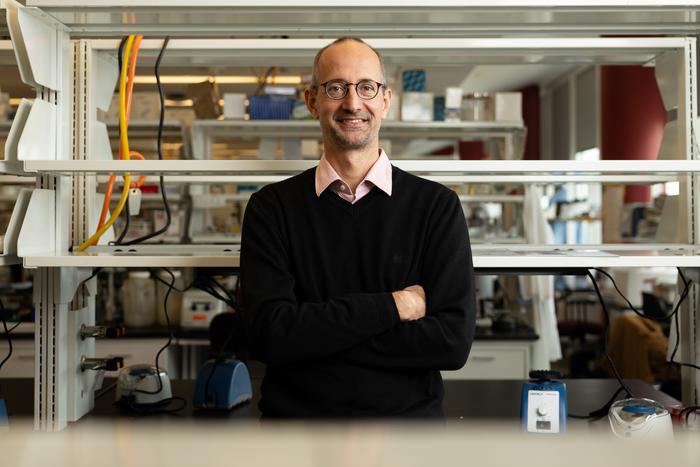
Quentin Vicens

Credit: University of Houston

University of Houston Assistant Professor of Biology and Biochemistry Quentin Vicens has been awarded a $1.2 million grant from the National Institute of General Medical Sciences to unravel the mystery of Z-RNA – an enigmatic RNA structure within our cells that plays a critical role in immune response. This work is in collaboration with the laboratory of Beat Vögeli, associate professor at the University of Colorado and co-recipient of the award.

Vicens, Vögeli and their research teams are on a mission to understand how Z-RNA forms, how often it appears in our genetic material and what it means for proteins that are known to recognize this structure. They are focusing on a process called RNA editing, where one letter in RNA is transformed into another. Think of it like changing a letter in a word to make a new word. This editing happens more in conditions like cancer and infections and is linked to the presence of a unique protein part that can attach to Z-RNA.

“Helices come in generally two ‘flavors.’ The typical formation is to the right. The one to the left is not stable, but it does occur in cells. Yet researchers do not yet truly understand how it is possible for this helix to occur in cells when it is not stable,” said Vicens, a faculty member in UH’s College of Natural Sciences and Mathematics. “We want to know what happens at the molecular level that causes this RNA structure to flip from one direction to another and then revert. Think of a staircase spiraling up to the right that one day spirals to the left.”

The team will use nuclear magnetic resonance or NMR methods, an expertise of Vögeli’s lab, which involves magnets and radio waves taking pictures of the tiny structures inside our cells. This way, they can see how RNA changes from its usual form to the Z-form.

Vicens’ lab group is interested in using cryo-electron microscopy that lets them see large groups of proteins and molecules frozen in a glassy state. They are also diving into the world of genomics by studying how natural modifications of cellular RNA affect whether Z-RNA is adopted in cells.

While the research delves into the fundamental science of RNA biology, it also has promise for understanding and potentially addressing various diseases, like Aicardi-Goutières syndrome, as well as cancer and autoimmune deficiencies.

“When RNA gets edited incorrectly, it can lead to these diseases, making it vital that we fully understand their function,” said Vicens. “We hope that this work reveals how proteins and Z-RNA work together, potentially giving us new ways to diagnose or treat these illnesses.”

Research reported in this publication was supported by the National Institute of General Medical Sciences of the National Institutes of Health under award number R01GM150642. The content is solely the responsibility of the authors and does not necessarily represent the official views of the National Institutes of Health.



Share12Tweet8Share2ShareShareShare2

Related Posts

Brain Power May Hold the Key to Predicting Cognitive Decline

Brain Power May Hold the Key to Predicting Cognitive Decline

April 2, 2026
Insights into CD4+ T-Cell Depletion and Pulmonary Infections in Critically Ill Immunocompromised Patients

Insights into CD4+ T-Cell Depletion and Pulmonary Infections in Critically Ill Immunocompromised Patients

April 2, 2026

Advanced Sensors Reduce Costs in Genetic Disorder Research

April 2, 2026

Advancing Blood Purification: Innovations Beyond Traditional Dialysis

April 2, 2026

POPULAR NEWS

  • blank

    Revolutionary AI Model Enhances Precision in Detecting Food Contamination

    96 shares
    Share 38 Tweet 24
  • Imagine a Social Media Feed That Challenges Your Views Instead of Reinforcing Them

    1007 shares
    Share 398 Tweet 249
  • Promising Outcomes from First Clinical Trials of Gene Regulation in Epilepsy

    51 shares
    Share 20 Tweet 13
  • Popular Anti-Aging Compound Linked to Damage in Corpus Callosum, Study Finds

    44 shares
    Share 18 Tweet 11

About

We bring you the latest biotechnology news from best research centers and universities around the world. Check our website.

Follow us

Recent News

Revolutionary Magnetic Biochar Gel Tackles Arsenic and Antimony Pollution in Rice Cultivation

Engineered Biochar Harnesses Soil Chemistry to Degrade Antibiotic Pollution

Leading Cancer Scientist Thales “PapaG” Papagiannakopoulos Joins Salk Institute

Subscribe to Blog via Email

Enter your email address to subscribe to this blog and receive notifications of new posts by email.

Join 78 other subscribers
  • Contact Us

Bioengineer.org © Copyright 2023 All Rights Reserved.

Welcome Back!

Login to your account below

Forgotten Password?

Retrieve your password

Please enter your username or email address to reset your password.

Log In
No Result
View All Result
  • Homepages
    • Home Page 1
    • Home Page 2
  • News
  • National
  • Business
  • Health
  • Lifestyle
  • Science

Bioengineer.org © Copyright 2023 All Rights Reserved.