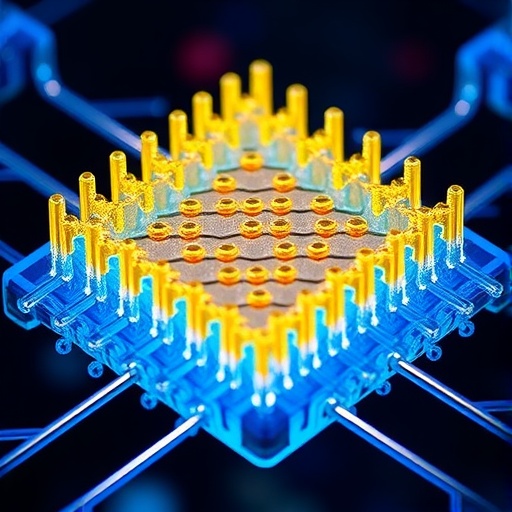
A groundbreaking advance at UCLA has opened a compelling new frontier in the realm of next-generation electronics by addressing one of the most persistent challenges in perovskite semiconductor integration: the inefficient transfer of electrical current at the critical interface between metal electrodes and perovskite materials. Perovskites, celebrated for their unique optoelectronic properties and cost-effective production, have long teased scientists with the promise of revolutionizing solar cells, photodetectors, and sensors. Yet, the bottleneck posed by the metal–perovskite junction has hindered their transition from laboratory research to commercially viable technologies.
The crux of the problem lies in what can be described as a “clogged doorway” at the metal–perovskite interface. Typically, when electrical current attempts to pass from a metal electrode into the perovskite semiconductor, it faces an energy barrier too substantial to overcome efficiently. This resistance not only wastes precious energy but also stifles the performance of devices employing these materials, a dilemma that has remained largely unresolved despite intensive research efforts. Traditional semiconductor technologies have relied extensively on impurity doping—introducing extra charge carriers to boost their conductivity—to alleviate such issues. However, perovskites pose complications due to their soft and chemically sensitive nature, rendering conventional doping techniques challenging to implement without damaging the material.
The pioneering research led by Xiangfeng Duan and his team at UCLA innovatively circumvents this obstacle by focusing on engineering the immediate microscopic region beneath the metal contact rather than attempting to alter the entire perovskite material. Their method involves a precise and localized modification that leverages quantum mechanical principles to facilitate charge carrier movement. This localized approach results in a dramatic reduction of the effective energy barrier at the interface, allowing for current to flow more freely and efficiently.
At the heart of this innovative technique is the creation of a van der Waals–laminated metal electrode meticulously placed on the perovskite surface. This step minimizes physical damage to the delicate semiconductor. Subsequently, a mild thermal annealing process induces the controlled diffusion of silver atoms into the near-surface region of the perovskite. The final transformative stage subjects the interface to ultraviolet light exposure, converting these silver atoms into silver oxide nanoclusters. These nanostructures then function as powerful electron acceptors, effectively pulling electrons away from the neighboring perovskite region and thereby establishing a localized p-doped domain directly beneath the metal contact.
The significance of this locally induced doping cannot be overstated. By constricting the blocking energy barrier region from approximately 250 nanometers down to less than 25 nanometers, the research team enabled a quantum tunneling process — specifically, Fowler–Nordheim tunneling — to dominate electronic transport across the interface. Unlike traditional thermionic emission, which requires overcoming an energy barrier by thermal activation, quantum tunneling allows electrons to pass through the barrier despite its presence, provided the barrier is sufficiently thin. This mechanism dramatically lowers electrical resistance and permits charge to flow at reduced voltages, enhancing efficiency and device speed.
Implications of this discovery reach far beyond theoretical interest. The newly developed contact-induced charge-transfer doping strategy marks a critical leap towards the practical realization of perovskite-based devices, setting the stage for electronics that not only consume less power but also exhibit improved reliability and longevity. With faster current injection at metal contacts, next-generation transistors, photodetectors, and other optoelectronic components built on perovskite substrates could become a tangible reality.
This work illuminates a promising heuristic for semiconductor interface engineering—concentrating modification efforts on the nanoscopic local interface rather than the bulk material. The method’s novelty lies in coaxing the semiconductor itself to self-modify via contact-induced doping, inspired by leveraging intrinsic materials chemistry and quantum mechanical effects. Given the versatile electrical and optical properties of perovskites, coupled with the scalability of the described technique, this approach could accelerate perovskite technologies’ transition from experimental curiosities to commercial mainstays.
While the results currently remain at a laboratory proof-of-concept stage, they already offer a clear blueprint for overcoming one of the most frustrating physical barriers in the field. By developing a controlled and minimally invasive technique to sculpt the electronic landscape precisely at the interface, researchers have unlocked a pathway to low-resistance electrical contacts critical to the device function. This achievement represents a milestone in materials science, showing that nuanced electronic engineering at the nanoscale can produce outsized benefits for device performance.
Moreover, the principles demonstrated here may bear relevance far beyond perovskite semiconductors. The paradigm of contact-induced self-doping offers a versatile framework that other emerging semiconductor materials, many of which also suffer from interface bottlenecks, could adopt. Future explorations could examine different metals, nanocluster compositions, or interface geometries to extend this concept’s reach and tailor it for diverse semiconductor applications.
The research also showcases the power of multidisciplinary collaboration, blending materials science, chemistry, and quantum physics to tackle a challenge that sits at the intersection of these fields. By employing a combination of precise fabrication techniques, controlled thermal and optical processing, and detailed physical characterization, the team delivered a compelling solution that pushes technological boundaries.
This discovery is poised to accelerate the integration of perovskite semiconductors into everyday electronic devices, promising not just incremental improvements but potentially transformative advances in efficiency, power consumption, and overall device architecture. As the scientific community continues to refine and expand upon this work, the age of perovskite-based electronics stands nearer than ever before to becoming a defining reality of modern technology.
Subject of Research: Electrical current transfer enhancement at metal–perovskite semiconductor interfaces using contact-induced charge-transfer doping.
Article Title: Bulk-heterojunction doping in lead halide perovskites for low-resistance metal contacts
News Publication Date: 20-Feb-2026
Web References: Nature Materials DOI
Image Credits: Duan lab/UCLA
Keywords
Perovskites, Semiconductors, Metal contacts, Electrical conductivity, Quantum tunneling, Charge-transfer doping, Lead halide perovskites, Van der Waals electrodes, Silver oxide nanoclusters, Optoelectronic devices, Electronics, Interface engineering
Tags: advanced materials for electronics innovationcost-effective perovskite device fabricationimproving electrical current transfer in perovskitesmetal-perovskite interface energy barriernanoscale interface engineeringnext-generation electronics developmentoptoelectronic properties of perovskitesovercoming semiconductor doping limitationsperovskite photodetector efficiencyperovskite semiconductor integration challengesscalable perovskite solar cell technologyUCLA nanoscale research breakthroughs