• HOME
  • NEWS
  • EXPLORE
    • CAREER
      • Companies
      • Jobs
    • EVENTS
    • iGEM
      • News
      • Team
    • PHOTOS
    • VIDEO
    • WIKI
  • BLOG
  • COMMUNITY
    • FACEBOOK
    • INSTAGRAM
    • TWITTER
Saturday, December 13, 2025
BIOENGINEER.ORG
No Result
View All Result
  • Login
  • HOME
  • NEWS
  • EXPLORE
    • CAREER
      • Companies
      • Jobs
        • Lecturer
        • PhD Studentship
        • Postdoc
        • Research Assistant
    • EVENTS
    • iGEM
      • News
      • Team
    • PHOTOS
    • VIDEO
    • WIKI
  • BLOG
  • COMMUNITY
    • FACEBOOK
    • INSTAGRAM
    • TWITTER
  • HOME
  • NEWS
  • EXPLORE
    • CAREER
      • Companies
      • Jobs
        • Lecturer
        • PhD Studentship
        • Postdoc
        • Research Assistant
    • EVENTS
    • iGEM
      • News
      • Team
    • PHOTOS
    • VIDEO
    • WIKI
  • BLOG
  • COMMUNITY
    • FACEBOOK
    • INSTAGRAM
    • TWITTER
No Result
View All Result
Bioengineer.org
No Result
View All Result
Home NEWS Science News

UCI scientists create organs-on-chips for large-scale drug screening

Bioengineer by Bioengineer
February 8, 2017
in Science News
Reading Time: 2 mins read
0
Share on FacebookShare on TwitterShare on LinkedinShare on RedditShare on Telegram
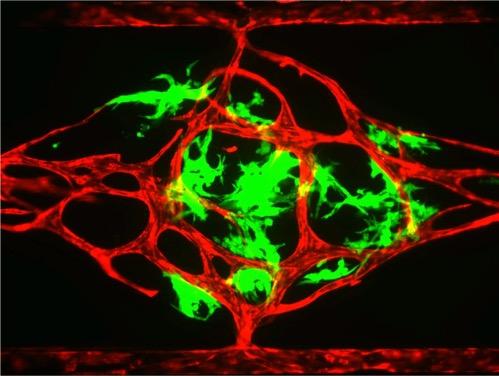
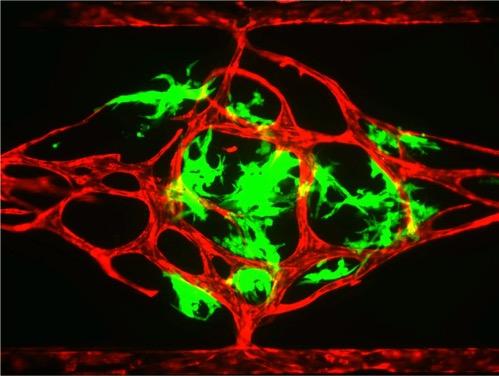
IMAGE

Credit: Hughes Lab

Led by UCI professor of molecular biology & biochemistry Christopher C.W. Hughes, the research team successfully established multiple vascularized micro-organs on an industry-standard 96-well plate. Hughes and the study's first author, Duc T. T. Phan, showed that these miniature tissues are much better at reproducing human drug responses than previous model systems. Hughes and his group have shown how the flow of a blood substitute through the vascular network they created can deliver nutrients to multiple kinds of tissues, including heart, pancreas, brain and various tumors.

"This is truly a unique platform – we have recreated in a dish the key element common to all tissues, which is that they depend on blood vessels for their survival. This feature is missing in all previously described in vitro organ cultures," Hughes said.

Hughes' team was also able to establish a functional vascularized microtumor (VMT) within the 96-well plate system and demonstrated its potential for anti-cancer drug screening. Working with a panel of FDA-approved anti-cancer drugs and a human colon cancer, they found that the VMT platform could accurately identify drugs that target the tumor cells, the vessels that supply them, or both.

"This is a major breakthrough", continued Dr. Hughes, "For the first time we can identify in the same assay drugs that target both tumor cells and the vessels that feed them."

The full study can be found online in the Royal Society of Chemistry's journal Lab on a Chip.

###

Contributing to this study were, Xiaolin Wang, Brianna Craver, Agua Sobrino, Da Zhao, Jerry Chen, Lilian Lee, Steven George, and Abraham Lee. The study was supported by grants from the National Institutes of Health, UCI and the National Natural Science Foundation of China.

About the University of California, Irvine: Founded in 1965, UCI is the youngest member of the prestigious Association of American Universities. The campus has produced three Nobel laureates and is known for its academic achievement, premier research, innovation and anteater mascot. Led by Chancellor Howard Gillman, UCI has more than 30,000 students and offers 192 degree programs. It's located in one of the world's safest and most economically vibrant communities and is Orange County's second-largest employer, contributing $5 billion annually to the local economy. For more on UCI, visit http://www.uci.edu.

Media access: Radio programs/stations may, for a fee, use an on-campus ISDN line to interview UCI faculty and experts, subject to availability and university approval. For more UCI news, visit news.uci.edu. Additional resources for journalists may be found at communications.uci.edu/for-journalists.

Media Contact

Rahasson Ager
[email protected]
949-824-6282
@UCIrvine

http://www.uci.edu

############

Story Source: Materials provided by Scienmag
Share12Tweet8Share2ShareShareShare2

Related Posts

Hyperdynamic Circulation: A Key Obesity Indicator?

December 13, 2025
Rethinking Vigabatrin for Infantile Spasms: Risks and Insights

Rethinking Vigabatrin for Infantile Spasms: Risks and Insights

December 13, 2025

Impact of LED Light on Turmeric Pigment Stability

December 13, 2025

Intracranial Needle Found in Infant’s Brain: CT Discovery

December 13, 2025
Please login to join discussion

POPULAR NEWS

  • Scientists Uncover Chameleon’s Telephone-Cord-Like Optic Nerves, A Feature Missed by Aristotle and Newton

    Scientists Uncover Chameleon’s Telephone-Cord-Like Optic Nerves, A Feature Missed by Aristotle and Newton

    121 shares
    Share 48 Tweet 30
  • Neurological Impacts of COVID and MIS-C in Children

    108 shares
    Share 43 Tweet 27
  • Nurses’ Views on Online Learning: Effects on Performance

    69 shares
    Share 28 Tweet 17
  • NSF funds machine-learning research at UNO and UNL to study energy requirements of walking in older adults

    70 shares
    Share 28 Tweet 18

About

We bring you the latest biotechnology news from best research centers and universities around the world. Check our website.

Follow us

Recent News

Hyperdynamic Circulation: A Key Obesity Indicator?

Rethinking Vigabatrin for Infantile Spasms: Risks and Insights

Impact of LED Light on Turmeric Pigment Stability

Subscribe to Blog via Email

Enter your email address to subscribe to this blog and receive notifications of new posts by email.

Join 69 other subscribers
  • Contact Us

Bioengineer.org © Copyright 2023 All Rights Reserved.

Welcome Back!

Login to your account below

Forgotten Password?

Retrieve your password

Please enter your username or email address to reset your password.

Log In
No Result
View All Result
  • Homepages
    • Home Page 1
    • Home Page 2
  • News
  • National
  • Business
  • Health
  • Lifestyle
  • Science

Bioengineer.org © Copyright 2023 All Rights Reserved.