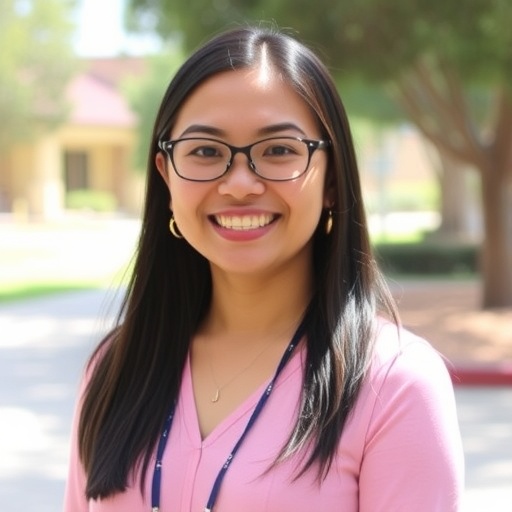
Ryan Milton, a dedicated doctoral candidate specializing in nuclear physics at the University of California, Riverside (UCR), has recently earned the prestigious Graduate Student Research Fellowship from the U.S. Department of Energy’s Office of Science. This fellowship offers a substantial monthly stipend to support Milton’s innovative research efforts at SLAC National Accelerator Laboratory, an eminent facility affiliated with Stanford University. His work underscores an exciting intersection of artificial intelligence and the intricate subatomic investigations crucial to modern physics.
At the heart of Milton’s research lies the quest to decipher the complex internal structure of protons and neutrons within atomic nuclei. These fundamental particles are comprised of quarks, yet the dynamics of these quarks, especially their interactions and behavior when confined inside the nucleus, remain largely enigmatic. This gap in understanding presents a profound challenge for nuclear physicists aiming to unravel the building blocks of matter at an unprecedented granularity.
To tackle this problem, Milton is developing advanced artificial intelligence methodologies, specifically focusing on “unbinned” data analysis. Unlike traditional techniques that rely on categorizing experimental data into discrete bins, unbinned analysis leverages continuous data distributions, thereby extracting maximal information from particle collision events and nuclear interactions. This novel approach enhances precision in measuring nuclear phenomena and reduces bias inherent in binning processes.
Collaborating with Dr. Ben Nachman at SLAC, Milton aims to refine these AI algorithms and apply them to experimental data sets from Jefferson Lab as well as simulations targeted for the upcoming Electron-Ion Collider (EIC). The EIC, slated for deployment at Brookhaven National Laboratory, represents one of the most ambitious projects in nuclear physics, designed to probe the inner workings of nuclear matter by colliding electrons with ions at near-light speeds.
Milton’s advisor, Professor Miguel Arratia from UCR’s Department of Physics and Astronomy, commends his emerging role as a leader within the burgeoning field of AI applications in physics. Arratia highlights Milton’s development of user-friendly software tools that democratize access to cutting-edge AI techniques, facilitating their utilization within the physics research community. Such tools are vital to accelerating discovery and innovation across multiple experimental platforms.
Significantly, Milton’s recent first-author paper, supported by an NSF cyberinfrastructure grant, demonstrates tangible impact, validating his methodological innovations. The integration of AI-driven analysis into nuclear physics embodies a paradigm shift, allowing for far more nuanced interpretations of complex physical systems. This shift holds promise for revealing new insights into the quantum realm that were previously obscured by data limitations.
Beyond theoretical advances, Milton’s fellowship enables him to engage directly with experimental frameworks that are crucial to validating AI models. Working at SLAC offers unparalleled access to cutting-edge detector technologies, high-performance computing resources, and collaborative expertise necessary to translate AI techniques into practical experimental tools.
The broader implications of Milton’s research extend well beyond nuclear physics. By enhancing precision and interpretability in scientific measurements, AI-powered unbinned analysis techniques have the potential to revolutionize data-intensive fields across science and engineering. They promise to refine how scientific knowledge is extracted from increasingly complex data sets, thereby advancing a more comprehensive and accurate understanding of the physical world.
Milton’s enthusiasm for this interdisciplinary approach traces back to his undergraduate years at UCLA, where he first gravitated towards nuclear physics through serendipitous academic exposure. His early interest in computational methods blossomed into a sophisticated research agenda combining physics, statistics, and AI. His personal narrative underscores the importance of fostering flexible, innovative education pathways to nurture future leaders in scientific computing.
Underpinning Milton’s accomplishments is a robust support ecosystem, notably the Department of Energy’s AI grant which facilitated collaborations across national laboratories, including Lawrence Livermore and Berkeley. This strategic investment in AI research infrastructure reflects a broader institutional commitment to harnessing artificial intelligence to solve fundamental scientific challenges.
As Milton embarks on this fellowship-supported journey, he remains motivated by the profound excitement of probing nature’s deepest secrets. He is optimistic that advancing AI methodologies within nuclear physics will catalyze transformative discoveries, pushing the boundaries of what humanity understands about matter and the universe’s fundamental forces.
The recognition Milton has garnered through this fellowship is a testament to the growing synergy between physics and artificial intelligence. His work not only exemplifies the integration of state-of-the-art computational techniques with traditional experimental practice but also heralds a new era where interdisciplinary skillsets drive scientific innovation at an accelerated pace.
In summary, Ryan Milton’s fellowship marks a significant milestone in the fusion of AI with nuclear physics research. By pioneering unbinned AI analysis tools, contributing to flagship experimental endeavors like the Electron-Ion Collider, and fostering interdisciplinary collaborations, Milton is positioning himself at the forefront of a transformative scientific movement that promises to reshape our understanding of the atomic nucleus and beyond.
Subject of Research: Application of artificial intelligence in nuclear physics for analyzing protons and neutrons at the quark level using unbinned data analysis methods.
Article Title: Emerging AI Techniques Illuminate Inner Workings of Protons and Neutrons in Nuclei: UCR Doctoral Student’s Fellowship at SLAC
News Publication Date: Not specified
Web References:
– SCGSR Fellowship: https://science.osti.gov/wdts/scgsr
– UC Riverside Physics Department: https://www.physics.ucr.edu/
– Milton’s first-author paper: https://iopscience.iop.org/article/10.1088/1748-0221/20/05/P05034
– NSF cyberinfrastructure award: https://www.nsf.gov/awardsearch/showAward?AWD_ID=2311667&HistoricalAwards=false
– DOE AI grant details: https://pamspublic.science.energy.gov/WebPAMSExternal/Interface/Common/ViewPublicAbstract.aspx?rv=11cab0b4-d20b-4139-80d5-5e13533e1bfe&rtc=24
References: Milton, R. et al. (2023). [Title of the paper]. Journal of Instrumentation. [Exact citation details not provided in source]
Image Credits: R. Milton / University of California, Riverside
Tags: advanced methodologies in nuclear investigationsartificial intelligence in physicsDOE Graduate Student Research Fellowshipinnovative research in fundamental particlesmodern physics challengesnuclear physics researchparticle collision event analysisquark dynamics in protons and neutronsSLAC National Accelerator LaboratoryUC Riverside doctoral studentunbinned data analysis techniquesunderstanding atomic nuclei structure