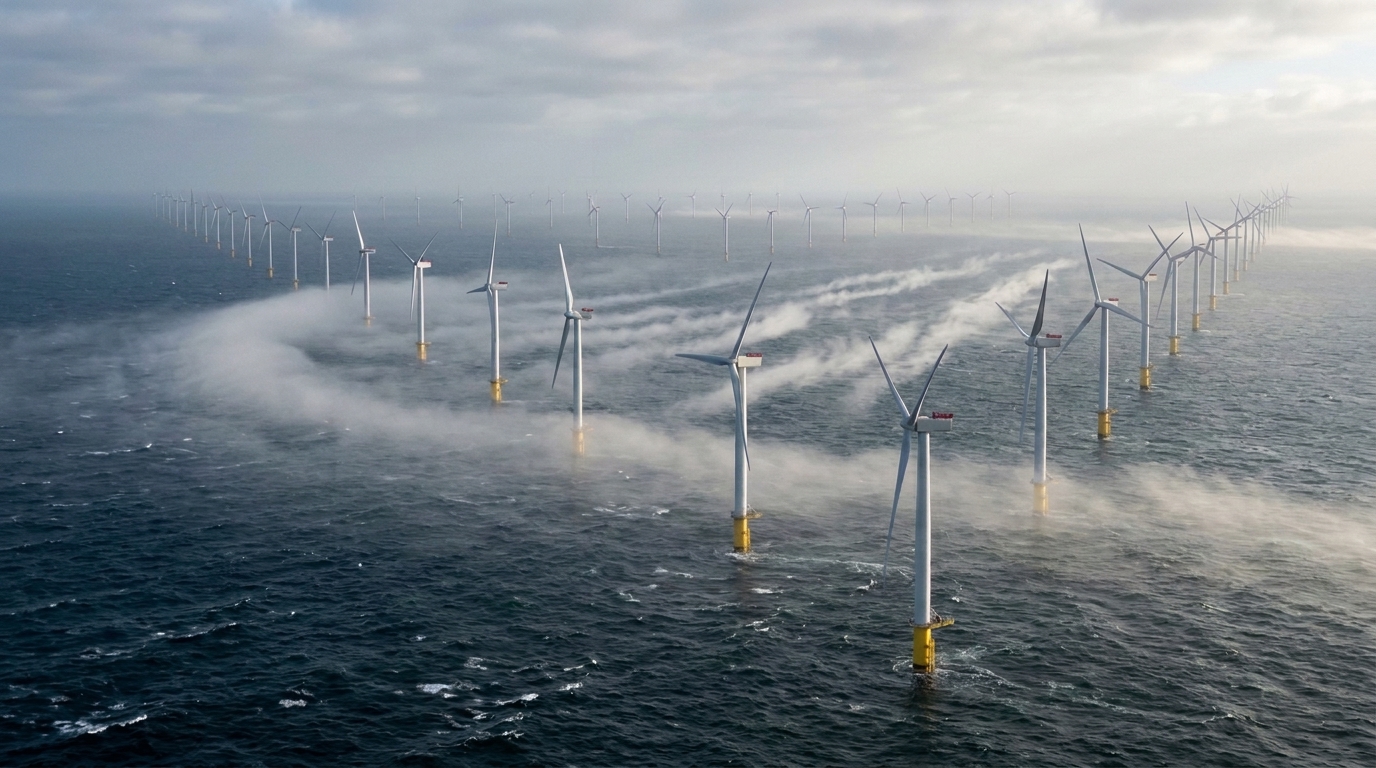
Large-scale offshore wind farms are increasingly recognized as substantial physical obstacles that disturb the structure of the entire atmospheric boundary layer, prompting engineers to seek more efficient modeling methods. When vast arrays of multi-megawatt turbines operate within conventionally neutral boundary layers topped by capping inversions and stratified upper air, their collective drag triggers atmospheric gravity waves. These waves generate adverse upstream pressure gradients that slow incoming air well before it encounters the perimeter turbines, producing an overall farm-scale blockage effect that meaningfully alters turbine power output. While high-fidelity computational fluid dynamics techniques such as large-eddy simulations and mesoscale numerical weather models can capture these complex interactions, their immense computational expense precludes routine use in commercial wind farm layout optimization, control scheduling, and annual energy production forecasting. Consequently, researchers Koen Devesse and Johan Meyers have formulated new modeling workflows that couple two-scale momentum theory with atmospheric perturbation models to compute blockage-corrected power outputs at a tiny fraction of conventional computational costs.
Standard industrial wind farm planning tools rely predominantly on analytical engineering wake models that calculate wake deficits behind individual turbines and superimpose their effects downstream. This superposition approach inherently presumes that the aggregate impact of an entire array does not exceed the sum of its isolated parts, ignoring broader interactions between the farm and the overlying atmosphere. Conversely, atmospheric perturbation models resolve mesoscale interactions across the boundary layer by treating the atmosphere as two vertically averaged horizontal flow layers separated by an interfacial pliant streamline surface. In this framework, wind-farm drag forces are injected directly into the lower layer momentum equations while influencing the stratified upper layer through vertical interfacial displacements. The resulting vertical displacements perturb the capping inversion and radiate gravity waves into the free troposphere, which exerts a downward pressure perturbation back upon the boundary layer. Capturing these reciprocal pressure feedbacks historically required solving large linear perturbation systems repeatedly within iterative fixed-point loops to reconcile local turbine thrust with evolving background velocity fields.
To overcome this computational bottleneck, the investigators leveraged the two-scale momentum framework initially introduced by Nishino and Dunstan, which splits the wind farm flow problem into distinct internal and external scales. Under this foundational scale-separation hypothesis, internal turbine-scale mechanics—such as rotor blade aerodynamics, setpoints, and local wake interactions—govern the ratio of individual turbine disk velocities to the mean streamwise velocity across the entire farm volume. Meanwhile, external mesoscale phenomena—including large-scale horizontal momentum advection, entrainment from overlying air, and wave-induced pressure gradients—act across the broader farm footprint to alter the farm-averaged velocity. Because total farm power and aggregate thrust scale with the cube and square of this farm-averaged velocity, variations in total energy yield caused by atmospheric gravity waves depend directly on variations in the average speed across the farm rather than on local spatial reconfigurations of turbine thrust.
Validating this core scale-separation premise required examining an extensive benchmark dataset generated through high-fidelity large-eddy simulations by Lanzilao and Meyers. The reference setup modeled a large offshore wind farm comprising one hundred sixty ten-megawatt turbines arranged in a regular rectangular staggered pattern across an idealized, steady conventionally neutral boundary layer. Operating below rated wind speeds with disk-based thrust coefficients held fixed at 1.94, the farm was simulated across thirty-six different meteorological configurations characterized by varying boundary layer heights, capping inversion thermal jumps, and tropospheric potential temperature lapse rates. By evaluating farm-level internal power and thrust coefficients from a neutral reference simulation and scaling them against the farm-averaged velocities extracted from the stratified simulations, the authors confirmed that internal farm coefficients remain remarkably stable across diverse mesoscale stratification regimes, yielding a root-mean-square error in total farm power of merely one percent of installed capacity.
Bridging two-scale momentum theory with the atmospheric perturbation model required reconciling their fundamentally different spatial averaging operations. The two-scale momentum theory defines farm velocity as a straightforward volumetric integral across a rigid rectangular domain encompassing the farm layout up to twice the turbine hub height. In contrast, the atmospheric perturbation model calculates velocities that are horizontally filtered using a Gaussian kernel of one-kilometer length scale and vertically averaged over a dynamic lower layer whose upper boundary shifts with streamline displacement. The researchers resolved this geometric discrepancy by assuming that average velocity perturbations within the displaced layer above the reference volume scale proportionally with the core velocity deficit beneath it via an empirical parameter tuned to 0.16 against neutral large-eddy simulation fields, enabling robust translation between model states.
Building upon this spatial bridge, the researchers constructed a simplified atmospheric perturbation model that assumes the normalized spatial footprint of turbine thrust remains constant over the farm footprint. In classical perturbation implementations, the governing momentum and continuity equations had to be solved repeatedly via Fourier-Galerkin spectral matrix inversions because local turbine thrust varied continuously with local velocity perturbations. By decoupling the spatial force footprint from local perturbation states and scaling total thrust directly through the farm-averaged two-scale momentum relation, the governing partial differential equations collapse into a simplified system of scalar algebraic relations. Consequently, the large linear operator governing atmospheric wave dynamics needs to be inverted only once, condensing the primary computational effort of the mesoscale model to a single evaluation step.
When tested across twenty-seven conventionally neutral flow cases from the large-eddy simulation benchmark library, this coefficient-based model exhibited close agreement with high-fidelity benchmark predictions. The formulation yielded an overall root-mean-square error in farm power of 4.8 times the power of a standalone turbine, representing approximately three percent of total installed capacity. Most of this discrepancy stemmed from variance across different atmospheric states, accompanied by a modest positive mean bias that became more pronounced during conditions featuring intense blockage and depressed power yields. Detailed velocity deficit profiles indicated that while the model slightly overpredicted wind speeds near the front array rows and underpredicted speeds near the rear, spatial error cancellation preserved high accuracy in the farm-averaged velocity. Crucially, each run required approximately 1.3 central processing unit seconds on a 2.4-gigahertz processor, running thirty-five times slower than an engineering wake model but hundreds of times faster than classical coupled perturbation solvers.
To evaluate the practical feasibility of deploying this approach without prior numerical simulations, the authors investigated whether standard engineering wake models could supply the necessary farm coefficients. Employing an uncalibrated Gaussian wake model incorporating wake superposition, turbulence intensity modeling, mirrored ground effects, and near-wake turbine induction corrections, they evaluated aggregate thrust and power across the three-dimensional control volume. The wake model yielded farm thrust and power coefficients of 1.05 and 0.79, respectively, underestimating the values of 1.15 and 0.92 obtained from the neutral large-eddy simulation due to systematic overpredictions of farm-averaged velocity. When inserted into the perturbation solver, these wake-model-derived coefficients introduced a consistent negative bias in farm power predictions, demonstrating that while wake models can conceptually eliminate expensive simulation prerequisites, their accuracy hinges on precise flow modeling within induction and near-wake zones.
Recognizing the sensitivities associated with pre-computed coefficients, the authors formulated a second model that couples the farm-averaged atmospheric perturbation model directly to engineering wake models without requiring explicit coefficient derivations. Adapting the pressure-based coupling concept of Stipa and colleagues, this formulation interprets the total mesoscale velocity perturbation as the sum of a neutral wake deficit component and a pressure-induced correction component. By subtracting the neutral perturbation equations from the full governing set, the researchers isolated an explicit correction operator that responds exclusively to wave-induced pressure gradients. Because this gravity-wave correction system exhibits parabolic mathematical behavior, it was solved using a first-order forward marching scheme on a shortened computational domain without periodic boundaries, avoiding the large domain lengths demanded by spectral Fourier-Galerkin solvers.
In this farm-level pressure-based framework, the averaged correction velocity is translated into a uniform background velocity shift that is fed into repeated wake model evaluations within a relaxed fixed-point iteration loop. Validated against the same twenty-seven stratified cases, this direct coupling technique achieved a root-mean-square error in farm power of 5.1 times single-turbine capacity, or 3.2 percent of installed capacity, matching the overall accuracy of the coefficient-based formulation. While the direct pressure-coupled approach exhibited a consistent negative bias attributable to an overprediction of blockage-induced velocity drops, it delivered significantly lower error variance than standalone wake models. Standalone wake models achieved an equivalent root-mean-square error solely because their zero-bias neutral baselines coincided with the midpoints of the stratified dataset, despite failing entirely to capture the physical spread of power variations across different atmospheric lapse rates and inversion strengths.
The comparative findings indicate that both accelerated modeling strategies successfully capture mesoscale blockage dynamics while maintaining runtime requirements within the operational envelope of industrial planning tools. The coefficient-based model requires solving only a single algebraic system once farm coefficients are established, making it extraordinarily fast and accurate provided that robust values for thrust and power coefficients are available from operational supervisory control datasets or pre-computed lookup tables. Conversely, the direct pressure-based coupling model eliminates the need to calculate external coefficients beforehand, offering immediate flexibility for irregular turbine layouts, variable turbine spacings, and complex curtailment setpoints at the expense of running secondary marching solvers and iterative wake evaluations.
Both models present a transformative speed-up by compressing the cost of mesoscale atmospheric blockage predictions to within an order of magnitude of conventional engineering tools, yet the authors underscore several crucial physical limitations. The validation campaign relied strictly on idealized, steady-state simulations of a convex rectangular wind farm operating below rated capacity with uniform thrust coefficients in horizontally homogeneous inflow. Future investigations must evaluate whether the scale-separation hypothesis holds in transient weather regimes, complex coastal geographies, non-convex farm boundaries, and heterogeneous turbine control modes. Furthermore, refining underlying engineering wake formulations and calibrating induction models against empirical supervisory data could eliminate systematic bias, providing the offshore wind energy sector with rapid, dependable tools to optimize massive turbine clusters.
Subject of Research: Computational modeling of atmospheric gravity waves and wind farm blockage effects
Article Title: Fast models for blockage and gravity-wave effects on wind-farm power output
Article References: Devesse, K., & Meyers, J. (2026). Fast models for blockage and gravity-wave effects on wind-farm power output. Wind Energy Science, 11(11), 4349-4365. https://doi.org/10.5194/wes-11-4349-2026
Image Credits: AI Generated
Keywords: Offshore wind energy, Atmospheric perturbation model, Two-scale momentum theory, Wind farm blockage, Gravity waves, Wake models, Atmospheric boundary layer, Computational fluid dynamics, Large eddy simulation, Conventionally neutral boundary layer, Turbine wake interaction, Energy yield prediction, Turbine thrust coefficient, Internal power coefficient, Fixed-point iteration, Fourier-Galerkin method, Pressure-based coupling, Velocity matching
News Source: Alan Morgan. (November 17, 2026). Two-Scale Perturbation Models Accelerate Offshore Wind Farm Atmospheric Blockage Predictions. Scienmag.