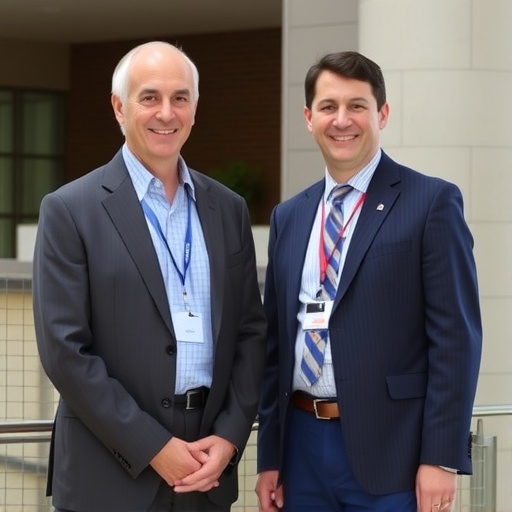
In a landmark announcement that resonates across the engineering and operations research communities, two exemplary figures—John-Paul Clarke of the University of Texas at Austin and Oleg Gusikhin of Ford Motor Company—have been inducted into the National Academy of Engineering (NAE) for their transformative contributions that have propelled their respective fields forward. This prestigious election not only honors their groundbreaking achievements but also underscores the crucial role engineering plays in addressing contemporary societal challenges, from sustainable aviation to resilient supply chain systems.
John-Paul Clarke’s pioneering research has fundamentally altered the landscape of civil aviation by advancing both its operational efficiency and environmental sustainability. His work on the development and implementation of continuous descent approaches (CDAs) represents a significant leap in reducing fuel consumption and noise pollution during aircraft landings. By optimizing flight paths to enable smoother, continuous descents rather than conventional stepped approaches, Clarke’s methodologies have dramatically lowered emissions and improved the environmental footprint of air travel worldwide.
Moreover, Clarke’s efforts in aviation systems analysis have provided policymakers and practitioners with robust frameworks that enable the integration of emerging technologies—such as next-generation air traffic management solutions and uncrewed aerial systems—into existing infrastructure. The sophisticated modeling and simulation techniques pioneered under his guidance offer indispensable tools for refining airspace design and enhancing overall traffic throughput while maintaining stringent safety standards. This has direct implications for reducing congestion delays, thereby delivering economic benefits alongside environmental gains.
On a different frontier, Oleg Gusikhin’s contributions to automotive engineering and supply chain operations embody the intricate blend of industrial engineering, data analytics, and real-time systems integration. His work in supply chain risk management has equipped global manufacturing networks with sophisticated predictive tools that assess vulnerabilities and design resilience strategies against disruptions, a critical capability in today’s volatile global economic environment. By harnessing advanced algorithms and stochastic modeling, Gusikhin’s innovations facilitate anticipatory responses to uncertainties ranging from material shortages to geopolitical crises.
Gusikhin’s impact extends deeply into production scheduling and assembly line design within automotive manufacturing, where he has introduced novel optimization frameworks that balance throughput, quality, and flexibility. These frameworks enable dynamic adjustments to production sequences based on real-time data, minimizing downtime and maximizing resource utilization. His research into connected vehicle analytics further exemplifies a forward-thinking approach to integrating vehicle-to-everything (V2X) communication with operational analytics, paving the way for smarter, safer, and more responsive automotive ecosystems.
Together, the achievements of Clarke and Gusikhin illustrate the expansive scope of engineering’s role in shaping future technologies and infrastructures. Their election to the NAE signals validation from the highest echelon of engineering authorities, affirming that their work not only meets but exceeds standards of excellence, innovation, and societal impact. The recognition also highlights the interdisciplinary synergy between operational research, data analytics, and engineering design—fields that collectively drive innovation in a complex, interconnected world.
The significance of continuous descent approaches advocated by Clarke cannot be overstated in the context of global climate change and aviation’s contribution to greenhouse gas emissions. As aviation seeks to decarbonize, operational improvements such as CDAs represent immediate, scalable interventions complementing long-term advancements like sustainable aviation fuels and electric propulsion. Clarke’s research serves as a benchmark for engineering solutions that align operational efficiency with environmental stewardship, reinforcing the imperative for holistic systems thinking.
Conversely, Gusikhin’s work addresses equally pressing challenges in industrial supply chains, where the proliferation of globalized production networks introduces both efficiency gains and heightened risks. The unprecedented disruptions witnessed during recent global crises have spotlighted the fragility of supply chains, underscoring the necessity for integrated risk-aware management systems. Gusikhin’s contributions provide essential paradigms for predictive risk assessment and agile operational adjustments, ensuring manufacturers can sustain performance amidst uncertainty.
Beyond their technical accomplishments, the careers of both Clarke and Gusikhin exemplify the importance of bridging academia, industry, and policy. Clarke’s scholarly rigor combined with collaborative engagements with regulatory bodies and aviation stakeholders illustrates a model for translating theoretical insights into practical, impactful solutions. Similarly, Gusikhin’s industry leadership at Ford demonstrates how cutting-edge research can be seamlessly integrated into large-scale manufacturing operations, enhancing competitive advantage while fulfilling societal expectations for resilient and sustainable production systems.
Their induction into the National Academy of Engineering also draws attention to the evolving nature of engineering challenges in the 21st century. As technological complexity grows, so too does the need for engineers capable of navigating interdisciplinary domains—melding systems engineering, data science, and domain expertise. Clarke and Gusikhin embody this integrative approach, leveraging complex modeling and analytics not merely to optimize systems but to innovate fundamentally new operational paradigms.
The formal induction ceremony scheduled for October 4, 2026, will celebrate these engineering luminaries alongside peers whose achievements collectively chart the future trajectory of engineering innovation. Such recognition serves not only as a personal honor but also as inspiration for emerging scholars and professionals committed to harnessing engineering for the public good. It reaffirms the essential role of the engineering profession in addressing global challenges—be it climate change mitigation, sustainable transportation, or resilient industrial ecosystems.
At the heart of this prestigious honor is INFORMS (The Institute for Operations Research and the Management Sciences), the world’s largest professional association at the nexus of operations research, artificial intelligence, analytics, and data science. INFORMS fosters the dissemination and application of cutting-edge methodologies that members like Clarke and Gusikhin exemplify. With over 12,000 members globally, the organization catalyzes advances that bridge theoretical insights with real-world problems, amplifying the societal impact of scientific innovation.
INFORMS’ commitment to interdisciplinary collaboration is reflected in its peer-reviewed journals, conferences, and certification programs that elevate standards and propagate best practices across sectors. The success of Clarke and Gusikhin underscores the practical benefits of such an ecosystem, where knowledge exchange, mentorship, and rigorous scholarship converge to create engineering breakthroughs. Their election to the NAE resonates as an affirmation of INFORMS’ mission and the vital contributions of its diverse community.
As the engineering world celebrates this milestone, the broader implications for environmental sustainability, industrial resilience, and technological progress are profound. The work of John-Paul Clarke and Oleg Gusikhin stands as a testament to the power of engineering research and its capacity to transform complex systems for a better, more efficient, and more sustainable future. Their ongoing endeavors will undoubtedly inspire ongoing innovation and serve as guiding models for generations of engineers to come.
Subject of Research: Advances in aviation systems optimization, continuous descent approaches, supply chain risk management, production scheduling, assembly line layout, and connected vehicle analytics.
Article Title: Leading Engineers John-Paul Clarke and Oleg Gusikhin Elected to National Academy of Engineering for Pioneering Innovations
News Publication Date: April 16, 2026
Web References: www.informs.org
Keywords: Civil aviation efficiency, continuous descent approach, environmental sustainability in aviation, supply chain risk management, production scheduling optimization, assembly line design, connected vehicle analytics, operations research, engineering innovation, National Academy of Engineering, INFORMS.
Tags: aviation systems analysis frameworkscontinuous descent approaches in aviationenvironmental sustainability in air travelJohn-Paul Clarke aviation researchNational Academy of Engineering inductionnext-generation air traffic managementOleg Gusikhin Ford Motor contributionsoperations research in engineeringresilient supply chain engineeringsustainable aviation technologiestransformative engineering achievementsuncrewed aerial systems integration