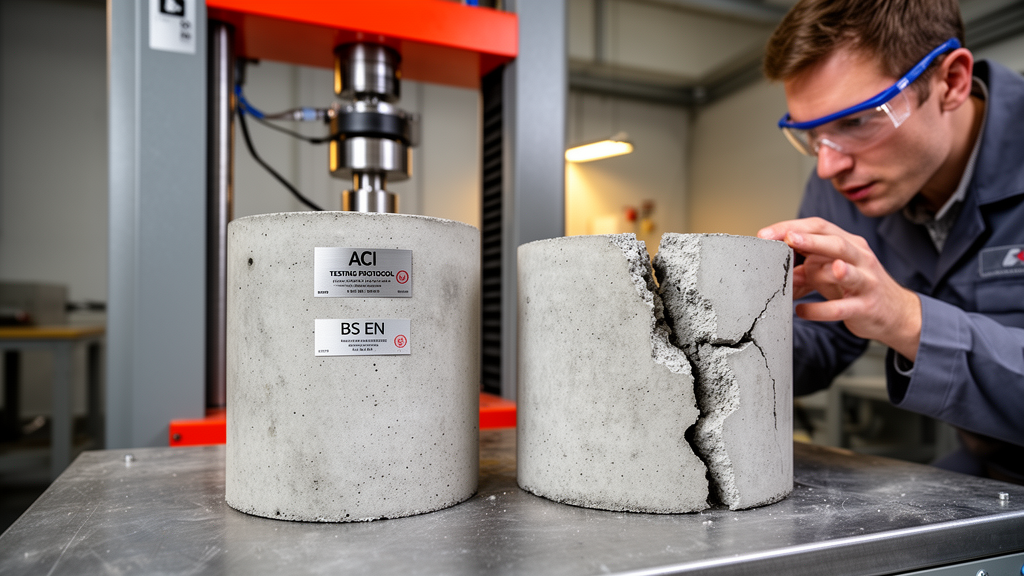
Concrete is the most widely used construction material on Earth, yet the recipes engineers use to make it are not universal. In the United States, mixes are proportioned under the American Concrete Institute’s ACI 211.1 procedure, while much of Europe and many countries in the Global South rely on the performance-based BS EN 206 standard. A new open-access study from researchers at Ghana’s CSIR-Building and Road Research Institute has put these two design philosophies head to head under strictly identical materials, target grade and testing conditions, and the results reveal a genuine trade-off between performance and sustainability rather than a clear winner.
Mark Bediako and Timothy Kofi Ametefe designed two C24/30 concretes, one by each standard, using the same ordinary Portland cement, potable tap water and well-graded natural fine and coarse aggregates. The cement was GHACEM Extra, conforming to ASTM C150 and classified CEM I 42.5 N, with a specific gravity of 3.02 and a Blaine fineness of 402 square metres per kilogram. Coarse aggregate was crushed granite with a 20 mm nominal maximum size from a quarry in the Ashanti Region, while the fine aggregate was natural pit sand with a fineness modulus of 3.00. Aggregate moisture contents of 0.60% and 0.30% were measured and used to correct batch quantities.
The proportioning differences were substantial. The ACI 211.1 mix prescribed 412 kilograms of cement per cubic metre, about 7% more than the 385 kilograms specified by BS EN 206, and adopted a water-to-cement ratio of 0.505 against 0.545 for the European method. Water demand was nearly identical, at 208 versus 210 kilograms per cubic metre. The BS EN 206 mix carried a leaner, coarser aggregate skeleton, with 1,167 kilograms of coarse aggregate per cubic metre against 963 for the ACI mix, while the ACI design used more fine aggregate, 731 versus 628 kilograms. The authors note that ACI’s cement-rich approach is consistent with earlier comparative findings that the American method generally prescribes higher cement contents.
Both mixes hit their workability targets, with measured slumps of 95 mm for the ACI concrete and 90 mm for the BS EN concrete, and both fell in the expected range for normal-weight fresh concrete. The strength story, however, diverged sharply. At early ages the ACI mix was approximately 32%, 28% and 25% stronger than the BS EN mix at 1, 3 and 7 days respectively, an advantage the researchers attribute to its lower water-to-cement ratio and higher cement content accelerating hydration and calcium silicate hydrate formation. At 28 days the ACI mix reached roughly 34.5 MPa against about 30.2 MPa, a 12% improvement, and it remained 20% and 18% ahead at 60 and 90 days.
The statistical picture is more nuanced than the raw numbers suggest. A two-sample t-test across all curing ages found the difference in mean compressive strength, 31.2 MPa for ACI versus 24.73 MPa for BS EN 206, to be statistically insignificant, with t(10) = 1.18 and p = 0.265. The authors explain that substantial strength variation across the six curing ages inflated within-group variance and reduced the test’s ability to detect differences. They argue the consistently higher ACI values at every age still represent a practically relevant performance difference under the experimental conditions. Flexural strength told a different story entirely: overall means were identical at 5.63 MPa for both mixes, yielding a t-statistic of zero and a p-value of 1.0, indicating no detectable difference in overall flexural performance.
Durability testing favoured the ACI mix across nearly every transport property measured at 28 days. Sorption was 0.646 versus 0.692, porosity 5.570% versus 6.283%, water absorption 2.322% versus 2.589%, and rapid chloride permeability 2,787 coulombs versus 2,884 coulombs. Both mixes fell within the moderate chloride ion ingress classification, and surface resistivity measured by Wenner four-point probe was 14.6 kilohm-centimetres for the ACI mix against 13.5 for the BS EN mix, also both moderate. Sorptivity showed the widest gap: the BS EN mix absorbed water at a total rate of 0.0391 mm per square root second, roughly 33% faster than the ACI mix’s 0.0265, with an initial absorption rate nearly double that of the American-designed concrete.
Acid resistance produced the study’s most counterintuitive result. After 28 days immersed in a 5% sulphuric acid solution, the ACI mix lost up to 9.69% of its mass, well above the 5.65% loss of the BS EN mix, though both satisfied the ASTM C267 acceptance limit of 15%. The authors attribute the greater mass loss to the ACI mix’s higher cement content, which supplied a larger volume of acid-reactive hydrates vulnerable to dissolution; photographs showed cement paste leached from the ACI specimens, leaving a coarse aggregate skeleton. Yet when compressive strength change was quantified, the ACI mix recorded a slightly lower factor of 58.19% versus 59.55% for BS EN 206, suggesting better retention of internal load-bearing capacity, possibly because its lower water-to-cement ratio limited transport of aggressive species into the matrix even as its surface dissolved faster.
The sustainability accounting tipped the balance back toward the European method. Using a cradle-to-gate life cycle assessment with a functional unit of one cubic metre of concrete produced in Kumasi, and transport distances of 263 kilometres for cement, 26 kilometres for coarse aggregate and 18.3 kilometres for sand, the researchers calculated total embodied carbon of 461 kilograms of CO2-equivalent per cubic metre for the ACI mix against 436 for the BS EN mix, about a 5% difference driven almost entirely by the extra 27 kilograms of cement. Cement dominated the emissions profile for both mixes, contributing roughly 80% of the total, while the BS EN mix’s larger aggregate mass could not offset the carbon savings of its leaner binder content. Cost followed the same pattern: the ACI mix came in at GH₵ 1,444.04 (US$ 117.90) per cubic metre versus GH₵ 1,400.37 (US$ 114.33), a 3.1% premium attributable mainly to cement, which cost GH₵ 988.8 versus GH₵ 924.0.
The authors are careful to frame their conclusions within a defined scope. Durability mechanisms were interpreted from standardized transport properties without complementary microstructural characterization such as SEM, XRD or mercury intrusion porosimetry, a limitation they plan to address in future work. Only one target strength class and one set of constituent materials were tested, three replicate specimens were used per condition, and the study deliberately used ordinary Portland cement and natural aggregates to isolate the effect of the design standards themselves. They also note that while the BS EN mix is more carbon-efficient at the production stage, the ACI mix’s superior durability could translate into longer service life and reduced maintenance, potentially offsetting its higher initial emissions over a structure’s lifecycle.
The practical recommendation is a matter of matching the standard to the priority. Where high strength and durability are critical, the ACI 211.1 approach delivered measurably denser, stronger and less permeable concrete in this controlled comparison. Where cost and carbon footprint dominate, BS EN 206 produced a leaner mix with only modestly lower strength and durability indices at a 3% cost saving and 5% carbon saving. The researchers also point to a broader lever: since cement drives both cost and embodied carbon, reducing binder content through supplementary cementitious materials, without compromising performance, remains the most promising route to reconciling the two standards’ competing advantages.
Subject of Research: Comparative experimental evaluation of concrete mixes designed to ACI 211.1 and BS EN 206 standards
Article Title: Performance and sustainability of concrete mixes designed by ACI 211 and BS EN 206
Article References: Bediako, M., & Ametefe, T. K. (2026). Performance and sustainability of concrete mixes designed by ACI 211 and BS EN 206. Discover Concrete and Cement, 2(1), Article 90. https://doi.org/10.1007/s44416-026-00131-y
Image Credits: AI Generated
DOI: 10.1007/s44416-026-00131-y
Keywords: concrete, mix design, ACI 211.1, BS EN 206, compressive strength, durability, embodied carbon, chloride permeability, acid attack, cost analysis, C24/30, sustainability
News Source: Denise Maddox. (October 28, 2026). Two Concrete Design Standards, One Grade: ACI Beats BS EN on Strength but Costs More Carbon. Scienmag.