• HOME
  • NEWS
  • EXPLORE
    • CAREER
      • Companies
      • Jobs
    • EVENTS
    • iGEM
      • News
      • Team
    • PHOTOS
    • VIDEO
    • WIKI
  • BLOG
  • COMMUNITY
    • FACEBOOK
    • INSTAGRAM
    • TWITTER
Monday, May 11, 2026
BIOENGINEER.ORG
No Result
View All Result
  • Login
  • HOME
  • NEWS
  • EXPLORE
    • CAREER
      • Companies
      • Jobs
        • Lecturer
        • PhD Studentship
        • Postdoc
        • Research Assistant
    • EVENTS
    • iGEM
      • News
      • Team
    • PHOTOS
    • VIDEO
    • WIKI
  • BLOG
  • COMMUNITY
    • FACEBOOK
    • INSTAGRAM
    • TWITTER
  • HOME
  • NEWS
  • EXPLORE
    • CAREER
      • Companies
      • Jobs
        • Lecturer
        • PhD Studentship
        • Postdoc
        • Research Assistant
    • EVENTS
    • iGEM
      • News
      • Team
    • PHOTOS
    • VIDEO
    • WIKI
  • BLOG
  • COMMUNITY
    • FACEBOOK
    • INSTAGRAM
    • TWITTER
No Result
View All Result
Bioengineer.org
No Result
View All Result
Home NEWS Science News Biology

Turning off growth to make flowers grow

Bioengineer by Bioengineer
May 13, 2019
in Biology
Reading Time: 3 mins read
0
IMAGE
Share on FacebookShare on TwitterShare on LinkedinShare on RedditShare on Telegram

IMAGE

Credit: Toshiro Ito

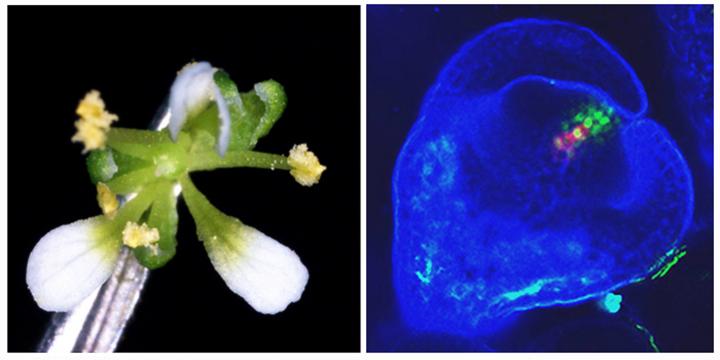
The beautiful colors and smells of flowers serve a much greater purpose than just decorating one’s home. Flowers are where the plant’s reproductive organs are found, and those same colors and smells that make a room beautiful also attract bees and other animals for pollination. Floral stem cells are crucial for the growth of the flower and its organs. That growth must eventually terminate for the flower to fully develop and set seeds. A new study led by scientists at the Nara Institute of Science and Technology (NAIST) and seen in The Plant Cell shows that the transcription factor KNUCKLES is a key regulator of this stem cell arrest by initiating a serious of epigenetic events to repress the stem cell determinant WUSCHEL.

“Floral stem cell activity vanishes when WUSHCEL is suppressed and silenced through changes in its chromatin state. What we did not know was how this change begins and how it is sustained,” explains NAIST Professor Toshiro Ito, who led the study.

Ito’s team looked at the activation and suppression of floral stem cells from Arabidopsis. Stem cell activation was marked by a clear expression of WUSCHEL, but that changed when the cells also began to express KNUCKLES, which bound to the WUSCHEL locus and led to WUSCHEL‘s expression almost halving four hours later.

Then at 8-12 hours after the KNUCKLES expression, the group found that the WUSCHEL locus showed signs of H3K27me3 histone methylation, a marker of sustained gene suppression.

The question Ito wanted to answer was what were the events that took place from the KNUCKLES binding to the WUSCHEL locus to the H3K27me3 histone methylation that could terminate the stem cell activation.

“H3K27me3 is catalyzed by Polycomb Group complexes, but nothing is known about how the complexes are recruited to the WUSCHEL locus,” says Ito.

The researchers discovered that KNUCKLES binding to WUSCHEL jettisoned SPLAYED, a chromatin remodeling protein that activates WUSCHEL. This effect leads to rapid transcriptional repression of WUSCHEL, followed by the recruitment of Polycomb Group complex to WUSCHEL, where it formed H3K27me3 marks on the chromatin to suppress gene expression.

“KNUCKLES binding was essential for the rapid removal of active H3K4me3 marks and the following deposition of repressive H3K27me3 marks,” explains Ito.

The recruitment was done by KNUCKLES interacting with a specific component of the Polycomb Group complex known as FERTILIZATION-INDEPENDENT ENDOSPERM.

“Our study reveals the temporal steps from KNUCKLES binding to H3K27me marks that silence the WUSCHEL chromatin. Understanding how stem cell activation is terminated will assist in new food technologies,” says Ito.

###

Resource

Title: Integration of transcriptional repression and Polycomb-mediated silencing of WUSCHEL in floral meristems

Authors: Bo Sun, Yingying Zhou, Jie Cai, Erlei Shang, Nobutoshi Yamaguchi, Jun Xiao, Liang-Sheng Looi, Wan-Yi Wee, Xiuying Gao, Doris Wagner & Toshiro Ito

Journal: The Plant Cell

DOI: 10.1105/tpc.18.00450

Media Contact
Takahito Shikano
[email protected]

Related Journal Article

http://dx.doi.org/10.1105/tpc.18.00450

Tags: BiologyGenesMolecular BiologyPlant Sciences
Share12Tweet8Share2ShareShareShare2

Related Posts

From Complexity to Clarity: Unraveling the “Topological Laws” Governing Cell Death — Biology

From Complexity to Clarity: Unraveling the “Topological Laws” Governing Cell Death

May 11, 2026
New Classification Framework Identifies Tumor-Associated Bacterial Effectors as Crucial Drivers of Tumor Biology and Immune Response — Biology

New Classification Framework Identifies Tumor-Associated Bacterial Effectors as Crucial Drivers of Tumor Biology and Immune Response

May 11, 2026

HIV-1 Strains Reveal Varied Paths to Antibody Escape

May 11, 2026

CRISPRi Screening Identifies Fungal-Specific Drug Targets

May 11, 2026
Please login to join discussion

POPULAR NEWS

  • Research Indicates Potential Connection Between Prenatal Medication Exposure and Elevated Autism Risk

    841 shares
    Share 336 Tweet 210
  • New Study Reveals Plants Can Detect the Sound of Rain

    728 shares
    Share 290 Tweet 182
  • Salmonella Haem Blocks Macrophages, Boosts Infection

    62 shares
    Share 25 Tweet 16
  • Breastmilk Balances E. coli and Beneficial Bacteria in Infant Gut Microbiomes

    57 shares
    Share 23 Tweet 14

About

We bring you the latest biotechnology news from best research centers and universities around the world. Check our website.

Follow us

Recent News

Humans and Zebra Finches Share Similar Speech Learning Techniques #ASA190

New Study Uncovers How Fungal Parasites Attack Strawberries and Raspberries

City of Hope Researchers to Present Groundbreaking Immunotherapy and Precision Medicine Advances Across Multiple Cancer Types at ASCO 2026

Subscribe to Blog via Email

Enter your email address to subscribe to this blog and receive notifications of new posts by email.

Join 82 other subscribers
  • Contact Us

Bioengineer.org © Copyright 2023 All Rights Reserved.

Welcome Back!

Login to your account below

Forgotten Password?

Retrieve your password

Please enter your username or email address to reset your password.

Log In
No Result
View All Result
  • Homepages
    • Home Page 1
    • Home Page 2
  • News
  • National
  • Business
  • Health
  • Lifestyle
  • Science

Bioengineer.org © Copyright 2023 All Rights Reserved.