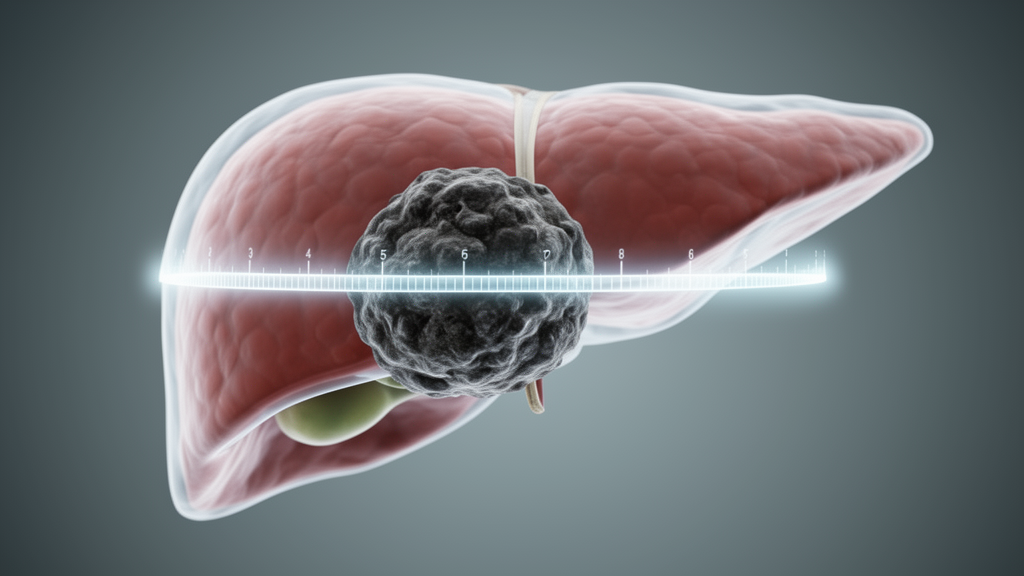
In a retrospective study evaluating yttrium-90 radiation segmentectomy for hepatocellular carcinoma, tumor diameter emerged as an independent predictor of complete treatment response, while the absorbed radiation dose threshold alone lost predictive significance in adjusted models. Researchers investigated whether delivering a perfused liver absorbed dose of at least 400 Gray is universally sufficient across different tumor dimensions, finding that baseline lesion size critically influences the likelihood of achieving complete radiological response.
The cohort study evaluated fifty-five patients with sixty-seven target lesions treated with yttrium-90 glass microspheres between June 2022 and June 2025. Eligible participants met the Barcelona Clinic Liver Cancer 2026 stage A or B criteria, with all treated target lesions measuring eight centimeters or less in diameter. Within the cohort, the mean patient age was 65 plus or minus 7.8 years, and 72.7 percent of the treated patients were male.
To investigate prognostic discrimination, the researchers tested a modified Barcelona Clinic Liver Cancer classification using a three-centimeter cutoff for solitary tumors. Solitary lesions within standard stage A measuring three centimeters or smaller were categorized as modified stage A, whereas solitary tumors larger than three centimeters were reclassified together with multinodular stage B cases into modified stage B. The primary endpoint was complete response at six months assessed by modified Response Evaluation Criteria in Solid Tumors at both the overall patient level and the localized lesion level.
Baseline measurements indicated a median target lesion diameter of 4.2 centimeters, with an interquartile range of 2.8 to 5.2 centimeters, encompassing 31.3 percent of lesions measuring three centimeters or smaller and 68.7 percent exceeding three centimeters. The overall mean perfused liver absorbed dose delivered to target liver tissue was 494 plus or minus 175 Gray. At the six-month evaluation mark, complete response was confirmed in 49.1 percent of patients, representing 27 of 55 individuals, and in 53.7 percent of target lesions, representing 36 of 67 treated tumors.
Stratification by staging models revealed significant differences in response discrimination between classification schemes. Patients in the modified stage A group achieved a 92.3 percent complete response rate, compared with 35.7 percent among patients in modified stage B, yielding a highly significant distinction. Under the standard 2026 staging framework, the difference between stage A and stage B was more modest, at 60 percent versus 30 percent. In multivariate logistic regression analysis, standard staging lost statistical significance, whereas modified stage A remained an independent predictor of complete response with an odds ratio of 17.3.
Lesion-specific outcomes mirrored the patient-level trends, with lesions measuring three centimeters or smaller achieving a complete response rate of 90.5 percent, compared to 37.0 percent for lesions larger than three centimeters. This disparity occurred despite comparable radiation exposure between the groups, as smaller lesions received a mean dose of 499 Gray compared to 491 Gray in larger tumors. In multivariate modeling, a perfused liver absorbed dose exceeding 400 Gray lost statistical significance, while a lesion diameter of three centimeters or smaller remained an independent predictor of complete response with an odds ratio of 14.4.
The study authors concluded that tumor size is a critical determinant alongside absorbed radiation dose when evaluating response probabilities following radiation segmentectomy. Incorporating a three-centimeter cutoff for solitary lesions provides improved discrimination of complete response compared to the standard staging system, underscoring that anatomical lesion dimensions remain essential when planning radioembolization in hepatocellular carcinoma.
To evaluate the independent determinants of radiological success, the researchers performed univariate and multivariate logistic regression analyses with complete uncertainty measures. In the multivariate model examining patient-level outcomes, the modified Barcelona Clinic Liver Cancer stage A classification remained an independent predictor of complete response, yielding an odds ratio of 17.3 with a 95 percent confidence interval of 1.9 to 158 and a p-value of 0.011. In contrast, the standard 2026 staging framework lost statistical significance in multivariate testing, showing a p-value of 0.463. At the individual lesion level, a baseline diameter of three centimeters or smaller was confirmed as an independent predictor of complete response, registering an odds ratio of 14.4 with a 95 percent confidence interval between 2.9 and 70.8 and a p-value of 0.001. Under the same multivariate model, delivering a perfused liver absorbed dose above 400 Gray produced an odds ratio of 2.5 with a non-significant p-value of 0.124.
The investigative findings also demonstrated the limits of physical dosimetry when predicting treatment efficacy across different tumor sizes. Although lesions measuring three centimeters or smaller received an average dose of 499 Gray compared with 491 Gray for larger tumors, this small variation was not statistically significant, yielding a p-value of 0.864. Nevertheless, smaller lesions attained a 90.5 percent complete response rate versus 37.0 percent in larger lesions, achieving significance with a p-value below 0.001. Across the whole cohort, the authors emphasized that the retrospective analysis was limited to fifty-five patients with sixty-seven target tumors measuring eight centimeters or less, and that assessing response at both the patient and lesion levels using modified Response Evaluation Criteria in Solid Tumors at six months confirms that tumor diameter provides essential prognostic value beyond radiation dosage alone.
Subject of Research: Predictors of complete response after radiation segmentectomy in hepatocellular carcinoma
Article Title: Is 400 Gy enough for every tumor? The 3 cm cutoff and a modified BCLC classification for predicting complete response after radiation segmentectomy in hepatocellular carcinoma
Article References: Kaya, E. M., Esen Akkaş, B., Erdim, Ç., Dablan, A., Arslan, M. F., Şin, C., Kapucu, H. B., Dere, A. B., & Kaya, M. (2026). Is 400 Gy enough for every tumor? The 3 cm cutoff and a modified BCLC classification for predicting complete response after radiation segmentectomy in hepatocellular carcinoma. EJNMMI Research. https://doi.org/10.1186/s13550-026-01508-7
Image Credits: AI Generated
DOI: 10.1186/s13550-026-01508-7
Keywords: hepatocellular carcinoma, radiation segmentectomy, yttrium-90, tumor diameter, BCLC staging, mRECIST response, absorbed dose, interventional oncology, enough, every, tumor, cutoff
News Source: Nathaniel Bowman. (November 10, 2026). Tumor Diameter Outperforms Radiation Dose in Predicting Liver Cancer Response. Scienmag.