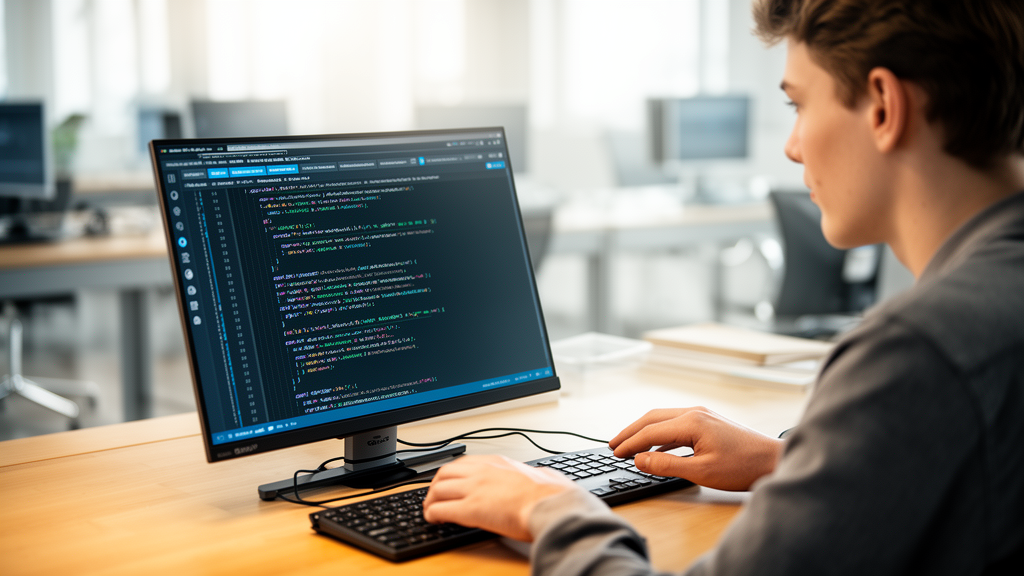
Researchers at the Institute of Theoretical and Computational Physics at Graz University of Technology (TU Graz) have developed an interactive learning platform called computor, which deploys an artificial intelligence tutor designed to guide students through programming exercises without providing direct solutions. Led by Christopher Albert, the development team created the browser-based environment to address the pedagogical challenges arising as artificial intelligence systems become increasingly capable of generating complete computer programmes independently. By focusing on guided problem-solving, the platform aims to ensure that university students build a foundational understanding of how computer code operates, while also acquiring the analytical skills necessary to identify and troubleshoot software errors autonomously.
The system is already actively deployed in formal academic instruction, including the “Programming in Physics” course at TU Graz, and has simultaneously been made available to the general public. Modern university education faces an emerging dilemma where generative tools can easily complete coding coursework on behalf of learners, potentially preventing them from mastering core technical competencies. The computor platform addresses this educational shift by training students to use modern computational tools critically and effectively, ensuring they understand the underlying logic of the algorithms they deploy rather than simply outsourcing their coursework to automated engines.
At the technical core of the platform is an artificial intelligence tutor named Lena, which is integrated directly into the programming workspace. When learners encounter difficulties or become stuck while completing an assigned programming task, Lena provides tailored guidance based on the context of the exercise. The digital tutor is informed about the specific requirements of the assignment as well as the actual lines of code written by the student up to that point. This contextual awareness allows Lena to deliver targeted pedagogical hints and troubleshooting strategies, adhering strictly to a system architecture that deliberately withholds pre-computed or ready-made answers.
As explained by project leader Christopher Albert, the primary objective is to encourage students to resolve programmatic issues through their own reasoning rather than relying passively on artificial intelligence for answers. According to the research group, learners must first establish core programming competencies, such as the numerical routines required for physics calculations, before they can progressively develop the independence and critical judgment needed to employ artificial intelligence tools professionally in scientific and technical disciplines.
Beyond interactive guidance, computor incorporates an automated validation engine that verifies whether user-submitted programmes yield expected numerical results. In degree programmes such as physics, this automated control mechanism is applied in specialized disciplines like plasma physics. Before students are granted access to conduct physical laboratory experiments, they are required to simulate and calculate the relevant physical processes using computer code they have written themselves. The computor platform automatically evaluates the precision of these computational outputs and assists students in isolating programmatic bugs when calculations fail.
The integration of automated checking mechanisms is also designed to relieve teaching staff of routine evaluation tasks. Through a centralized administration dashboard, instructors can configure bespoke courses, organize assignments, and continuously monitor student learning metrics. The management interface records analytical data, such as the total number of attempts required to solve an exercise, whether students engage with course assignments consistently or postpone their work until deadlines approach, and instances where assignments are finished unusually fast. These metrics enable educators to identify learning bottlenecks at an early stage and intervene with tailored pedagogical support.
The developers emphasize that automated assistance is not intended to substitute for personal teaching support. Instead, automating routine code reviews allows human tutors to dedicate instructional hours toward in-depth technical discussions and qualitative assessments of student comprehension. Concurrently, students retain continuous access to Lena whenever immediate assistance is required outside conventional teaching hours. Furthermore, because the AI tutor operates directly on TU Graz’s own computing infrastructure, students can access the learning aid without requiring personal subscriptions or accounts with commercial artificial intelligence providers.
Supported by funding from the “netidee” initiative run by the Austrian Internet Foundation, the development team expanded computor into an open, web-based platform accessible to external learners. The underlying source code has been published as open-source software, and users can access the complete programming environment at computor.at without installing additional local software dependencies. The platform is targeted primarily at individuals requiring programming skills for applications in the natural sciences, engineering, and data analysis, and currently offers three introductory data science courses based on Python featuring 70 practical exercises that external schools, universities, and companies can adapt for their own instructional needs.
Subject of Research: AI-guided programming education platform developed at Graz University of Technology
Article Title: AI tutor from Graz University of Technology as a programming learning aid
Article References: AI tutor from Graz University of Technology as a programming learning aid. Original publication (Bibliographic details unavailable.)
Image Credits: AI Generated
DOI: Not provided
Keywords: Graz University of Technology, TU Graz, computor, AI tutor, Lena, programming education, Christopher Albert, Institute of Theoretical and Computational Physics, Python programming, plasma physics, data science, netidee, Austrian Internet Foundation, open source software, educational technology, computor.at, browser-based learning
News Source: Katie Riggs. (November 19, 2026). TU Graz Launches Open AI Tutor Computor for Coding Instruction. Scienmag.