Credit: Mario Bretfeld
Tropical trees respond to drought differently depending on their ages, according to new research led by a postdoctoral scientist at the University of Wyoming.
Mario Bretfeld, who works in the lab of UW Department of Botany Professor Brent Ewers, is the lead author of an article that appears today (Monday) in the journal New Phytologist, one of the top journals in the field of plant controls over the water cycle. The research was conducted in collaboration with the Smithsonian Tropical Research Institute (STRI).
"The paper provides some very interesting insights into how forest age interacts with drought to determine how much water is produced from tropical forests," Ewers says. "This work has implications for the operation of the Panama Canal, as well as providing fundamental insights into how forests control the water cycle."
The research team compared responses to drought in 8-, 25- and 80-year-old forest patches in the Agua Salud project, a 700-hectare land-use experiment collaboration with the Panama Canal Authority, Panama's Ministry of the Environment and other partners. The team measured water use in 76 trees representing more than 40 different species in forests of different ages in the Panama Canal watershed during an especially extended drought resulting from El Niño conditions in 2015 and 2016.
The information gained from the study is critical to understanding how tropical forests respond to the severe and frequent droughts predicted by climate change scenarios, says Jefferson Hall, staff scientist at STRI. He notes that, globally, 2016 registered as the warmest year since climate records began to be compiled.
"Droughts can be really hard on tropical forests," Hall says. "Too much heat, low humidity and not enough water can drastically alter which trees survive. We found that forest age matters."
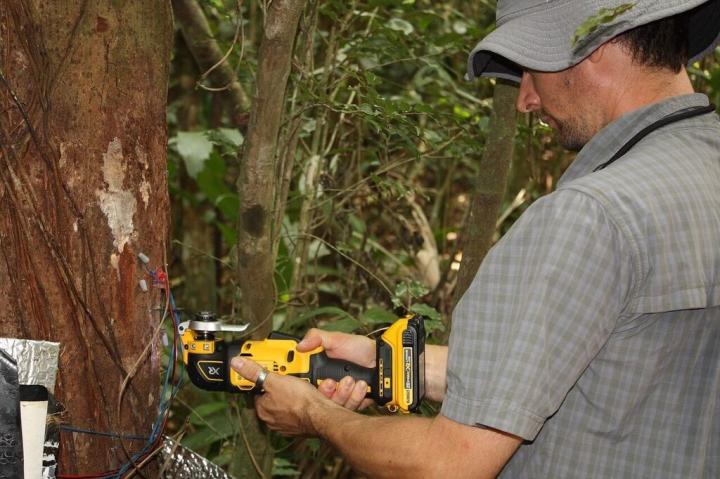
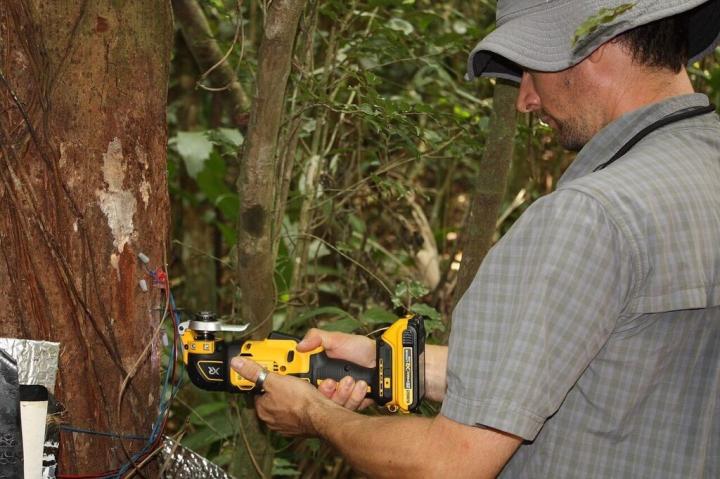
Water moves from soil into roots, through stems and branches into tree leaves, where some of it is used for photosynthesis. Most of this water is released into the atmosphere — a process called transpiration. Transpiration, or plant water use, can be measured using sap flow sensors in the stem.
"Transpiration is regulated by external factors — for example, how dry the atmosphere is and how much water is available in the soil — as well as internal factors, such as differences in the structure and function of wood and leaves," Bretfeld says. "Our results indicate that the factors most important for regulation of transpiration in young forests had to do with their ability to access water in the soil, whereas older forests were more affected by atmospheric conditions."
During the record drought, water use increased significantly in the oldest forests, whose expansive root systems supplied trees with water from deep soil layers and allowed for maintenance of transpiration on typically sunny and hot days. Trees in younger forests suffered from a lack of water, probably because their shallower root systems could not access water stored deeper in the ground. In response, trees in younger forests regulated the amount of water they were using during the dry period.
"All trees are not created equal. Their species and age matter. We are working on designing techniques we're calling 'smart reforestation,' making decisions about which tree species to plant to achieve different land-use objectives," Hall says. "This study is the perfect example of the link between basic and applied science, because it highlights the need to consider drought tolerance as we reforest wet, yet drought-prone areas."
###
This research was made possible with funding from the U.S. National Science Foundation, Stanley Motta, the Silicon Valley Foundation and the Heising-Simons Foundation.
STRI, headquartered in Panama City, Panama, is a unit of the Smithsonian Institution. The institute furthers the understanding of tropical biodiversity and its importance to human welfare; trains students to conduct research in the tropics; and promotes conservation by increasing public awareness of the beauty and importance of tropical ecosystems.
Media Contact
Brent Ewers
[email protected]
307-766-2625
http://www.uwyo.edu
Original Source
http://www.uwyo.edu/uw/news/2018/03/uw-research-tropical-forest-response-to-drought-depends-on-age.html http://dx.doi.org/10.1111/nph.15071