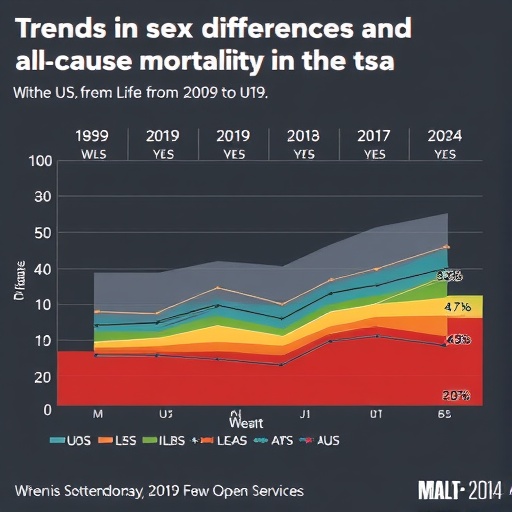
A groundbreaking cohort study drawing on data from 47,000 adults in the National Health and Nutrition Examination Survey has unveiled a significant sex-based disparity in mortality risk, after comprehensive adjustments for a broad spectrum of demographic, behavioral, and clinical variables. This meticulous analysis reveals that males exhibit a 63% greater risk of all-cause mortality compared to females, a finding that persists beyond factors such as age, race and ethnicity, smoking habits, alcohol consumption, and chronic disease conditions including diabetes and hypertension.
This study’s robust design accounts for potential confounders, strengthening the hypothesis that intrinsic biological differences between sexes contribute substantially to mortality divergence. Unlike earlier observational studies that were often limited by insufficient control of confounding variables, this research leverages comprehensive longitudinal data and advanced statistical modeling, providing an unprecedented depth of insight into the biological underpinnings of sex-related mortality disparities.
Sex differences in mortality have long been a subject of epidemiological interest, with males typically experiencing higher mortality rates across a wide range of populations and diseases. However, the mechanisms driving this discrepancy remain elusive. This research posits that intrinsic biological factors—such as the influence of sex hormones like estrogens and androgens, the differential chromosomal constitution (XX in females versus XY in males), and sex-specific variations in immune function—may fundamentally shape survival outcomes.
Sex hormones have been shown to modulate numerous physiological processes, including cardiovascular health, metabolic regulation, and immune responses. Estrogens, predominant in females, often confer protective vascular effects and enhance immune surveillance, potentially contributing to their survival advantage. In contrast, androgens, more abundant in males, have been implicated in increased susceptibility to cardiovascular diseases and may dampen immune responsiveness, rendering males more prone to infections and inflammatory conditions.
Chromosomal differences also exert critical influence through gene dosage effects and the expression of sex-linked genes. The presence of two X chromosomes in females provides a buffer against deleterious mutations that can elevate vulnerability to disease, while the single X chromosome in males may leave them more exposed to genetic disorders and mortality risks. Additionally, the Y chromosome harbors genes implicated in male-specific immune modulation and inflammatory pathways, further complicating the biological landscape of sex-specific mortality.
Immune system variability represents another crucial avenue through which sex differences in mortality may arise. Females generally display higher basal and adaptive immune responses, affording improved defense against pathogens but also increasing susceptibility to autoimmune disorders. Males, conversely, tend to have a comparatively subdued immune profile, which may impair pathogen clearance and exacerbate mortality risks. The interplay between immune competence and sex hormones underlines the complex biological architecture influencing survival.
This study’s implications extend beyond the academic realm, informing public health policies and clinical practices aimed at reducing sex-differential mortality. Understanding the biological basis of these differences could pioneer precision medicine approaches tailored to sex-specific risk profiles. For instance, therapeutic strategies modulating hormonal pathways or immune function might be customized to optimize male survival rates.
Moreover, by integrating behavioral and chronic disease factors into the analytical model, the research underscores that lifestyle modifications and chronic disease management, while crucial, do not fully mitigate the male mortality disadvantage. This suggests an imperative to foster biomedical research into intrinsic mechanisms, such as molecular and genetic underpinnings of sex disparities, which remain underexplored yet potentially transformative.
The cohort’s diversity, encompassing various racial and ethnic groups, further bolsters the generalizability of the findings across the heterogeneous U.S. population. It also highlights the intersectionality of sex with other sociodemographic determinants, inviting future inquiry into how integrated biological and social factors collectively influence mortality trends.
Importantly, this study sets the stage for next-generation research exploring sex-linked biological factors in greater mechanistic detail. Potential avenues encompass genomics, transcriptomics, epigenetics, and systems biology approaches to decode how sex chromosome composition and hormonal milieus orchestrate complex physiological networks affecting longevity.
The researchers advocate for enhanced interdisciplinary collaborations bridging epidemiology, molecular biology, endocrinology, and immunology to unravel the multifactorial nature of sex-specific mortality risk. Such integrative efforts could spur breakthroughs in understanding mortality disparities and unveil novel biomarkers or targets for intervention.
In conclusion, this landmark investigation not only quantifies the male survival disadvantage at a population level but also frames an urgent research agenda to probe the underlying biological determinants. Its findings serve as a clarion call to the scientific community to delve deeper into sex-specific biology as a pivotal element shaping human health and lifespan.
Corresponding author Dr. Sarah S. Jackson encourages the scientific community to leverage these insights and advance research elucidating hormonal, chromosomal, and immunological contributions to sex differences in mortality. Addressing these gaps holds promise for devising innovative strategies to narrow longevity disparities and improve population health equitably.
Subject of Research: Intrinsic biological factors underlying sex differences in all-cause mortality risk among U.S. adults.
Article Title: [Not provided in the content]
News Publication Date: [Not provided in the content]
Web References: [Not provided in the content]
References: doi:10.1001/jamanetworkopen.2025.56299
Image Credits: [Not provided in the content]
Keywords: Mortality rates, Sex ratios, United States population, Demography, Adults, Diabetes, Hypertension, Risk factors, Behaviorism, Age groups, Racial differences, Ethnicity, Smoke, Alcoholism, Cohort studies, Hormones, Bioactivity, Womens studies
Tags: all-cause mortality trendsbiological factors in mortalitychronic disease impacts on mortalitydemographic health disparitiesfemale mortality ratesintrinsic biological differences in healthlongitudinal studies on mortalitymale mortality riskNational Health and Nutrition Examination Surveysex differences in mortalitysex hormones and health outcomesstatistical modeling in epidemiology