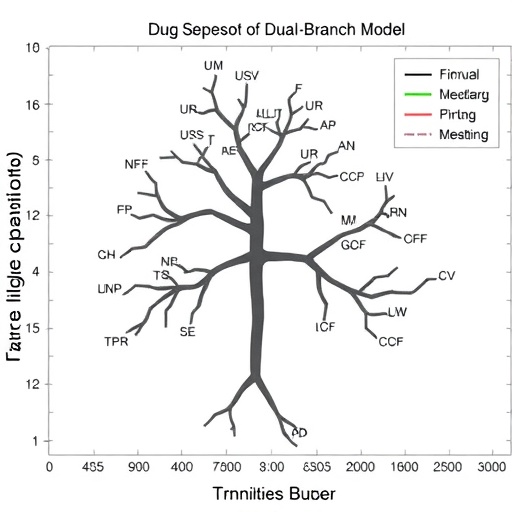
In an age where the intersection of artificial intelligence and biology is becoming increasingly pivotal, a groundbreaking study published in Nature Machine Intelligence has illuminated a novel approach to understanding drug-induced cellular responses. The research, conducted by an accomplished team including Guo, Zhang, and Hu, proposes a dual-branch transformer model that could revolutionize the way we evaluate the perturbations caused by various pharmaceuticals at the cellular level. This advancement comes at a crucial time when precision medicine is on the rise, necessitating more refined predictions about how drugs will interact with complex biological systems.
The research indicates that traditional methods of studying drug responses often fall short due to their inability to comprehensively account for the multifaceted nature of cellular systems. The authors of the study highlight the limitations of previous models, which often either oversimplify biological processes or lack the computational power necessary to accurately predict outcomes. This new dual-branch transformer model addresses these shortcomings by integrating biological principles with advanced machine learning techniques, enabling a more nuanced analysis of cellular responses to drug treatments.
At the heart of this innovation is the dual-branch structure of the transformer model, which marries graph-based learning with sequence-based approaches. The researchers harness the potential of graph neural networks to capture the complex networks of interactions between proteins, genes, and other cellular components during drug exposure. This is complemented by transformer architectures that specialize in natural language processing, facilitating the modeling of temporal dynamics and the sequential nature of biological events. The synergy of these two methodologies presents a sophisticated tool for predicting how cells will react to various therapeutic agents.
The implications of this research extend far beyond mere academic interest. As the pharmaceutical industry increasingly relies on complex data for drug discovery and development, the ability to accurately model cellular responses could significantly streamline the process. By better understanding how different drugs elicit specific cellular reactions, researchers can optimize drug formulations and tailor therapies to individual patient profiles. This move towards personalization in medicine could not only enhance efficacy but also minimize adverse effects, ultimately improving patient outcomes.
In addition to its immediate applicability in drug development, the dual-branch transformer model holds potential for broader applications in pharmacovigilance and drug repurposing. The ability to swiftly and accurately assess how drugs impact cellular systems could aid regulatory bodies in evaluating the safety profiles of existing medications. Furthermore, the knowledge gained from cellular perturbation modeling may uncover new uses for well-established drugs, providing an expeditious path to novel treatments without the need for full re-approval processes.
The study employed extensive datasets derived from various cellular perturbation experiments to train the dual-branch model. This comprehensive approach not only reinforced the robustness of the findings but also elucidated patterns that might be overlooked by conventional analysis methods. The researchers meticulously analyzed the input features that define the model, ensuring that both biological relevance and computational efficacy are maintained. This dual emphasis on science and technology exemplifies the future of biomedical research, where interdisciplinary collaboration drives innovation.
As the dual-branch transformer model gains traction, further research will be needed to validate its predictive capabilities across diverse biological contexts. For instance, ongoing studies are expected to incorporate a wider array of cell types, drug classes, and perturbation experiments. These efforts will culminate in a more holistic understanding of cellular dynamics, and the hope is that this advancing knowledge will prompt systematic changes in how drugs are tested and approved.
In a climate where collaborative efforts lead to exponential gains in knowledge, the partnership between data scientists, biologists, and pharmacologists will be essential to fully leverage the potential of the dual-branch transformer. This holistic approach could serve as a blueprint for future innovations in the biosciences, drawing upon the strengths of multiple disciplines to create more comprehensive and accurate predictive models.
The authors emphasize that by continuously refining the model’s parameters with new data, the adaptability of the dual-branch transformer will be instrumental in accommodating the ever-evolving landscape of drug discovery. This dynamic nature allows the model not only to improve its performance over time but also to remain relevant as new therapeutic modalities emerge.
Moreover, the researchers anticipate that the model will soon be integrated into virtual environments that simulate drug interactions in silico. Such platforms could dramatically reduce the time and cost associated with preclinical studies, paving the way for more rapid advancements in translational medicine. As a result, researchers may be able to bring promising therapies from the laboratory bench to the bedside with unprecedented efficiency.
Finally, the study represents a significant stepping stone in the ongoing dialogue about the role of artificial intelligence in the life sciences. The dual-branch transformer model is not just a technological feat; it embodies a philosophical shift towards embracing computational tools as vital partners in biological research. As we continue to explore the complexities of life at the cellular level, it is crucial that we remain open to innovative methodologies that enhance our understanding and shape the future of healthcare.
In summation, the research led by Guo, Zhang, and Hu provides an exciting glimpse into the future of drug interaction modeling. The dual-branch transformer model stands to transform our approach to cellular perturbation responses, reinforcing the potential for enhanced therapeutic interventions in the realm of precision medicine. As this transformative technology finds its footing within the scientific community, it promises to enhance not only our understanding of pharmacodynamics but also the very nature of drug discovery itself.
Subject of Research: Drug-induced cellular perturbation responses using a dual-branch transformer model
Article Title: Modelling drug-induced cellular perturbation responses with a biologically informed dual-branch transformer.
Article References:
Guo, Y., Zhang, H., Hu, H. et al. Modelling drug-induced cellular perturbation responses with a biologically informed dual-branch transformer.
Nat Mach Intell (2026). https://doi.org/10.1038/s42256-025-01165-w
Image Credits: AI Generated
DOI: https://doi.org/10.1038/s42256-025-01165-w
Keywords: Drug discovery, cellular perturbation, dual-branch transformer, machine learning, precision medicine.
Tags: artificial intelligence in biologycellular response analysisdrug response predictionsdual-branch transformer modelgraph-based learning techniqueslimitations of traditional drug studiesmachine learning in drug evaluationNature Machine Intelligence publicationnovel approaches in drug researchpharmaceutical perturbation modelingPrecision Medicine Advancementssequence-based learning methods