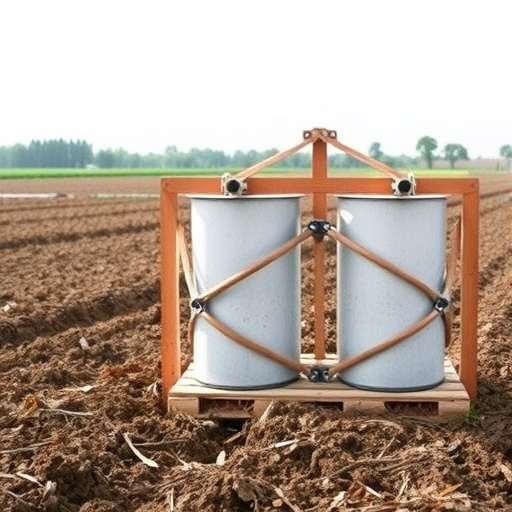
Researchers at the Tobacco Research Institute of the Chinese Academy of Agricultural Sciences have unveiled a groundbreaking advancement in water purification technology through the enhancement of biochar derived from biogas residue. This newly developed modified biochar showcases a remarkable ability to adsorb ammonium nitrogen from aqueous solutions, addressing one of agriculture’s most persistent environmental challenges with an innovative, sustainable approach.
Ammonium nitrogen, prevalent in agricultural runoff largely due to excessive fertilizer use and livestock management, is a significant contributor to nutrient pollution in aquatic systems. Its presence in waterways accelerates eutrophication, leading to harmful algal blooms and oxygen depletion that threaten freshwater ecosystems. Additionally, the infiltration of ammonium into groundwater poses serious human health risks. Scientists have long pursued materials capable of capturing ammonium ions efficiently before they contaminate water sources, and biochar, a carbonaceous byproduct of organic waste pyrolysis, has been a promising candidate. However, conventional biochar often falls short in adsorption efficiency, limiting its practical deployment.
The research team, spearheaded by Dr. Xuebo Zheng and Dr. Wenjing Song, has addressed these limitations by chemically modifying biochar produced from biogas residue—an abundant renewable resource generated during anaerobic digestion in bioenergy systems. Their study, recently published in the journal Biochar, details how treatments with potassium permanganate, hydrogen peroxide, and sodium hydroxide dramatically transform the physical and chemical properties of biochar, thereby elevating its ammonium adsorption capacity by up to fourfold.
Among the three chemical modifications tested, potassium permanganate treatment stood out as the most effective. This oxidizing agent extensively restructured the biochar’s pore architecture, generating a complex network of micro- and mesopores. The proliferation of these pores significantly expands the surface area available for adsorption, creating numerous active sites that facilitate the capture of ammonium ions. Such modifications enhance not just the quantity but the accessibility of adsorption sites, fundamentally improving the biochar’s performance in aqueous environments.
In contrast, treatments with hydrogen peroxide and sodium hydroxide primarily augmented the abundance of oxygen-containing functional groups on the biochar’s surface. These groups engender strong electrostatic attractions with positively charged ammonium ions, contributing to a higher adsorption affinity. However, without substantial changes to pore structure, these modifications were less effective than potassium permanganate in maximizing ammonium uptake, highlighting the critical role that physical pore development plays in adsorption processes.
Laboratory adsorption experiments quantified the superiority of potassium-permanganate-modified biochar, recording a maximum ammonium adsorption capacity of 68.15 milligrams per gram. This performance metric far exceeds the capacities reported for untreated biochar and sets a new benchmark for biochar-based ammonium adsorbents. The results signify that optimizing pore connectivity and volume yields more pronounced gains in adsorption efficiency than focusing solely on chemical surface modifications.
Scanning electron microscopy and nitrogen adsorption-desorption isotherms substantiated these findings, illustrating how the potassium permanganate treatment fostered a dense and multidimensional pore network. This enhanced structure improves mass transfer dynamics and increases the likelihood that ammonium ions in solution encounter and bind to adsorption sites. Simultaneously, the chemical modifications promote the introduction of reactive oxygen-containing moieties, which augment surface polarity and foster ion exchange mechanisms.
This dual mechanism—combining physical pore enhancement with chemical functionalization—positions modified biogas residue biochar as a multifaceted adsorbent capable of tackling complex nutrient pollutants. Such versatility underscores its potential beyond ammonium removal, possibly extending applications to other contaminants like heavy metals and organic pollutants by tuning the surface chemistry accordingly.
The approach also exemplifies the circular economy principle by repurposing biogas residue, a material often regarded as waste, into a valuable resource for environmental remediation. This valorization not only mitigates pollution associated with agricultural operations but also addresses disposal challenges of biogas digestion byproducts, fostering sustainable waste management practices.
Looking forward, the researchers emphasize the importance of scaling laboratory successes to real-world settings. Field trials will be essential to validate the efficacy and durability of modified biochar under varying environmental conditions, including diverse water chemistries and contaminant loads. Additionally, economic assessments will be critical to evaluating the feasibility of widespread adoption by farmers, wastewater treatment facilities, and regulatory bodies.
Integration of this technology into existing agricultural management practices could revolutionize nitrogen retention strategies, reducing environmental nitrogen losses and enhancing fertilizer efficiency. Moreover, protecting freshwater ecosystems from nutrient over-enrichment aligns with global efforts to safeguard biodiversity and ensure water quality in the face of burgeoning agricultural intensification.
The innovation presented by Drs. Zheng and Song thus represents a promising convergence of materials science, environmental engineering, and sustainable agriculture. By unlocking the latent potential of biogas residue through chemical modification, their work paves the way for advanced, cost-effective, and environmentally harmonious solutions to one of the critical pollution challenges of our time.
As this research gains traction, it is poised to stimulate further exploration of biochar modification techniques and broaden the scope of biochar applications. It also highlights the importance of interdisciplinary collaboration in addressing complex environmental problems with practical, scalable technologies.
In summary, the chemically modified biogas residue biochar developed by the Chinese research team offers a highly efficient, novel adsorbent for ammonium removal from water. Its superior adsorption capacity, rooted in enhanced pore structure and surface chemistry, exemplifies how targeted chemical treatments can drastically improve biochar functionality. This development holds significant promise for mitigating agricultural nitrogen pollution and advancing sustainable water management strategies globally.
Subject of Research: Not applicable
Article Title: Improved adsorption capacity of ammonium from aqueous solution by modified biogas residue biochar
News Publication Date: 25-Aug-2025
Web References: DOI link
References:
Cong, P., Song, S., Zhu, Y., et al. Improved adsorption capacity of ammonium from aqueous solution by modified biogas residue biochar. Biochar 7, 97 (2025).
Image Credits: Ping Cong, Shuhui Song, Yanmei Zhu, Xinwei Ji, Shuai Liu, Shuai Kuang, Yanli Xu, Qiuqiang Hou, Xuebo Zheng & Wenjing Song
Keywords
Biofuels, Biochemical engineering, Fuel, Hydrogen storage, Environmental remediation, Environmental chemistry, Environmental sciences
Tags: ammonium pollution remediationanaerobic digestion benefitsbiochar adsorption efficiencybiogas waste conversioneutrophication and algal bloomsgroundwater contamination preventioninnovative environmental solutionsmodified biochar technologynutrient pollution in agriculturerenewable resource utilization in agriculturesustainable water purification methodswater quality improvement strategies