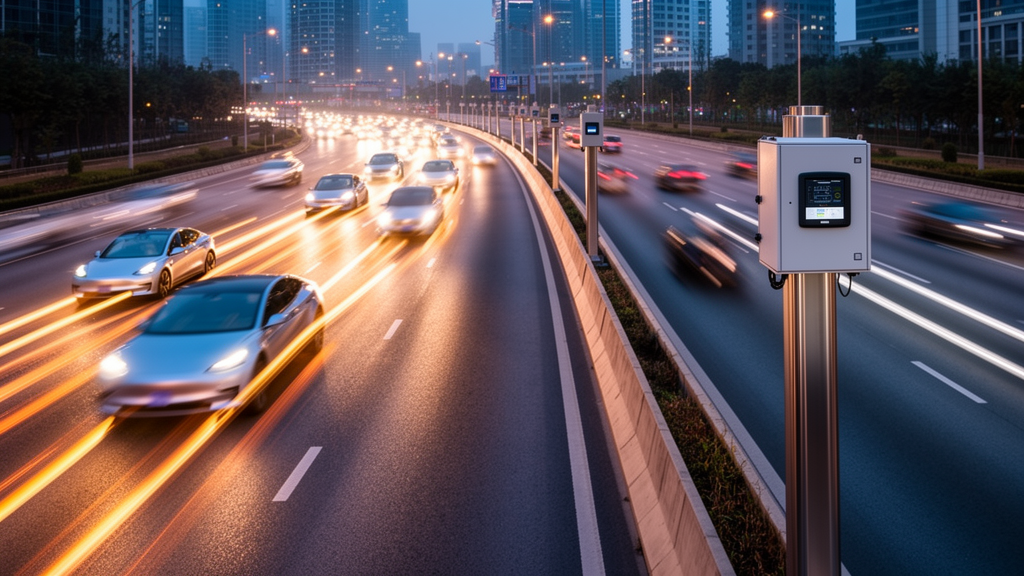
Researchers from SRM University AP in Amaravati, India, have proposed a new framework for deploying edge servers in vehicular edge computing environments. The study, published in Frontiers in Computer Science, introduces a traffic density-aware multi-objective optimization approach designed to address the challenges posed by dynamic vehicle mobility and uneven traffic distribution. The primary objective of the proposed system is to support latency-sensitive and computation-intensive applications by optimizing the physical placement of edge servers within urban networks.
The core of the proposed solution is the Traffic Density-Aware Non-Dominated Sorting Genetic Algorithm II, or TDA-NSGA-II. By incorporating traffic density data into the optimization process, the framework aims to identify high-density traffic regions and position edge servers accordingly. This approach seeks to mitigate issues such as increased communication latency, higher energy consumption, service interruptions, and frequent handovers that typically degrade overall network performance in mobile environments.
To ensure the proposed framework reflects real-world conditions, the researchers utilized vehicular mobility traces generated by the Simulation of Urban MObility, or SUMO, platform. By exploiting these realistic mobility traces, the TDA-NSGA-II algorithm can accurately identify areas where traffic congestion is likely to occur.
The optimization process within the framework is multi-objective, meaning it simultaneously seeks to minimize multiple conflicting metrics. Specifically, the algorithm jointly minimizes communication latency and energy consumption while also aiming to improve network coverage and reduce the frequency of handovers.
In addition to optimizing server placement, the proposed scheme implements mobility-aware vehicle-to-server association. This component ensures that vehicles are connected to the most appropriate edge server based on their current movement and location. By providing stable connectivity under dynamic vehicular movement, this association strategy helps to maintain consistent service quality. The combination of optimized server deployment and intelligent vehicle association creates a comprehensive solution for managing the dynamic nature of vehicular edge computing environments.
The experimental evaluations were conducted based on realistic traffic mobility scenarios to test the effectiveness of the proposed framework. The researchers compared the performance of the TDA-NSGA-II algorithm against several conventional optimization approaches, including the standard Genetic Algorithm (GA), Particle Swarm Optimization (PSO), and Ant Colony Optimization (ACO).
Simulation results demonstrated that the proposed TDA-NSGA-II framework achieves substantially lower latency and energy consumption compared to the GA, PSO, and ACO baselines. Furthermore, the coverage provided by the TDA-NSGA-II framework was found to be comparable to the best-performing baseline, indicating that the algorithm does not sacrifice network reachability for the sake of efficiency. However, the study noted that handover counts remained comparable to the baselines rather than being consistently reduced, suggesting that while latency and energy are improved, the frequency of server switches is not significantly lower in all scenarios.
The findings illustrate that traffic-density-aware edge server deployment can significantly improve the efficiency and reliability of vehicular edge computing networks. By leveraging realistic mobility data and multi-objective optimization, the framework offers an effective solution for adaptive server deployment in dynamic environments.
Subject of Research: Optimization of edge server deployment in vehicular edge computing networks using traffic density-aware algorithms.
Article Title: Traffic density-aware multi-objective edge server deployment for vehicular edge computing
Article References: Lakshmi Parvathi, A., Anamalamudi, S., Carie, A., & Enduri, M. K. (2026). Traffic Density-Aware Multi-Objective Edge Server Deployment for Vehicular Edge Computing. Frontiers in Computer Science, 8, 1948353. https://doi.org/10.3389/fcomp.2026.1948353
Image Credits: AI Generated
DOI: 10.3389/fcomp.2026.1948353
Keywords: Vehicular Edge Computing, Edge Server Deployment, TDA-NSGA-II, Multi-Objective Optimization, Traffic Density Analysis, SUMO Simulation, Communication Latency, Energy Consumption, Vehicle-to-Server Association, Network Reliability, Urban Mobility Traces, Genetic Algorithm, Particle Swarm Optimization, Ant Colony Optimization, Handover Frequency, Intelligent Transportation, Resource Utilization, Dynamic Mobility, Network Coverage, SRM University AP
News Source: Marilyn Langley. (November 13, 2026). Traffic-Density Algorithm Cuts Latency in Vehicular Edge Computing. Scienmag.