• HOME
  • NEWS
  • EXPLORE
    • CAREER
      • Companies
      • Jobs
    • EVENTS
    • iGEM
      • News
      • Team
    • PHOTOS
    • VIDEO
    • WIKI
  • BLOG
  • COMMUNITY
    • FACEBOOK
    • INSTAGRAM
    • TWITTER
Sunday, October 4, 2026
BIOENGINEER.ORG
No Result
View All Result
  • Login
  • HOME
  • NEWS
  • EXPLORE
    • CAREER
      • Companies
      • Jobs
        • Lecturer
        • PhD Studentship
        • Postdoc
        • Research Assistant
    • EVENTS
    • iGEM
      • News
      • Team
    • PHOTOS
    • VIDEO
    • WIKI
  • BLOG
  • COMMUNITY
    • FACEBOOK
    • INSTAGRAM
    • TWITTER
  • HOME
  • NEWS
  • EXPLORE
    • CAREER
      • Companies
      • Jobs
        • Lecturer
        • PhD Studentship
        • Postdoc
        • Research Assistant
    • EVENTS
    • iGEM
      • News
      • Team
    • PHOTOS
    • VIDEO
    • WIKI
  • BLOG
  • COMMUNITY
    • FACEBOOK
    • INSTAGRAM
    • TWITTER
No Result
View All Result
Bioengineer.org
No Result
View All Result
Home NEWS Science News Chemistry

Toward tunable molecular switches from organic compounds

Bioengineer by Bioengineer
April 7, 2023
in Chemistry
Reading Time: 2 mins read
0
Crystals of the newly synthesized anthraquinodimethane derivatives
Share on FacebookShare on TwitterShare on LinkedinShare on RedditShare on Telegram

Newly synthesized organic molecules can be tuned to emit different colors depending on their molecular structures in crystal form.
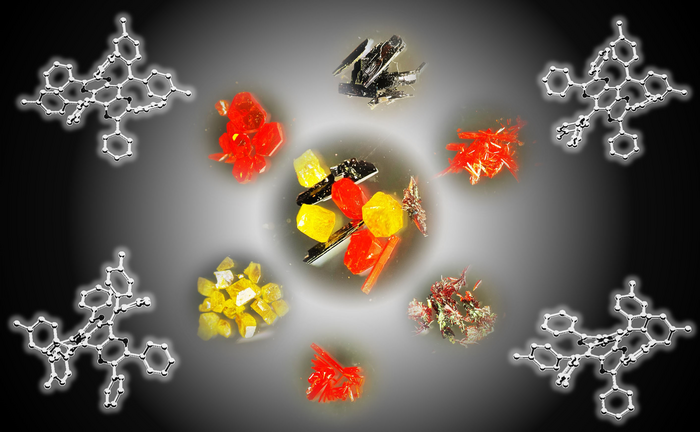
Crystals of the newly synthesized anthraquinodimethane derivatives

Credit: Yusuke Ishigaki

Newly synthesized organic molecules can be tuned to emit different colors depending on their molecular structures in crystal form.

Molecular switches are chemicals with molecular structures that can be shifted between two or more stable configurations in response to changes in their environment. They are of great interest in the development of molecular computers, molecular machines and drug delivery systems. Compounds with conformational isomers—identical molecular formulas but different molecular structures—can make very effective molecular switches.

Researchers at Hokkaido University and Kyushu University have developed a technique to synthesize potential molecular switches from anthraquinodimethanes (AQDs), a group of overcrowded organic molecules. The study, led by Associate Professor Yusuke Ishigaki at Hokkaido University and Associate Professor Toshikazu Ono at Kyushu University, was published in the journal Materials Chemistry Frontiers. 

“AQDs are a type of overcrowded ethylene, molecules with carbon-carbon double bonds surrounded by large chemical groups,” explains Ono. “They have two common isomers, the folded and twisted forms. They are especially interesting as molecular switches, as their sterically hindered double bond can provide isomers absorbing and emitting different wavelengths of light.”

AQDs generally adopt the most stable folded or twisted form, making it difficult to isolate pure samples of any other isomer to study its properties. The researchers surmounted this obstacle by designing flexible AQD derivatives that can more easily and stably form different isomers.

The synthesized derivatives were not only able to stably form twisted and folded isomers, but also other isomeric forms, when recrystallized in different solvents. The researchers performed detailed analysis of the derivatives to fully understand their properties.

In a crystalline state, each of these isomers absorbs and emits distinct frequencies of light, which is due to the differences in the distribution of electrons in the isomer molecules. Interestingly, the light absorption and emission changed when the crystals were ground into amorphous solid, and following treatment with appropriate solvents can produce original or other crystals with a variety of colors.

“This work is the first report on the isolation of multiple isomeric forms of AQD,” Ishigaki concluded. “Their absorption and emission of different light frequencies, and more importantly, the ability to modulate the absorption and emission by external stimuli, make these compounds excellent candidates for the development of molecular switches.”


Journal

Materials Chemistry Frontiers

DOI

10.1039/D2QM01199A

Method of Research

Experimental study

Subject of Research

Not applicable

Article Title

Exceptionally flexible quinodimethanes with multiple conformations: polymorph-dependent colour tone and emission of crystals

Article Publication Date

8-Feb-2023
Share12Tweet8Share2ShareShareShare2

Related Posts

Ancient Chinese Medicine Compounds Turned Into Next-Generation Antibiotic Candidates by AI

Ancient Chinese Medicine Compounds Turned Into Next-Generation Antibiotic Candidates by AI

October 4, 2026
How Bacteria Wire Themselves to Electrodes: The Electron Transfer Secrets Powering Microbial Fuel Cells

How Bacteria Wire Themselves to Electrodes: The Electron Transfer Secrets Powering Microbial Fuel Cells

October 4, 2026

Scientists unlock rice protein’s hidden power as a plant-based emulsifier

October 4, 2026

MOF Catalyst Turns Oleic Acid into Biodiesel with 93.9% Conversion

October 4, 2026

POPULAR NEWS

  • Alloys That Shrink Their Own Grains: New PIX Mechanism Refines Metals With Heat Alone

    Alloys That Shrink Their Own Grains: New PIX Mechanism Refines Metals With Heat Alone

    29 shares
    Share 12 Tweet 7
  • Endurance Exercise Reshapes the Liver in Males and Females Through Distinct Molecular Routes

    29 shares
    Share 12 Tweet 7
  • Single Transcription Factor PU.1 Rapidly Converts Fibroblasts into Macrophage-Lineage Cells

    29 shares
    Share 12 Tweet 7
  • New Scale Measures How Ready Nurse Educators Really Are for the AI Era

    29 shares
    Share 12 Tweet 7

About

We bring you the latest biotechnology news from best research centers and universities around the world. Check our website.

Follow us

Recent News

Alloys That Shrink Their Own Grains: New PIX Mechanism Refines Metals With Heat Alone

Endurance Exercise Reshapes the Liver in Males and Females Through Distinct Molecular Routes

Single Transcription Factor PU.1 Rapidly Converts Fibroblasts into Macrophage-Lineage Cells

Subscribe to Blog via Email

Success! An email was just sent to confirm your subscription. Please find the email now and click 'Confirm' to start subscribing.

Join 85 other subscribers
  • Contact Us

Bioengineer.org © Copyright 2023 All Rights Reserved.

Welcome Back!

Login to your account below

Forgotten Password?

Retrieve your password

Please enter your username or email address to reset your password.

Log In
No Result
View All Result
  • Homepages
    • Home Page 1
    • Home Page 2
  • News
  • National
  • Business
  • Health
  • Lifestyle
  • Science

Bioengineer.org © Copyright 2023 All Rights Reserved.