Osaka, Japan – How is a donut similar to a coffee cup? This question often serves as an illustrative example to explain the concept of topology. Topology is a field of mathematics that examines the properties of objects that remain consistent even when they are stretched or deformed—provided they are not torn or stitched together. For instance, both a donut and a coffee cup have a single hole. This means, theoretically, if either were pliable enough, it could be reshaped into the other. This branch of mathematics provides a more flexible way to describe shapes in data, such as the connections between individuals in a social network or the atomic coordinates of materials. This understanding has led to the development of a novel technique: topological data analysis.
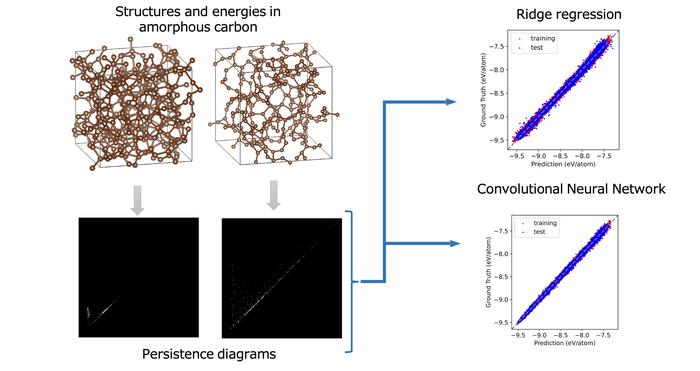
Credit: 2023 Minamitani et al., Persistent homology-based descriptor for machine-learning potential of amorphous structures. The Journal of Chemical Physics
Osaka, Japan – How is a donut similar to a coffee cup? This question often serves as an illustrative example to explain the concept of topology. Topology is a field of mathematics that examines the properties of objects that remain consistent even when they are stretched or deformed—provided they are not torn or stitched together. For instance, both a donut and a coffee cup have a single hole. This means, theoretically, if either were pliable enough, it could be reshaped into the other. This branch of mathematics provides a more flexible way to describe shapes in data, such as the connections between individuals in a social network or the atomic coordinates of materials. This understanding has led to the development of a novel technique: topological data analysis.
In a study published this month in The Journal of Chemical Physics, researchers from SANKEN (The Institute of Scientific and Industrial Research) at Osaka University and two other universities have used topological data analysis and machine learning to formulate a new method to predict the properties of amorphous materials.
A standout technique in the realm of topological data analysis is persistent homology. This method offers insights into topological features, specifically the “holes” and “cavities” within data. When applied to material structures, it allows us to identify and quantify their crucial structural characteristics.
Now, these researchers have employed a method that combines persistent homology and machine learning to predict the properties of amorphous materials. Amorphous materials, which include substances like glass, consist of disordered particles that lack repeating patterns.
A crucial aspect of using machine-learning models to predict the physical properties of amorphous substances lies in finding an appropriate method to convert atomic coordinates into a list of vectors. Merely utilizing coordinates as a list of vectors is inadequate because the energies of amorphous systems remain unchanged with rotation, translation, and permutation of the same type of atoms. Consequently, the representation of atomic configurations should embody these symmetry constraints. Topological methods are inherently well-suited for such challenges. “Using conventional methods to extract information about the connections between numerous atoms characterizing amorphous structures was challenging. However, the task has become more straightforward with the application of persistent homology,” explains Emi Minamitani, the lead author of the study.
The researchers discovered that by integrating persistent homology with basic machine-learning models, they could accurately predict the energies of disordered structures composed of carbon atoms at varying densities. This strategy demands significantly less computational time compared to quantum mechanics-based simulations of these amorphous materials.
The techniques showcased in this study hold potential for facilitating more efficient and rapid calculations of material properties in other disordered systems, such as amorphous glasses or metal alloys.
###
The article, “Persistent homology-based descriptor for machine-learning potential of amorphous structures,” was published in The Journal of Chemical Physics at https://doi.org/10.1063/5.0159349
Journal
The Journal of Chemical Physics
DOI
10.1063/5.0159349
Method of Research
Computational simulation/modeling
Subject of Research
Not applicable
Article Title
Persistent homology-based descriptor for machine-learning potential of amorphous structures
Article Publication Date
22-Aug-2023