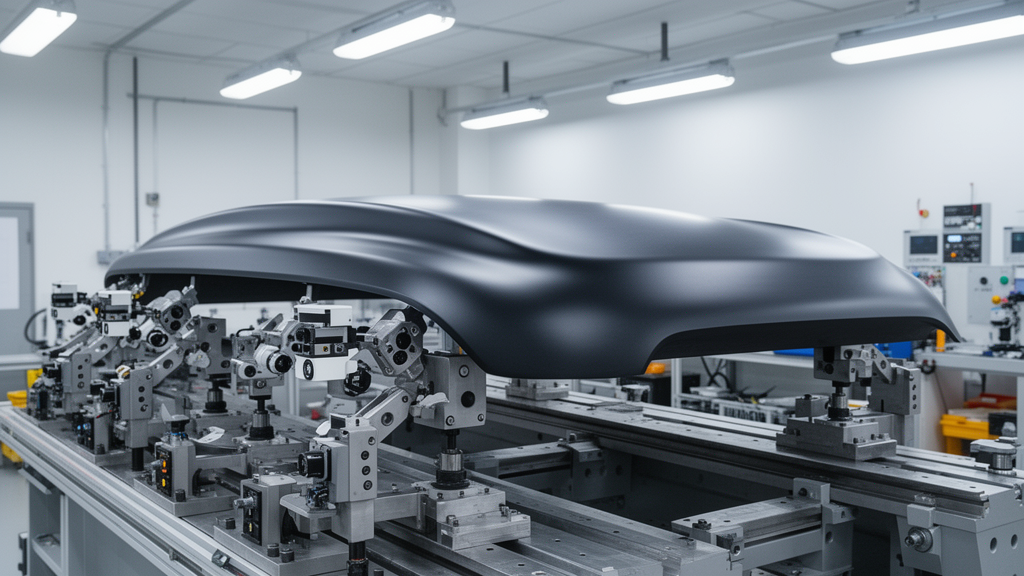
The study, published in the journal Discover Vehicles, presents an integrated investigation that combines tool design, finite element simulations, and experimental validation. By producing a physical prototype from aluminum AA1050 sheet metal, the team confirmed that the structural component can be formed without localized necking, wrinkling, or material splitting. This work addresses the automotive industry’s ongoing pursuit of lightweight structural solutions to reduce fuel consumption, emissions, and material usage.
The transition from conventional polylithic, or multi-part, rooftop designs to monolithic, single-piece structures offers significant advantages in terms of part count reduction and manufacturing simplification. Traditional multi-part assemblies require multiple production steps involving mechanical fasteners, adhesives, and welding, which add weight and create potential leakage paths. In contrast, a monolithic structure eliminates these joining operations, thereby reducing production time and long-term durability concerns associated with outdoor environmental conditions. However, producing large, stiffened monolithic sheet-metal components via deep drawing poses significant manufacturing challenges, including thinning, wrinkling, tearing, and springback.
To address these challenges, the research team designed a specialized deep-drawing toolset consisting of a punch, die, and blank holder using Siemens NX software. The tool geometry was derived directly from the component design, with the die shape matching the external geometry of the rooftop and the punch corresponding to the internal profile. To reduce manufacturing costs and enable practical tool fabrication, the original rooftop geometry, which measured 2.3 meters by 1.4 meters, was scaled down by a factor of 0.20. This scaling approach allowed for experimental validation while preserving the geometric characteristics of the full-scale design. The punch and die corner radii were set to 10 millimeters to minimize stress concentrations and prevent tearing.
Finite element simulations were conducted using AutoForm software to assess forming feasibility, thinning behavior, and springback prior to production. The simulations modeled the aluminum AA1050 sheet metal as a formable body, while the tooling was treated as rigid bodies. Material properties were defined based on experimental results from previous publications, including an average yield strength of 29 MPa and an ultimate tensile strength of 78 MPa. The simulations utilized the Barlat’89 anisotropic yield criterion to capture directional material behavior, incorporating plastic strain ratios measured in rolling, diagonal, and transverse directions. These parameters ensured that the simulated stress-strain response closely matched the experimentally measured behavior of the alloy.
The simulation results indicated that the deep drawing process was feasible without defects. The forming limit diagram showed that approximately 99.00% of the elements remained within the safe zone, with no elements exceeding the failure limit curve. The maximum major strain observed was approximately 0.25, well below the forming limit curve threshold of 0.38 to 0.40. Predicted springback ranged between 0.409 mm and 0.688 mm, which is within the acceptable range of ±1 mm for dimensional stability.
Following the simulation phase, the tooling was manufactured from D-2 tool steel, a material selected for its high wear resistance and compressive strength. The components were machined using CNC milling and turning, then heat-treated and polished to reduce friction during forming. The assembled tooling was mounted on a servo spindle press machine with a maximum pressing force of 2000 kN at the Fraunhofer IWU Institute for Machine Tools and Forming Technology in Chemnitz, Germany. The deep drawing process was conducted using a double-action inverted type configuration, where the blank holder secures the sheet before the punch performs the drawing operation.
The physical prototype was produced using a 1.5 mm thick aluminum AA1050 blank, cut to size using a hydraulic guillotine shear. During the forming process, Raziol CLF 250 S-KR lubricant was applied to reduce friction between the tool and the sheet metal. The resulting monolithic hard-shell rooftop exhibited superior surface integrity, with no observable defects, fractures, or wrinkling. A systematic visual examination under controlled lighting confirmed that the component satisfied established surface quality requirements, particularly in critical zones such as corner regions and areas incorporating stiffness geometries.
Post-production evaluation focused on material thickness distribution and structural stiffness. The prototype was scanned using a T-scan Hawk 2 laser 3D optical scanner, with data analyzed in ZEISS INSPECT 3D software. The scan revealed a uniform thickness distribution of 1.5 mm ± 0.13 mm across 38 strategically selected measurement points. The standard deviation of the thickness measurements was calculated to be 0.08 mm, which corresponds to approximately 5% of the mean thickness. This low variability indicates high process stability and good forming consistency, ensuring that the structure maintains a consistent load-bearing capacity across its entire surface.
A direct comparison between the simulation and experimental results showed a strong correlation. The maximum thinning deviation between the simulated and experimental values was 0.012 mm, which is less than 1% of the sheet thickness. This minor variation is attributed to simplifications in the numerical model, such as idealized boundary conditions and uniform material properties. The close agreement confirms the accuracy of the finite element simulations in representing real-world deep drawing behavior, validating the methodology for guiding design decisions before physical trials.
Structural stiffness was evaluated using a Universal Testing Machine at the Technische Universität Chemnitz. The prototype was subjected to point loads at a cross-head speed of 5 mm/min. The maximum displacement reached was 24.09 mm under a peak applied force of 2,641.91 N, resulting in a calculated stiffness of 109.67 N/mm. The deformation process took 4 minutes and 37 seconds, reflecting the energy absorption capacity of the monolithic structure and its resistance to plastic collapse. No tearing was observed, and the deformation was localized around intended load-path regions, demonstrating the effectiveness of the integrated stiffness geometries in distributing stresses.
The study highlights the importance of integrated stiffness geometries in maintaining structural integrity without adding weight. These features help redistribute stresses and reduce strain concentrations during forming, while also preventing widespread deformation under external loading. In comparison, polylithic structures would require additional stiffeners to achieve comparable load-bearing capacity, which would increase weight and part count. The monolithic design thus offers a highly efficient structural solution that balances lightweighting with mechanical performance.
Limitations of the study include the fact that springback validation was limited to simulation-based predictions, with detailed experimental springback investigation planned for future work. Additionally, the current study does not include a detailed economic assessment or large-scale production analysis. Nevertheless, the research provides quantitative evidence of thickness distribution, maximum thinning, springback, and stiffness performance for a functional prototype, confirming the practical feasibility of manufacturing automotive rooftops as monolithic structures.
While previous publications by the authors established the conceptual foundation, material selection strategy, and integrated framework for transitioning from polylithic to monolithic structures, those earlier studies did not experimentally confirm that the design could be produced at an industrial scale. This current investigation addresses that gap by providing empirical evidence through physical prototyping, thereby confirming the practical viability of the approach beyond theoretical modelling and simulation alone.
The economic rationale for adopting monolithic structures involves balancing higher initial manufacturing costs against long-term operational efficiencies. Producing a single-piece rooftop requires specialized tooling and advanced forming processes, which increase upfront expenses compared to conventional multi-part assemblies. However, these investments are offset by reduced material usage, lower assembly labour, and shorter production times. By eliminating joining processes such as welding, bolting, riveting, or adhesive sealing, the monolithic design also removes potential leakage paths and part failures, contributing to improved lifecycle durability and overall product performance in outdoor environmental conditions.
The finite element simulations incorporated specific process parameters to ensure realistic industrial conditions. The friction coefficient between the punch, die, and aluminium sheet was set to 0.15, a value recommended by the Numisheet Benchmark #1 to represent moderate friction and smooth interaction. An initial blank holder pressure of 3 MPa was applied, with a total force of 60 kN exerted on specific pin surfaces to secure the blank. This force level was selected to prevent wrinkling, which occurs if the force is too low, while avoiding material failure that can result from excessive pressure. The double-acting inverted stroke involved a 60 mm blank holder stroke followed by a 200 mm punch stroke, allowing for better control of material flow during the deep drawing operation.
Material characterization played a crucial role in the simulation accuracy, utilizing the Ludwik power law to define the strain hardening behaviour of the aluminium AA1050 sheet. Unlike the Hollomon equation, which assumes immediate hardening at zero strain, the Ludwik equation incorporates the initial yield stress, providing a more realistic description of plastic deformation. The strain hardening exponent was determined to be 0.218, and the strength coefficient was calculated as 135 MPa. These parameters, along with the plastic strain ratios measured in rolling, diagonal, and transverse directions, were essential for predicting material flow, thickness variation, and resistance to localized necking during the forming process.
The experimental setup at the Fraunhofer IWU utilized a servo spindle press machine, specifically the ServoSpindelPresse MSP4-2000, manufactured by H&T Produktions Technologie GmbH. This machine, with a maximum pressing force of 2000 kN, provided a significant safety margin over the peak forming load of 1,588.5 kN observed in the simulations. The servo electric mechanism allowed for precise control of force and displacement, enhancing the accuracy and consistency of the deep drawing operations. The tooling was mounted and calibrated on this press to ensure that the physical prototype met the required specifications and quality standards established by the simulation results.
Subject of Research: Tool design simulation and experimental validation of a monolithic hard-shell rooftop
Article Title: Tool design simulation and experimental validation of a monolithic hard-shell rooftop
Article References: Chirinda, G. P., Matope, S., Sterzing, A., & Nagel, M. (2026). Tool design simulation and experimental validation of a monolithic hard-shell rooftop. Discover Vehicles, 2(1), Article 13. https://doi.org/10.1007/s44465-026-00016-1
Image Credits: AI Generated
DOI: 10.1007/s44465-026-00016-1
Keywords: Tool, design, simulation, experimental, validation, monolithic, hard-shell, rooftop, scientific research
News Source: Denise Maddox. (November 10, 2026). Tool design simulation and experimental validation of a monolithic hard-shell rooftop. Scienmag.