• HOME
  • NEWS
  • EXPLORE
    • CAREER
      • Companies
      • Jobs
    • EVENTS
    • iGEM
      • News
      • Team
    • PHOTOS
    • VIDEO
    • WIKI
  • BLOG
  • COMMUNITY
    • FACEBOOK
    • INSTAGRAM
    • TWITTER
Saturday, January 17, 2026
BIOENGINEER.ORG
No Result
View All Result
  • Login
  • HOME
  • NEWS
  • EXPLORE
    • CAREER
      • Companies
      • Jobs
        • Lecturer
        • PhD Studentship
        • Postdoc
        • Research Assistant
    • EVENTS
    • iGEM
      • News
      • Team
    • PHOTOS
    • VIDEO
    • WIKI
  • BLOG
  • COMMUNITY
    • FACEBOOK
    • INSTAGRAM
    • TWITTER
  • HOME
  • NEWS
  • EXPLORE
    • CAREER
      • Companies
      • Jobs
        • Lecturer
        • PhD Studentship
        • Postdoc
        • Research Assistant
    • EVENTS
    • iGEM
      • News
      • Team
    • PHOTOS
    • VIDEO
    • WIKI
  • BLOG
  • COMMUNITY
    • FACEBOOK
    • INSTAGRAM
    • TWITTER
No Result
View All Result
Bioengineer.org
No Result
View All Result
Home NEWS Science News

Tohoku University teaches old spectroscope new tricks

Bioengineer by Bioengineer
October 6, 2020
in Science News
Reading Time: 2 mins read
0
IMAGE
Share on FacebookShare on TwitterShare on LinkedinShare on RedditShare on Telegram

IMAGE

Credit: Tohoku University

Tohoku University researchers have improved a method for probing semiconducting crystals with light to detect defects and impurities. The details of their ‘omnidirectional photoluminescence (ODPL) spectroscopy’ set-up were published in the journal Applied Physics Express, and could help improve the fabrication of materials for electric cars and solar cells.

“Our technique can test materials at very low temperatures and can find even small amounts of defects and impurities,” says Tohoku University materials scientist Kazunobu Kojima.

Kojima and his colleagues demonstrated their approach using gallium nitride crystals. Gallium nitride is a semiconducting crystal that has been used in energy-saving light-emitting diodes (LEDs) since the 2000s. It has interesting optic and electronic properties, making it attractive for many applications, including power-switching devices in electric vehicles. But it can develop defects and impurities during its fabrication, which can affect performance. Currently available methods for testing these crystals are expensive or too invasive.

The ODPL spectroscopy, on the other hand, is a non-invasive technique that can test the crystals, but only at room temperature. Being able to change the crystal’s temperature is important to properly test its properties.

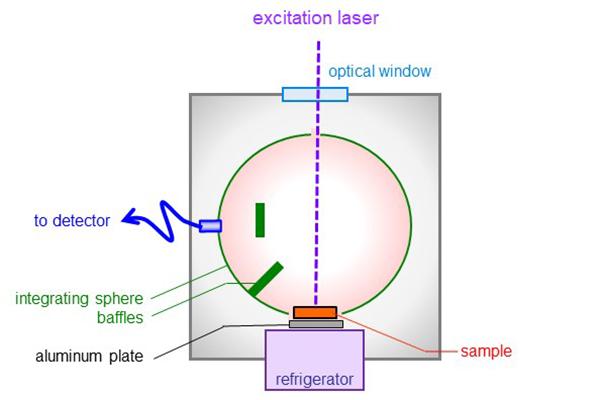
Kojima and his colleagues found a way to set up an ODPL instrument so that the crystal can be cooled. The process involves placing a gallium nitride crystal on an aluminum plate connected to a cooling device. This is placed under an ‘integrating sphere,’ which collects light coming from many directions. External light is shone through the sphere onto the crystal, exciting it. The crystal emits light back into the sphere in order to return to its initial unexcited state. The two lights, from the external source and the crystal, are integrated within the sphere and measured by a detector. The result reveals the crystal’s ‘internal quantum efficiency,’ which is reduced if it contains defects and impurities, and can be measured even at very low temperatures.

The team’s modification – placing the crystal outside the sphere and connecting it to something that cools it – means the temperature change crucially happens only within the crystal and not within the sphere. The scientists were able to measure the internal quantum efficiency of gallium nitride samples using this technique at temperatures ranging from -261°C to about 27°C.

“We next plan to use our method for testing other materials, such as perovskites for use in highly efficient solar cells and boron nitride as an atomically thin two-dimensional material,” says Kojima.

###

Media Contact
Kazunobu Kojima
[email protected]

Original Source

https://www.tohoku.ac.jp/en/press/old_spectroscope_new_tricks.html

Related Journal Article

http://dx.doi.org/10.35848/1882-0786/abb788

Tags: Chemistry/Physics/Materials SciencesTechnology/Engineering/Computer Science
Share12Tweet8Share2ShareShareShare2

Related Posts

Revolutionizing Medicine: 3D Printing in Medical Curricula

January 17, 2026

Optimizing Hydrogen Engine Control: Lean vs. Stoichiometric

January 17, 2026

Genome Assembly of Helan Shan Pika Aids Conservation

January 17, 2026

Distributed Model Predictive Control for Nano UAV Swarms

January 17, 2026
Please login to join discussion

POPULAR NEWS

  • Enhancing Spiritual Care Education in Nursing Programs

    155 shares
    Share 62 Tweet 39
  • PTSD, Depression, Anxiety in Childhood Cancer Survivors, Parents

    147 shares
    Share 59 Tweet 37
  • Robotic Ureteral Reconstruction: A Novel Approach

    77 shares
    Share 31 Tweet 19
  • Study Reveals Lipid Accumulation in ME/CFS Cells

    54 shares
    Share 22 Tweet 14

About

We bring you the latest biotechnology news from best research centers and universities around the world. Check our website.

Follow us

Recent News

Revolutionizing Medicine: 3D Printing in Medical Curricula

Optimizing Hydrogen Engine Control: Lean vs. Stoichiometric

Genome Assembly of Helan Shan Pika Aids Conservation

Subscribe to Blog via Email

Enter your email address to subscribe to this blog and receive notifications of new posts by email.

Join 71 other subscribers
  • Contact Us

Bioengineer.org © Copyright 2023 All Rights Reserved.

Welcome Back!

Login to your account below

Forgotten Password?

Retrieve your password

Please enter your username or email address to reset your password.

Log In
No Result
View All Result
  • Homepages
    • Home Page 1
    • Home Page 2
  • News
  • National
  • Business
  • Health
  • Lifestyle
  • Science

Bioengineer.org © Copyright 2023 All Rights Reserved.