Despite surface temperatures hot enough to melt lead, lava-spewing volcanoes, and puffy clouds of sulfuric acid, uninhabitable Venus offers vital lessons about the potential for life on other planets, a new paper argues.
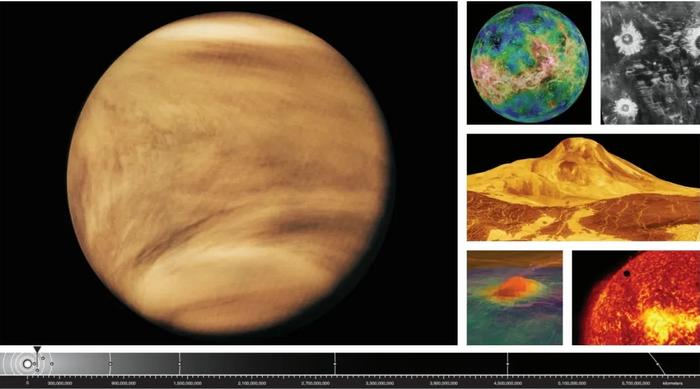
Credit: NASA
Despite surface temperatures hot enough to melt lead, lava-spewing volcanoes, and puffy clouds of sulfuric acid, uninhabitable Venus offers vital lessons about the potential for life on other planets, a new paper argues.
“We often assume that Earth is the model of habitability, but if you consider this planet in isolation, we don’t know where the boundaries and limitations are,” said UC Riverside astrophysicist and paper first author Stephen Kane. “Venus gives us that.”
Published today in the journal Nature Astronomy, the paper compiles much of the known information about Earth and Venus. It also describes Venus as an anchor point from which scientists can better understand the conditions that preclude life on planets around other stars.
Though it also features a pressure cooker-like atmosphere that would instantly flatten a human, Earth and Venus share some similarities. They have roughly the same mass and radius. Given the proximity to that planet, it’s natural to wonder why Earth turned out so differently.
Many scientists assume that insolation flux, the amount of energy Venus receives from the sun, caused a runaway greenhouse situation that ruined the planet.
“If you consider the solar energy received by Earth as 100%, Venus collects 191%. A lot of people think that’s why Venus turned out differently,” Kane said. “But hold on a second. Venus doesn’t have a moon, which is what gives Earth things like ocean tides and influenced the amount of water here.”
In addition to some of the known differences, more NASA missions to Venus would help clear up some of the unknowns. Scientists don’t know the size of its core, how it got to its present, relatively slow rotation rate, how its magnetic field changed over time, or anything about the chemistry of the lower atmosphere.
“Venus doesn’t have a detectable magnetic field. That could be related to the size of its core,” Kane said. “Core size also give us information about how a planet cools itself. Earth has a mantle circulating heat from its core. We don’t know what’s happening inside Venus.”
A terrestrial planet’s interior also influences its atmosphere. That is the case on Earth, where our atmosphere is largely the result of volcanic outgassing.
NASA does have twin missions to Venus planned for the end of this decade, and Kane is assisting with both of them. The DAVINCI mission will probe the acid-filled atmosphere to measure noble gases and other chemical elements.
“DAVINCI will measure the atmosphere all the way from the top to the bottom. That will really help us build new climate models and predict these kinds of atmospheres elsewhere, including on Earth, as we keep increasing the amount of CO2,” Kane said.
The VERITAS mission, led by NASA’s Jet Propulsion Laboratory, won’t land on the surface but it will allow scientists to create detailed 3D landscape reconstructions, revealing whether the planet has active plate tectonics or volcanoes.
“Currently, our maps of the planet are very incomplete. It’s very different to understand how active the surface is, versus how it may have changed through time. We need both kinds of information,” Kane said.
Ultimately, the paper advocates for missions like these to Venus for two main reasons. One is the ability, with better data, to use Venus to ensure inferences about life on farther-flung planets are correct.
“The sobering part of the search for life elsewhere in the universe is that we’re never going to have in situ data for an exoplanet. We aren’t going there, landing, or taking direct measurements of them,” Kane said.
“If we think another planet has life on the surface, we might not ever know we’re wrong, and we’d be dreaming about a planet with life that doesn’t have it. We are only going to get that right by properly understanding the Earth-size planets we can visit, and Venus gives us that chance.”
The other reason to research Venus is that it offers a preview of what Earth’s future could look like.
“One of the main reasons to study Venus is because of our sacred duties as caretakers of this planet, to preserve its future. My hope is that through studying the processes that produced present-day Venus, especially if Venus had a more temperate past that’s now devastated, there are lessons there for us. It can happen to us. It’s a question of how and when,” Kane said.
Journal
Nature Astronomy
DOI
10.48550/arXiv.2403.08830
Article Title
Venus as an Anchor Point for Planetary Habitability
Article Publication Date
22-Apr-2024