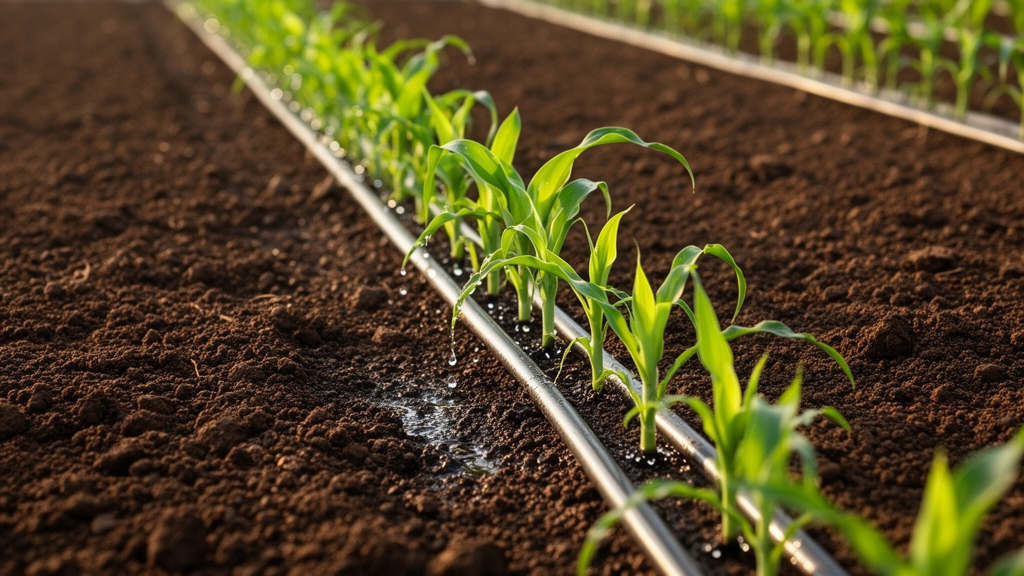
Applying drip irrigation for seedling emergence within three days after sowing significantly improves the emergence rate, enhances population uniformity, and increases the final harvest yield of summer maize, according to findings published in the Journal of Integrative Agriculture. Researchers from China established that the critical management window for initiating post-sowing drip irrigation is restricted to the first three days following seeding, noting that missing this operational window prevents the crop from realizing the full yield benefits of drip technology.
In agricultural production, uneven crop stands typically develop from natural variations in emergence time, which are strongly influenced by the specific irrigation measures implemented immediately after sowing. In the management of high-yielding maize populations, achieving both a high emergence rate and uniform stand structure represents a critical agronomic factor. The research team observed that suboptimal field implementation of drip irrigation methods has historically hindered the system from achieving its potential crop yield gains.
To evaluate these dynamics, the experimental study tested six distinct post-sowing irrigation treatments. Corresponding author Shaokun Li, a researcher at the Institute of Crop Sciences within the Chinese Academy of Agricultural Sciences, explained that the experimental protocol compared drip irrigation initiated on the zeroth, third, sixth, ninth, and twelfth days after sowing (designated DAS0, DAS3, DAS6, DAS9, and DAS12) alongside a control treatment consisting of sprinkling irrigation applied on the zeroth day after sowing (SI0). The investigators evaluated agronomic traits, ear characteristics, harvest yield, and multiple indices of population uniformity across critical crop growth stages.
The experimental measurements indicated that timely drip irrigation applied during the DAS0–3 period significantly outperformed the sprinkling irrigation treatment across primary yield components. Specifically, timely drip irrigation increased the seedling emergence rate and the final count of harvestable ears by 9.57 percent (representing 8,621.61 plants per hectare) and 10.54 percent (representing 8,017.05 ears per hectare), respectively, relative to sprinkling irrigation. Furthermore, the DAS0–3 treatments generated a 13.50 percent increase in ear length and a 24.85 percent gain in kernel weight per ear compared to the sprinkling control.
Conversely, maize stands subjected to delayed drip irrigation treatments between six and twelve days after sowing (DAS6–12) exhibited a progressive deterioration in stand quality throughout the growing season. Measurements taken at the silk stage demonstrated that the uniformity of plant height and ear height declined by 47.19 percent and 44.85 percent, respectively, compared to the timely DAS0–3 treatments. By the harvest stage, the uniformity of dry matter accumulation and leaf area index had decreased by 28.24 percent and 41.83 percent, respectively, relative to populations receiving timely drip irrigation.
Statistical evaluation further highlighted the direct connection between stand consistency and overall field productivity. Correlation analysis revealed that the uniformity of kernel weight per ear was most significantly associated with final yield, registering a correlation coefficient of 0.90**. Total yield in the timely DAS0–3 drip treatments was 23.71 percent higher than in the sprinkling irrigation control. In contrast, maize yields in the delayed DAS6–12 treatments dropped by 13.18 to 23.97 percent relative to timely application, falling to levels comparable to the sprinkling irrigation baseline.
The study concluded with a quantifiable assessment of the agronomic cost associated with delayed irrigation scheduling. The research team determined that each single day of delay in initiating drip irrigation beyond the third day post-sowing reduces summer maize yield by an average of 0.32 megagrams per hectare, underscoring the necessity of operating strictly within the three-day post-sowing emergence window.
The findings were published in the Journal of Integrative Agriculture, an open-access publication managed by KeAi Communications Co., Ltd. Established by Elsevier and China Science Publishing & Media Ltd, the publisher shifted its focus to open access publishing in 2013 and publishes journals across scientific disciplines in partnership with academic societies and institutions, including the National Natural Science Foundation of China. In this study, the authors declared no conflict of interest regarding their experimental work.
Subject of Research: Effects of post-sowing drip irrigation timing on summer maize population uniformity and yield
Article Title: Enhancing maize high-density population uniformity and yield through timely drip irrigation after sowing
Article References: Enhancing maize high-density population uniformity and yield through timely drip irrigation after sowing. Original publication (Bibliographic details unavailable.)
Image Credits: AI Generated
DOI: Not provided
Keywords: drip irrigation, summer maize, seedling emergence, population uniformity, sprinkling irrigation, kernel weight per ear, harvestable ears, ear length, leaf area index, dry matter accumulation, silk stage, plant height, ear height, irrigation timing, grain yield, Shaokun Li, Journal of Integrative Agriculture
News Source: Alan Morgan. (November 19, 2026). Timely Drip Irrigation Within Three Days After Sowing Increases Maize Yield. Scienmag.