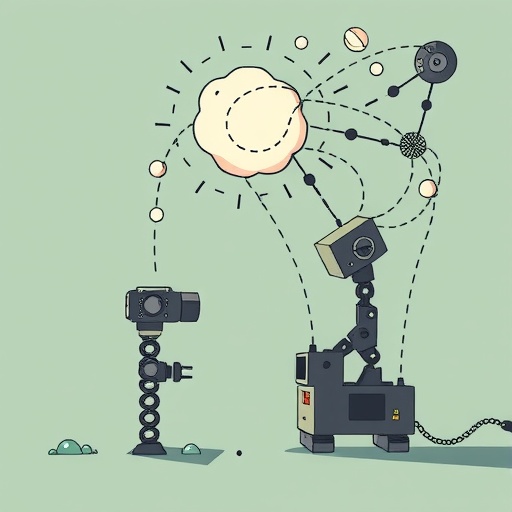
In the rapidly evolving landscape of artificial intelligence, the interaction between philosophy and technology has become increasingly critical. As we navigate through the complexities of the digital era, scholars have begun to explore the profound implications of epistemic automation—an area where machines not only assist in knowledge generation but also shape the epistemological underpinnings of how we acquire, validate, and disseminate knowledge. Livia Schütz-Bauer’s recent exploration of this theme in her work, “Philosophy in the Age of Rhetorical Machines: Three Paradoxes of Epistemic Automation,” offers a compelling lens through which we might examine the future of cognitive processes in an AI-dominated world.
Schütz-Bauer highlights three key paradoxes that embody the essence of epistemic automation. These paradoxes serve as critical touchstones for understanding the implications of AI-driven knowledge systems. The first paradox revolves around the tension between the democratization of knowledge and the potential for information overload. In an age where AI algorithms curate vast amounts of data, individuals are often inundated with information that might be misleading or irrelevant. This paradox raises fundamental questions about the nature of authority in knowledge creation and dissemination, underscoring the need for critical engagement with the sources and contexts of information.
The second paradox concerns the relationship between human creativity and machine-generated content. As AI tools become more sophisticated in their capacity to produce art, literature, and scholarly articles, we are forced to reconsider traditional notions of authorship and originality. Are automated systems genuinely creative, or do they merely remix and reproduce pre-existing ideas? Schütz-Bauer challenges us to reflect on what it means to create and the role of human agency in an era where machines can simulate human-like creativity. This debate invokes deeper philosophical inquiries into the nature of consciousness and the essence of being human in a technological context.
The final paradox addressed by Schütz-Bauer pertains to the ethical implications of epistemic automation. As machines increasingly take on roles traditionally held by human experts, we must confront the question of accountability. Who is responsible when an AI system errs in its judgment or produces biased information? The challenge lies in attributing ethical responsibility within frameworks that do not easily accommodate non-human agents. As societies increasingly rely on AI for critical decision-making, we must ensure that ethical considerations are embedded within the design and deployment of these systems. This complexity demands interdisciplinary collaboration, blending philosophical inquiry with technical expertise, to navigate the nuances of accountability in automation.
Schütz-Bauer’s analysis also engages with the historical dimensions of rhetoric and technology. The evolution of communication tools has always influenced how humans understand and engage with the world. From the printing press to the internet, technological advancements have reshaped societal narratives and power dynamics, often in ways that were unforeseen at the time. In the current context, rhetorical machines—powered by artificial intelligence—have the potential to replicate these historical patterns while introducing novel complexities. Understanding this historical continuity may aid us in contextualizing contemporary dilemmas around knowledge and technology.
Amidst these challenges, Schütz-Bauer emphasizes the importance of fostering an informed public discourse on epistemic automation. As we grapple with the implications of AI on knowledge, it is imperative that we encourage societal engagement and dialogue. Public understanding of these issues cannot be contingent solely on technical expertise; rather, it requires a democratic process that involves philosophers, scientists, policymakers, and citizens alike. By cultivating an educated populace, we enhance the collective capacity to critically assess technological advancements and their consequences.
Furthermore, Schütz-Bauer posits that educational institutions must adapt to this new epistemic landscape. By integrating discussions of AI and automation into curricula, educators can equip future generations with the critical thinking skills necessary to navigate a world increasingly influenced by machines. This educational shift must transcend traditional disciplines, encouraging creativity and interdisciplinary thinking that reflect the interconnectedness of these modern challenges.
An essential component of this discourse involves recognizing the role of bias in automated systems. AI technologies often reflect the prejudices present in their training data, which can lead to systemic inequalities and misinformation. By scrutinizing the biases inherent in the datasets used to train AI, we can better understand how these systems impact social structures. Philosophical inquiry must therefore be paired with technical critiques to address the moral responsibilities of developers and researchers in creating fair and equitable AI systems.
Moreover, as we probe deeper into the implications of epistemic automation, questions about the nature of truth in the digital age become paramount. With the rise of deepfakes, misinformation campaigns, and curated realities, discerning factual information has never been more difficult. Schütz-Bauer encourages a reevaluation of what we consider knowledge, prompting us to adopt a more nuanced understanding of truth that acknowledges the complexities introduced by digital platforms.
The exploration of these paradoxes is critical, not just for philosophers or scholars but for anyone engaged with technology in today’s world. As we become increasingly reliant on machines to process and interpret information, our collective future hinges on the choices we make regarding epistemic automation. The stakes are high, and the intersection of philosophy and AI must be foregrounded in both public discourse and academic inquiry.
Ultimately, Schütz-Bauer’s work invites us to reflect on our relationship with technology and the profound responsibilities we bear as architects of a digital future. It is a call to action for interdisciplinary collaboration, ethical foresight, and public engagement. As AI continues to redefine our epistemic frameworks, the philosophical scrutiny of these shifts will be vital in ensuring that we remain grounded in the values that underpin human knowledge and creativity.
In summary, “Philosophy in the Age of Rhetorical Machines: Three Paradoxes of Epistemic Automation” emerges as a crucial text for understanding the interplay between technology and knowledge in a rapidly changing world. It casts a much-needed light on the challenges we face in the age of AI and rhetorical machines, advocating for a thoughtful, responsible, and inclusive approach to the future of knowledge.
Subject of Research: The implications of epistemic automation in the context of artificial intelligence and its impact on knowledge creation, dissemination, and ethical considerations.
Article Title: Philosophy in the age of rhetorical machines: three paradoxes of epistemic automation.
Article References:
Schütz-Bauer, L. Philosophy in the age of rhetorical machines: three paradoxes of epistemic automation.
Discov Artif Intell 5, 373 (2025). https://doi.org/10.1007/s44163-025-00716-9
Image Credits: AI Generated
DOI: https://doi.org/10.1007/s44163-025-00716-9
Keywords: Epistemic automation, artificial intelligence, rhetorical machines, ethics, knowledge dissemination, information overload, creativity, bias in AI, truth in the digital age, public discourse, education.
Tags: authority in knowledge creationchallenges of AI in knowledge validationcomplexities of knowledge in artificial intelligencecritical engagement with information sourcesdemocratization of knowledge versus information overloadepistemic automation and cognitive processesfuture of knowledge dissemination in digital eraimplications of AI-driven knowledge systemsLivia Schütz-Bauer’s work on epistemologyparadoxes of knowledge in AIphilosophy and technology interplayunderstanding rhetorical machines in philosophy