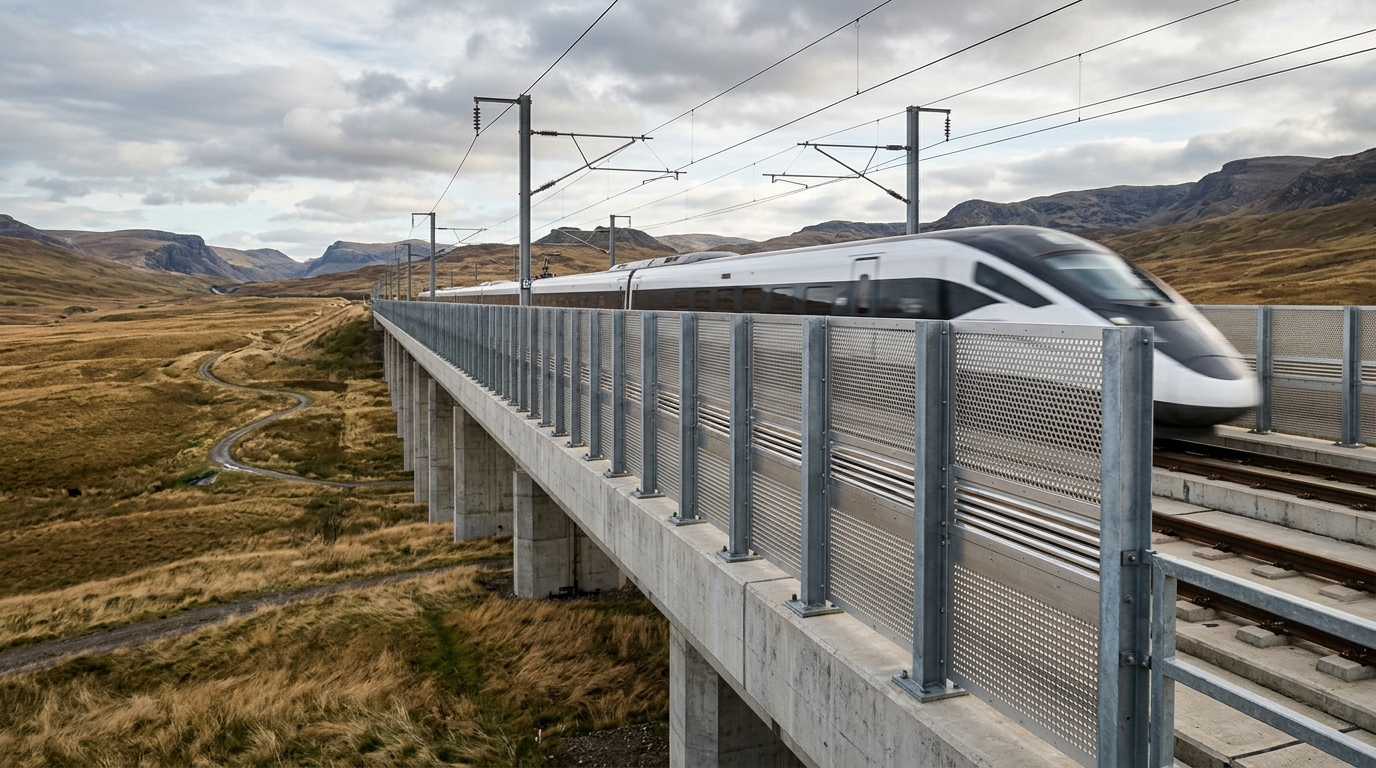
Engineers evaluating high-speed railway safety on long-span cable-stayed bridges have identified specific geometric parameters for deck-mounted wind barriers that significantly stabilize train operations in the turbulent wind fields created by bridge towers. Combining boundary-layer wind tunnel experiments with three-dimensional computational fluid dynamics simulations and dynamic multi-body vibration modeling, researchers systematically analyzed how barrier porosity, height, and length influence bridge deck wind fields, train aerodynamics, and driving performance. Results demonstrate that vertical perforated wind barriers effectively suppress large-scale wake vortices downstream of bridge towers, smooth sudden crosswind velocity changes, and reduce transient aerodynamic forces and lift forces acting on high-speed rail carriages. Furthermore, the investigations established that aerodynamic protection reaches a distinct saturation threshold at a barrier height of three meters, while an optimal porosity of thirty percent balances wind speed attenuation against adverse turbulence, and a tailored barrier length minimizes dynamic carbody vibrations through destructive phase cancellation.
The operational safety of high-speed trains traversing long-span bridges faces persistent hazards from strong atmospheric crosswinds, which historically have caused vehicle derailments and severe structural disruptions globally. As high-speed rail vehicles pass massive structural bridge pylons, the towers obstruct prevailing crosswinds and dramatically alter the local wind field through aerodynamic blockage, flow divergence, and wake vortex shedding. This localized tower shielding effect produces a sudden drop in wind speed directly behind the pylon alongside compressed, high-velocity bypass flow jets along the tower flanks, subjecting moving carriages to sharp, asymmetrical aerodynamic impulses upon entering and exiting the pylon area. These rapid aerodynamic load changes induce sudden spikes in carbody lateral acceleration, roll moments, and vertical oscillations that degrade passenger ride comfort and elevate derailment risks. While operational rules occasionally reduce train speeds to maintain safety margins, installing deck-level wind barriers provides a practical engineering intervention that preserves high design speeds and operational efficiency.
Previous aerodynamic research has extensively evaluated wind barrier geometries, optimizing cross-sectional profiles, fence configurations, barrier heights, and porosity percentages under uniform incoming wind fields to protect roadway and railway infrastructure. However, earlier studies largely restricted their focus to steady-state aerodynamic drag coefficients and localized wind velocity profiles, leaving the complex dynamic interaction between a high-speed train and the transient wind environment around bridge towers inadequately understood. Furthermore, evaluating wind barriers purely through fluid dynamics calculations provides an incomplete assessment of running stability because barriers also alter bridge deck aerodynamics, potentially exciting vortex-induced vibrations that transfer into the rail vehicle through track-bridge dynamic coupling. Existing literature addressing tower shielding has also concentrated predominantly on highway road vehicles rather than rail vehicles. To bridge these analytical gaps, researchers formulated an integrated evaluation framework that shifts focus from static aerodynamic force coefficients to actual train driving performance indicators, including derailment coefficients, wheel load reduction rates, and carbody accelerations.
The research team based their parametric investigation on a prototype twin-pylon cable-stayed railway bridge featuring a four-hundred-meter main span and an overall layout spanning seventy, one hundred thirty, four hundred, one hundred thirty, and seventy meters. The bridge’s two structural pylons each measure one hundred sixty-one meters in total height and ten meters in transverse width, incorporating chamfered corners measuring zero point thirty-five meters square designed to mitigate flow separation around the pylon perimeter. The bridge deck carries a double-line ballastless track system configured for sixteen-car CRH3 high-speed electric multiple units characterized by a car height of three point eighty-nine meters, a width of three point two meters, and an operational design speed of three hundred fifty kilometers per hour. For computational aerodynamic simulations, secondary local components such as pantographs, bogie assemblies, and windshield wipers were omitted, as prior aerodynamics research established that their influence on gross vehicle aerodynamic forces is negligible compared to the primary carbody profile.
To simulate aerodynamic interactions between the train and the bridge-tower assembly, researchers constructed a three-dimensional computational fluid dynamics domain measuring six hundred meters long, two hundred meters wide, and one hundred meters high. Using the train carbody height of three point eighty-nine meters as the characteristic length, domain boundaries were positioned beyond fifty characteristic heights laterally and downstream to achieve an aerodynamic blockage ratio under five percent, ensuring undisturbed flow and wake dissipation. The simulation treated air as an incompressible turbulent fluid at three hundred fifty kilometers per hour with a Reynolds number exceeding two million, applying the shear-stress transport k-omega two-equation turbulence model. A dynamic layering mesh scheme accommodated train motion by regenerating cell layers away from vehicle surfaces, maintaining twenty boundary layers with non-dimensional wall distance y-plus values between thirty and sixty. Mesh independence tests confirmed grid convergence index values below three percent with fifteen million elements, while wind tunnel tests using one-to-forty scale models confirmed numerical errors under ten percent.
Detailed analysis of the leeward velocity field behind the vertical perforated barriers identified three distinct vertical zones extending above the bridge deck: the near-deck wind shielding zone, an intermediate turbulent shear layer, and the undisturbed external free stream. In the wind shielding zone, mean airflow velocities drop to less than half of incoming crosswind speeds due to viscous barrier resistance. Evaluating barrier porosities of ten, thirty, fifty, and one hundred percent (an unshielded deck), researchers observed that lower porosity enhances wind speed reduction but introduces mechanical trade-offs. A low porosity of ten percent behaves similarly to a solid barrier, creating a broad separation bubble with negative surface pressures across carbody sides, yet generates an unstable shear layer with severe turbulence. Increasing porosity to thirty percent allows controlled seepage flow to replenish wake kinetic energy, moving flow reattachment upstream and achieving wind attenuation comparable to ten percent porosity while lowering the aerodynamic fluctuation amplitude from two point eighteen to one point eighty-nine.
The investigation of wind barrier height across test values of zero, two, three, and four meters demonstrated that height primarily governs the vertical elevation of the turbulent crest shear layer relative to the vehicle carbody. Static pressure contours and velocity streamlines revealed that a two-meter barrier provides suboptimal protection because the crest shear layer forms directly at mid-vehicle height, exposing the upper half of the carbody to strong transverse velocity gradients and violent turbulent mixing. In contrast, increasing barrier height to three meters lifts the turbulent shear layer entirely above the train roofline, allowing the carbody cross section to travel safely within the low-velocity core of the sheltered wake. When barrier height was further increased to four meters, computed aerodynamic side force coefficients, influence widths, and carbody pressure distributions exhibited negligible additional change. Because the three-meter barrier already raises the shear layer clear of the train roof, additional barrier height yields diminishing marginal returns and offers no meaningful aerodynamic advantage.
Examining barrier coverage lengths of thirty, sixty, and ninety meters centered on the bridge tower revealed that barrier length fundamentally alters the phase relationship between two consecutive transient shock events. The research defined the initial aerodynamic disturbance caused by entering the sheltered barrier zone as the first sudden change, while the disturbance caused by entering the tower wake was defined as the second sudden change. Aerodynamic simulations showed that coverage length does not alter peak aerodynamic force magnitudes experienced by the train, but dictates the time elapsed between these two opposing impulses. When trains traversed a sixty-meter wind barrier, free-vibration oscillations induced by barrier entry decayed to near zero precisely as the train reached the pylon, producing elevated lateral acceleration peaks upon encountering the second change. Conversely, barrier lengths of thirty meters and ninety meters created favorable phase timing where positive oscillations from the first change superposed against negative oscillations from the second change, producing destructive interference that substantially attenuated acceleration peaks.
To evaluate actual train driving performance, researchers coupled the time-varying aerodynamic load histories computed by computational fluid dynamics into a wind-train-track-bridge dynamic vibration system that incorporated rail irregularities using the German low-interference track spectrum. The dynamic formulation solved second-order matrix equations of motion across a sixteen-car CRH3 train traveling at two hundred fifty kilometers per hour under a twenty-meter-per-second perpendicular crosswind, extracting maximum values for carbody lateral acceleration, vertical acceleration, wheel load reduction rate, and derailment coefficient. Numerical simulations confirmed that installing wind barriers significantly curtailed dynamic response peaks across all sixteen carriages compared to unshielded operations. Lowering barrier porosity from fifty percent down to thirty percent progressively reduced lateral and vertical carbody acceleration peaks, whereas wheel load reduction rates and derailment coefficients exhibited nearly identical values across ten, thirty, and fifty percent porosities. Furthermore, the ninety-meter barrier configuration minimized lateral acceleration peaks at the pylon by balancing transient wind load phase offsets, directly enhancing vehicle stability and ride comfort.
Synthesizing these aerodynamic and dynamic findings, researchers concluded that effective wind barrier design for railway bridges must integrate multi-body dynamic vehicle responses rather than relying solely on static wind velocity deficits. The optimal configuration identified for mitigating sudden wind fields in bridge tower environments comprises a vertical perforated barrier with a height of three meters, a porosity of thirty percent, and a coverage length of ninety meters, which simultaneously optimizes mean wind speed reduction, suppresses violent pressure fluctuations, and induces destructive dynamic vibration interference. The authors noted several boundary constraints in their current model, including assuming a ninety-degree perpendicular crosswind, relying on one-way aerodynamic coupling without bridge aeroelastic feedback, and omitting bogie geometry. Consequently, they recommended that subsequent engineering investigations evaluate multi-angle yaw winds, implement advanced two-way fluid-structure interaction simulations with detailed railcar running gear, and explore functionally graded barriers with variable height and porosity transitions to refine aerodynamic protection along high-speed railway corridors.
Subject of Research: Aerodynamic and dynamic optimization of bridge deck wind barriers for high-speed trains passing bridge towers
Article Title: Optimization assessment of wind barriers for mitigating sudden wind fields in bridge tower areas based on train driving performance
Article References: Li, X., Zheng, Y., He, H., Wang, Z., & Wang, M. (2026). Optimization assessment of wind barriers for mitigating sudden wind fields in bridge tower areas based on train driving performance. Railway Engineering Science. https://doi.org/10.1007/s40534-026-00439-2
Image Credits: AI Generated
DOI: 10.1007/s40534-026-00439-2
Keywords: wind barriers, bridge tower shielding, high-speed trains, train driving performance, computational fluid dynamics, wind tunnel experiments, wind-train-bridge coupling, aerodynamic coefficients, barrier porosity, barrier height, barrier length, carbody acceleration, derailment coefficient, wheel load reduction rate, cable-stayed bridge, shear layer, transient aerodynamic loads
News Source: Audrey Campbell. (November 28, 2026). Three-Meter Wind Barriers With Thirty Percent Porosity Optimize High-Speed Train Stability. Scienmag.