Credit: International Center for Quantum Materials, Peking University
Since Von Klitzing discovered the quantum Hall effect in a two-dimensional electron gas system in 1980, there has been theoretical work discussing how to quantize the Hall conductance in a three-dimensional system. In a three-dimensional system, electrons form Landau levels in the directions perpendicular to the magnetic field, whereas own continuous dispersion along the direction of the magnetic field. Therefore, no matter where the Fermi energy is located, there will always be bulk electrons participating in the transport, resulting in the failure to make the Hall conductance quantized. However, the types of topological materials are gradually enriched in recent years, providing new ideas to realize the three-dimensional quantum Hall effect.
In recent years, the three-dimensional quantum Hall effect in topological semimetals has attracted extensive attention. In 2017, Professor Lu Haizhou’s group from Southern University of Science and Technology and Professor Xie Xincheng’s group from Peking University proposed a new mechanism to realize the three-dimensional effect in topological semimetals with the combination of the Fermi arcs at opposite surfaces. However, for this new three-dimensional quantum Hall effect, the physical picture of the edge states, how the edge states evolve and form a closed trajectory, and how it is affected by a tilted magnetic field is still missing. Recently, Professor Xie and his collaborators investigate the three-dimensional quantum Hall effect in Weyl semimetals and elucidate a global picture of the edge states. This work has been published in Physical Review Letters [Phys. Rev. Lett. 125, 036602. https:/
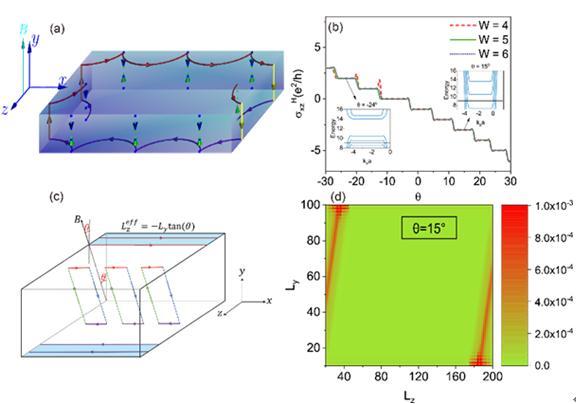
Weyl semimetals are three-dimensional topological quantum materials of which bulk energy bands are gapped except for an even number of points in the momentum space, named Weyl nodes. At some surfaces of a Weyl semimetal, there exist topologically protected surface states, so-called Fermi arcs. The Fermi arcs on the top and the bottom surfaces of the Weyl semimetal form a complete two-dimensional electron gas via Weyl nodes. In the presence of a magnetic field, bulk electrons form chiral Landau bands with linear dispersion along the direction of the magnetic field. Through the analysis of the semi-classical equations of motion of electrons and numerical simulations of the transport, they stated that in the bulk or topologically trivial side surfaces, electrons connect the top and the bottom surfaces via chiral Landau states; on the topologically non-trivial side surfaces, electrons connect the top and the bottom surfaces via Fermi-arc surface states, thereby forming a closed trajectory (see Figure.(a)). When the Fermi level is located at the Weyl node, the Hall conductance shows quantized plateaus.
In addition, under a tilted magnetic field, chiral Landau bands will affect the spatial distribution of the edge states, and the resulting edge states will lead to distinctive Hall transport phenomena. A tilted magnetic field contributes to an intrinsic Hall conductance, and such an intrinsic value only depends on the tilting angle of the magnetic field and the properties of the Weyl semimetal. In particular, they also predicted that there is a critical angle of tilted magnetic fields. When the tilting angle of the magnetic field exceeds the critical angle, the Hall conductance will change its sign with an abrupt spatial shift of the edge states. This study uncovers the physical picture of the three-dimensional quantum Hall effect in Weyl semimetals and relates it to the topological properties of Weyl semimetals.
###
Li Hailong, a Ph.D. candidate in Professor Xie’s group, is the first author, and both Professor Xie and Professor Jiang Hua from Soochow University are the corresponding authors of this paper. Other collaborators include Professor Liu Haiwen from Beijing Normal University. This work is financially supported by the National Natural Science Foundation of China.
Media Contact
Huang Weijian
[email protected]
Original Source
http://newsen.
Related Journal Article
http://dx.