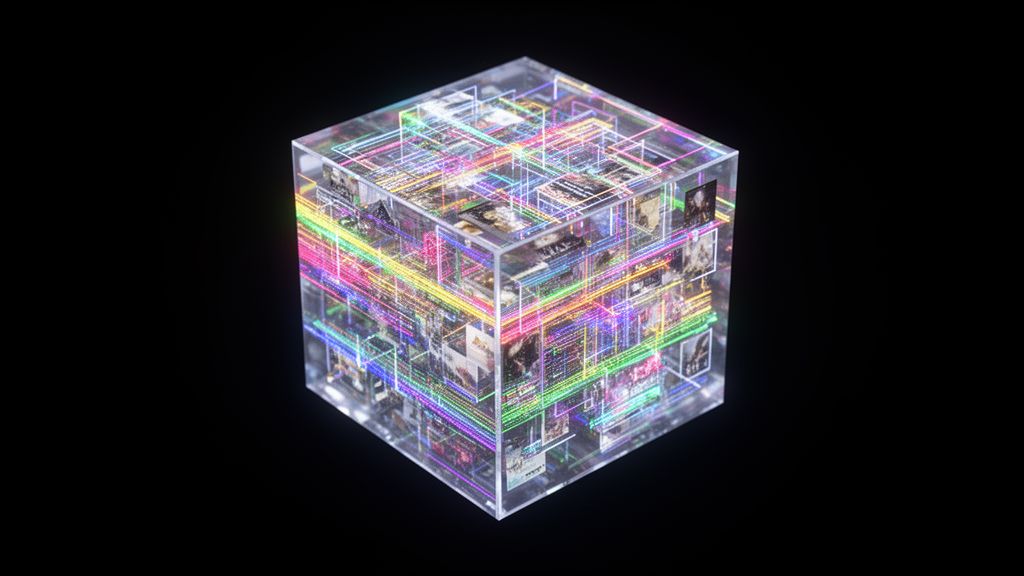
Securing digital imagery during transmission and storage across complex network infrastructures has become increasingly difficult as the sheer volume of visual data expands. Published in Multimedia Tools and Applications, the study demonstrates that reorganizing collections of color images into a unified cubic structure and subjecting them to multi-axis scrambling, inter-channel fusion, and bitwise diffusion produces cipher representations that achieve near-ideal entropy and resist statistical cryptanalysis.
Conventional cryptographic techniques designed for single-image workflows often struggle with the processing overhead and spatial complexity inherent to multi-image transmission. Many existing multiple-image approaches were developed primarily for grayscale images or restricted to fixed numbers of inputs, leaving the security of multiple simultaneous color images comparatively less explored. When color channels are handled in isolation or through restricted two-dimensional operations, inter-image dependencies and color correlation may not be sufficiently broken. To resolve these operational limitations, the research team designed a modular framework combining spatial patch reorganization with three well-established chaotic systems: the 3D Lorenz system, the 3D Rössler system, and the 3D Logistic map.
The encryption pipeline begins by segmenting input color images into non-overlapping patches and assembling them into a volumetric structure. Given N input color images of dimension M by M pixels, the system divides each image into patches of fixed dimension W by W pixels, creating a total depth of p sub-images. In an illustrative demonstration using eight 512 by 512 pixel color images and 128 by 128 pixel patches, the algorithm created a 128 by 128 by 128 colored cube. Prior to chaotic manipulation, four plaintext-dependent initialization values—denoted NR, NG, NB, and a combined value N0—are calculated from the raw red, green, and blue voxel data. By embedding these data-derived values into the initial states of the chaotic generators, the authors ensured that every generated chaotic sequence directly depends on the plaintext image content.
Once the colored cube is assembled, the framework executes a three-stage randomization phase along the z-, x-, and y-axes using distinct sequences produced by the 3D Lorenz chaotic system. The 3D Lorenz map, governed by classic differential equations with standard control parameters, provides extreme sensitivity to initial conditions and high unpredictability. Scrambling the sub-images across three perpendicular spatial axes breaks the original spatial relationships and redistributes the sub-image patches throughout the volumetric channels. This multi-axis transposition disrupts neighboring pixel groups before any channel mixing begins, establishing an initial layer of spatial confusion.
Following spatial randomization, the algorithm applies a fusion process specifically engineered to sever the high statistical correlation that typically exists between red, green, and blue channels. The randomized cubic structures for each color channel are flattened into one-dimensional vectors, and a 3D Rössler chaotic map, initialized with secret control parameters, is iterated for m steps to produce channel-specific chaotic sequences. These values are scaled and reduced modulo m to yield index mappings that permute voxel positions independently across each respective color channel. Flattening the volumes and swapping values according to Rössler-generated trajectories effectively scrambles pixel locations and prevents inter-channel dependencies from leaking information into the ciphertext.
The final encryption phase is a diffusion stage designed to disguise the actual numerical values of the image voxels. Here, the researchers iterated a three-dimensional Logistic map, whose control parameters operate within the unit interval, to generate three distinct chaotic key sequences. The flattened vectors from the fusion stage undergo bitwise XOR operations with these Logistic key streams, with key elements reduced modulo m. This bit-level alteration ensures that even if adjacent voxels possessed identical numerical properties prior to diffusion, the resulting ciphertext voxels are thoroughly altered. The diffused vectors are subsequently folded back into three-dimensional dimensions and combined to yield the final encrypted cipher cube.
Experimental evaluations performed on standard 512 by 512 color images confirmed substantial statistical scrambling across all channels. Information entropy measurements, which evaluate the degree of randomness on a theoretical scale where 8 bits per pixel represents total unpredictability, reached approximately 7.9999 bits per pixel in the encrypted cubes. Visual histogram analyses demonstrated that while plaintext color images exhibited distinct peaks corresponding to visual features, the encrypted cubes produced flat, uniform distributions across the red, green, and blue channels. Furthermore, Pearson correlation coefficients measured across adjacent voxels in horizontal, vertical, and diagonal directions dropped from high plaintext values to figures extremely close to zero, showing that the linear dependencies between neighboring pixels were effectively eliminated.
The algorithm was also subjected to differential attack testing, which quantifies how minor variations in the input influence the final encrypted output. The researchers evaluated the Number of Pixels Change Rate (NPCR) and the Unified Average Changing Intensity (UACI), which measure the percentage of changed pixels and the average intensity variation between two ciphertexts generated from plaintexts differing by a single pixel. Under single-pixel plaintext modifications, the cipher cube exhibited an average ciphertext change rate of 99.607642%, with individual channels showing change rates exceeding 99.60%. These values, alongside UACI percentages exceeding the 33% security baseline, demonstrate that minor modifications in the input image completely alter the resulting encrypted structure.
To assess robustness against physical channel distortions, the researchers conducted data-loss and noise contamination experiments. When portions of the ciphertext cube were intentionally cut away—simulating transmission loss of 12.5% and 25% through the removal of one or two 64 by 64 by 64 voxel blocks—the decrypted images remained recognizable, attaining peak signal-to-noise ratios of 19.39 dB and 15.37 dB, and structural similarity index values of 0.459 and 0.249, respectively. Similarly, introducing 15% and 25% salt-and-pepper noise yielded recovered images with PSNR values of 17.60 dB and 14.68 dB. Although reconstruction quality degraded as data loss or noise severity increased, the system demonstrated measurable tolerance against hostile or corrupted channel conditions.
Security analyses further addressed theoretical key space, key sensitivity, and resistance to chosen-plaintext and known-plaintext attacks. The cryptosystem’s secret key is composed of initial state values and system parameters across the Lorenz, Rössler, and Logistic systems, yielding a theoretical key space of approximately 10 to the 270th power when calculated at a numerical precision of 10 to the minus 15, well beyond the brute-force threshold of 2 to the 100th power. Key sensitivity testing confirmed that altering initial conditions by as little as 10 to the minus 8 completely prohibited valid image decryption. Furthermore, when equivalent diffusion keystreams extracted from known or chosen plaintexts were applied across different target images, cross-plaintext recovery rates averaged roughly 0.39%, aligning closely with the theoretical random byte-match probability of 0.390625% and confirming that diffusion keys cannot be trivially reused across different inputs.
Computational performance benchmarks indicated that the cryptosystem scales linearly with the total number of voxels, maintaining asymptotic time and memory complexities of O(V). Implemented in Python 3.10 with NumPy, OpenCV, and Numba acceleration on an Intel64 machine with 7.88 GB of RAM, an eight-image batch totaling 6.00 MiB required an average encryption time of 1.0296 seconds and an average decryption time of 0.5420 seconds. This translated to processing throughputs of 5.8277 MiB/s for encryption and 11.0698 MiB/s for decryption, with an average per-image encryption latency of approximately 0.129 seconds. The authors noted that while the current formulation focuses on static color images, future research could explore extending the 3D cubic framework into higher-dimensional representations to secure successive frames in temporal video streams.
Subject of Research: Multiple color image encryption using 3D chaotic maps and cubic representation
Article Title: Enhanced multiple color image encryption utilizing 3D chaotic maps with iterative sub-image randomization and fusion
Article References: Hosny, K. M., Elnabawy, Y. M., Elshewey, A. M., & Salama, R. A. (2026). Enhanced multiple color image encryption utilizing 3D chaotic maps with iterative sub-image randomization and fusion. Multimedia Tools and Applications, 85(12), Article 856. https://doi.org/10.1007/s11042-026-21995-z
Image Credits: AI Generated
DOI: 10.1007/s11042-026-21995-z
Keywords: Image Encryption, Multiple Image Encryption, Chaotic Systems, 3D Lorenz Map, 3D Rössler Map, 3D Logistic Map, Cubic Image Representation, Information Entropy, Differential Attack Resistance, NPCR, UACI, Color Image Security, Cryptographic Permutation, Bitwise Diffusion, Data Loss Robustness, Noise Robustness, Computational Complexity
News Source: Denise Maddox. (November 21, 2026). Three-Dimensional Chaotic System Encrypts Multiple Color Images in Unified Cube Architecture. Scienmag.