A prospective head-to-head evaluation conducted within a high-throughput clinical microbiology laboratory has demonstrated that three commercial matrix-assisted laser desorption/ionization time-of-flight mass spectrometry platforms deliver high levels of identification confidence and strong inter-device agreement across routine diagnostic workflows. Testing the platforms in parallel across everyday diagnostic routines revealed that initial single-run high-confidence identification rates reached 92.4 percent for the Biotyper sirius, 88.0 percent for the EXS2600, and 86.3 percent for the VITEK MS PRIME. When secondary repeat testing incorporating chemical extraction was applied to inconclusive isolates, final high-confidence rates rose to 97.7 percent, 95.7 percent, and 93.2 percent, respectively. Overall inter-device species concordance across the platforms reached 93.9 percent for isolates with valid results on all three instruments.
Microbial species identification serves as an essential pillar of diagnostic patient care, frequently guiding targeted anti-infective treatment choices before antimicrobial susceptibility profiles become fully available. Molecular strategies such as polymerase chain reaction and targeted or untargeted genomic sequencing overcome some of these constraints, yet they remain either limited in target breadth or too costly and operationally complex for high-volume routine workflows. Over the past decade, matrix-assisted laser desorption/ionization time-of-flight mass spectrometry has become the standard culture-based identification modality across bacteriology and mycology by providing rapid, cost-effective, and straightforward species determinations from grown colonies. Because clinical diagnostic services process daily workloads numbering between hundreds and thousands of diagnostic specimens, laboratory managers must balance hands-on processing demands, time to initial result, instrument throughput, and repeat-measurement requirements against analytical reliability.
The study setting at the Diagnostic and Research Institute in Graz provides comprehensive clinical microbiological services to the 1,600-bed University Hospital of Graz alongside more than 1,600 outpatient medical practices situated across South-Eastern Austria. Investigators collected pure microbial isolates cultured from routine clinical diagnostic specimens between May and July 2023, storing recovered cultures at 4 degrees Celsius for up to seven days prior to analysis while deliberately excluding mixed cultures and filamentous fungi. To ensure representative sampling of real-world operational conditions, study days were randomly distributed across the investigation window, with each weekday represented twice. A total of 254 distinct identification results were generated during the evaluation, spanning aerobic and anaerobic bacteria as well as clinical yeasts. Directly prior to spectrometric acquisition, all preserved isolates were subcultured using standardized growth media and standardized incubation conditions to guarantee consistent physiological states across all parallel diagnostic runs.
Bacterial and fungal culture protocols strictly regulated atmospheric conditions, incubation temperatures, and culture durations across all recovery media. Gram-positive and Gram-negative aerobic bacteria grown on MacConkey II agar and BBL CHROMagar Orientation medium were maintained at 35 degrees Celsius with a tolerance of one degree in ambient air, whereas isolates inoculated onto Columbia agar with 5 percent sheep blood, Chocolate PolyViteX agar, and Columbia CNA agar were incubated in a 5 percent carbon dioxide enriched atmosphere. Anaerobic species plated onto Schaedler agar with vitamin K1 and sheep blood or Schaedler kanamycin-vancomycin blood agar were incubated under strictly anaerobic conditions for 48 hours, while aerobic organisms were grown for 24 hours. Recovered yeast isolates were cultured on Sabouraud gentamicin chloramphenicol agar or CHROMID Candida agar at 30 or 35 degrees Celsius in ambient air for 24 hours. The testing order across the three diagnostic analyzers was permutated on a daily schedule, and technicians spotted targets blindly without knowledge of comparator instrument outputs.
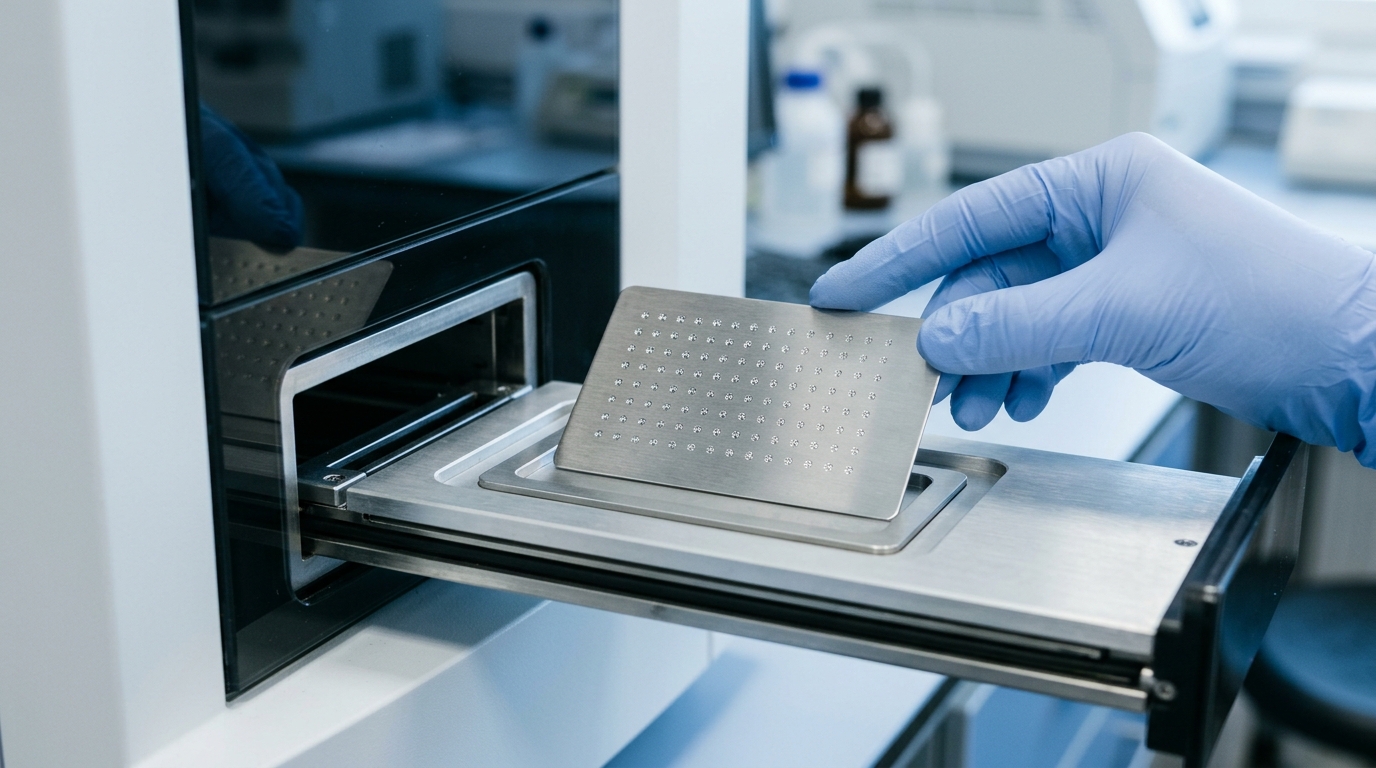
Preparation intervals were measured from the initial mechanical transfer of a microbial colony onto a disposable or reusable target plate through matrix application, matrix-embedded cell drying, and physical target loading into the mass spectrometer. Across 26 evaluated runs comprising 2,232 individual clinical samples, average hands-on sample preparation intervals showed no statistically significant divergence between the three platforms, ranging narrowly between 23.9 and 26.3 seconds per isolate. All specimens were initially spotted directly onto target plates without pre-analytical chemical lysis. Because proprietary target-handling enhancements, such as specialized drying heat blocks or optical spot-illumination guides, were not uniformly available across all three instrument platforms, the investigators excluded proprietary benchtop aids to preserve methodological comparability.
The Biotyper sirius demonstrated significantly faster spectral acquisition than both competing instruments, recording an average per-isolate measurement interval of 4.5 seconds. The EXS2600 registered an average measurement speed of 9.3 seconds per specimen, while the VITEK MS PRIME required an average of 32.0 seconds per isolate. For a complete 96-spot analytical plate, the Biotyper completed measurement runs in approximately seven minutes, whereas the VITEK MS PRIME required an average of 51 minutes to analyze equivalent isolate numbers across two 48-spot target plates. Although target transition exchanges prolonged runs on the VITEK system, mechanical switching accounted for only a minor fraction of the observed duration difference. However, the VITEK instrument accommodated up to 16 target slides simultaneously, enabling an unattended batch capacity of 768 analyses.
Each instrument categorizes measurement validity using a standardized traffic-light visual classification based on proprietary scoring thresholds and confidence algorithms. Green results represent reliable high-confidence identifications, yellow outputs indicate lower confidence or unresolved multi-taxon groupings requiring supplementary corroboration, and red outputs designate invalid measurements resulting from absent database matches or failed spectral acquisition. In first-attempt direct colony analyses involving 2,433 isolates, the Biotyper sirius achieved 2,249 green results representing 92.4 percent, the EXS2600 yielded 2,140 green results representing 88.0 percent, and the VITEK MS PRIME generated 2,099 green results representing 86.3 percent. When acceptable diagnostic confidence was broadened to include valid yellow results, initial overall confidence rates reached 98.4 percent for the Biotyper, 96.4 percent for the EXS2600, and 90.6 percent for the VITEK MS PRIME. Initial invalid red outputs occurred in 1.6 percent of Biotyper runs, 3.6 percent of EXS runs, and 9.4 percent of VITEK runs, with failed spectrum generation accounting for 8 percent of Biotyper failures, zero EXS failures, and 29 percent of VITEK failures.
Isolates that failed to yield green classifications during the initial direct measurement underwent subculture and pre-analytical cell extraction using formic acid in strict compliance with manufacturer instructions. Failed subculture growth prevented repeat testing for 77 Biotyper isolates, 38 EXS isolates, and 128 VITEK isolates, necessitating their exclusion from post-repetition performance metrics. Secondary testing resolved ambiguous results at differing platform-specific efficiencies, with successful upgrades to green status occurring in 67 percent of re-tested EXS isolates and 39 percent of re-tested VITEK isolates. Following completion of repeat measurements on available viable strains, cumulative high-confidence green identification proportions rose significantly to 97.7 percent for the Biotyper sirius (95 percent confidence interval 96.9 to 98.2 percent), 95.7 percent for the EXS2600 (95 percent confidence interval 94.7 to 96.4 percent), and 93.2 percent for the VITEK MS PRIME (95 percent confidence interval 92.1 to 94.2 percent). Persistent red invalid determinations dropped to 0.3 percent for the Biotyper, 1.1 percent for the EXS, and 3.2 percent for the VITEK instrument.
Analytical concordance across the three diagnostic systems remained high throughout the large clinical isolate cohort. Among the 2,222 clinical strains that produced a final valid result of at least yellow confidence on every instrument and fit a single concordance category, 2,086 isolates—representing 93.9 percent—achieved identical species identifications across all three platforms. Pairwise concordance comparisons demonstrated the highest shared agreement between the Biotyper sirius and VITEK MS PRIME, which agreed on 2,155 isolates, while the Biotyper and EXS2600 shared agreement on 2,113 isolates, and the EXS2600 and VITEK MS PRIME agreed on 2,114 isolates. Complete three-way discordance, where each platform reported a distinct species determination, was documented in only 12 isolates, accounting for 0.5 percent of the tri-evaluated specimen subset. The study documented species diversity across challenging Gram-positive aerobes, fastidious Gram-negative rods, clinically relevant anaerobes, and multiple opportunist yeast taxa.
The study authors highlighted several methodological considerations and clinical workflow trade-offs that laboratories must evaluate when reviewing these prospective findings. Crucially, the protocol operated without independent reference identification standards, such as gene sequencing or extensive reference biochemical profiling, preventing researchers from arbitrating discordant results or determining true diagnostic accuracy. Furthermore, fastidious bacteria and yeasts were overrepresented among strains that failed viability recovery for repeat testing, which could modestly overestimate final resolution rates after repetition. Because hands-on sample preparation demands proved nearly identical, diagnostic facilities selecting an analyzer can focus on balancing raw acquisition speed against automated target batching capacity, re-testing frequency, and local operational requirements.
Subject of Research: Comparative routine diagnostic performance of three commercial MALDI-TOF mass spectrometry platforms
Article Title: Hands-on time, time to result, and inter-device concordance: a prospective real-life comparison of three MALDI-TOF MS systems in the routine laboratory
Article References: Klugherz, I., Greimel, H., Friedl, S., Steinmetz, I., & Dichtl, K. (2026). Hands-on time, time to result, and inter-device concordance: a prospective real-life comparison of three MALDI-TOF MS systems in the routine laboratory. Frontiers in Cellular and Infection Microbiology, 16, 1924481. https://doi.org/10.3389/fcimb.2026.1924481
Image Credits: AI Generated
DOI: 10.3389/fcimb.2026.1924481
Keywords: MALDI-TOF mass spectrometry, microbial identification, clinical microbiology, Biotyper sirius, VITEK MS PRIME, EXS2600, diagnostic bacteriology, clinical mycology, routine diagnostics, turnaround time, hands-on time, species concordance, formic acid extraction, measurement confidence, laboratory automation, spectrometric profiling
News Source: Ophelia Keating. (November 27, 2026). Three Diagnostic Mass Spectrometry Systems Demonstrate High Agreement in Routine Microbial Testing. Scienmag.