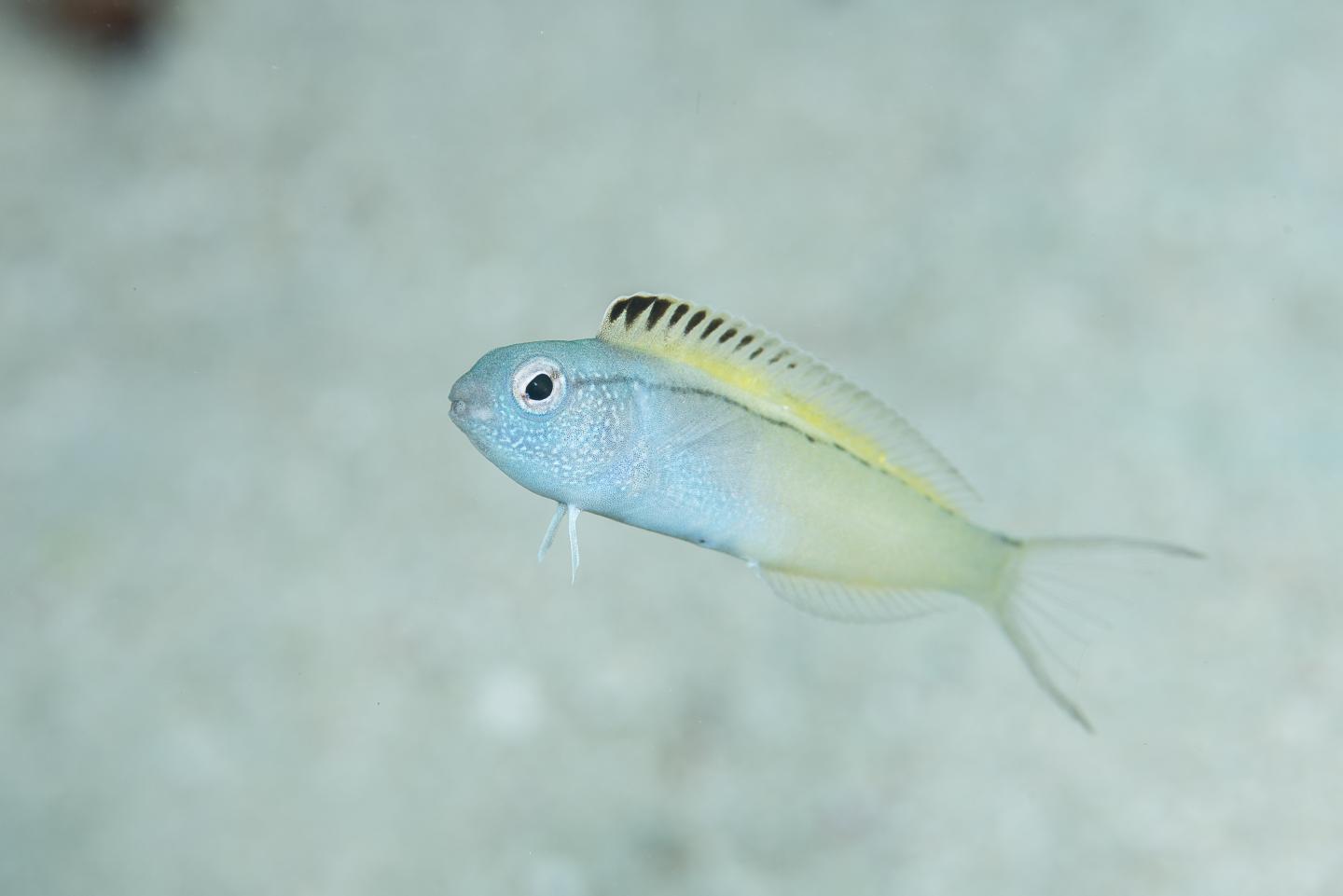
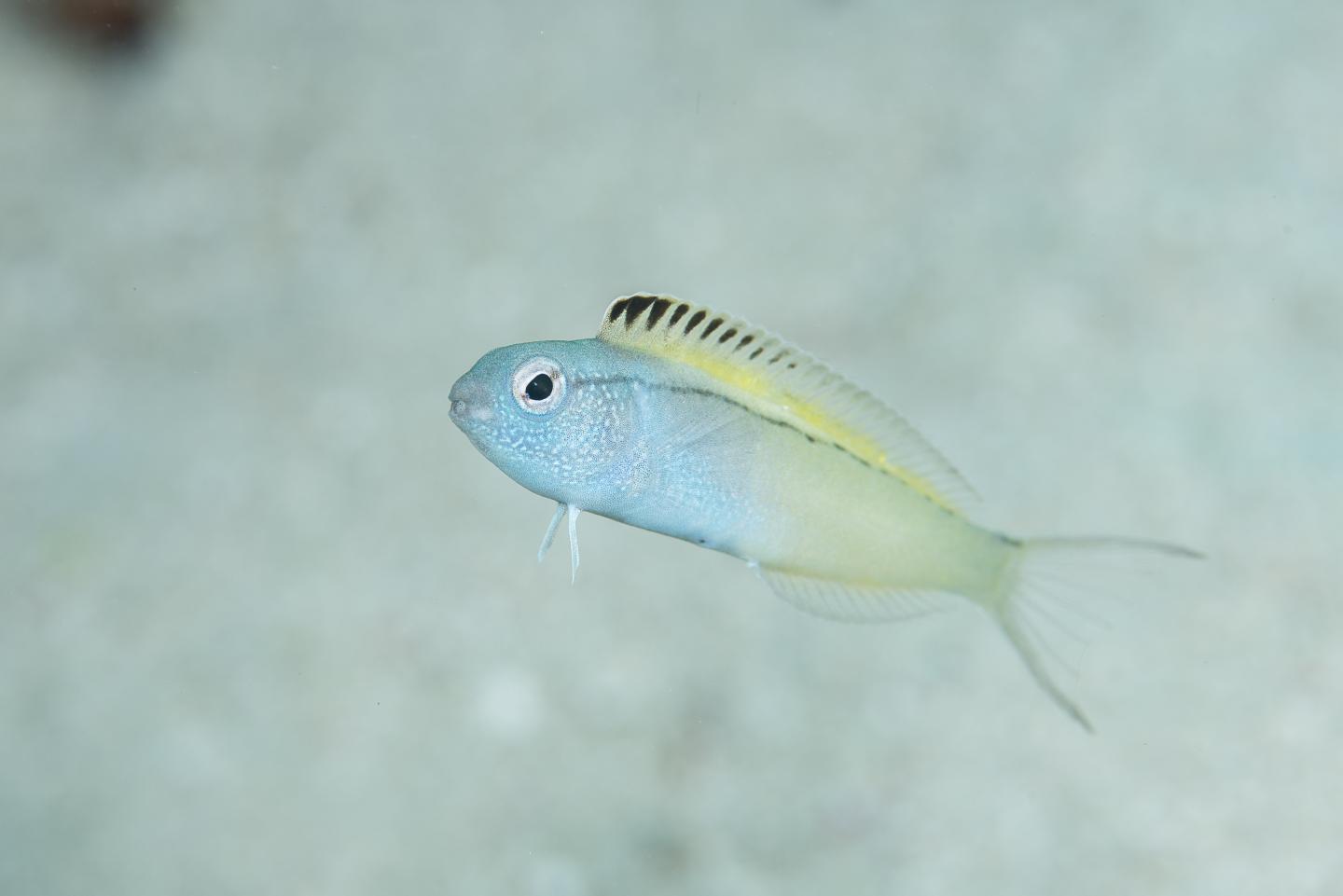
Credit: Richard Smith/OceanRealmImages
Fang blennies are small fish with big teeth. Specifically, they have two large canine teeth that jut out of their lower jaw. Since blenny fish are only about two inches long, these "fangs" would be less than intimidating if not for the venom within. Blenny fish venom most likely causes a sudden drop in blood pressure in would-be predators, such as grouper fish, that have been bitten by blennies, researchers report on March 30 in Current Biology.
When the researchers did a proteomic analysis of extracted fang blenny venom, they found three venom components–a neuropeptide that occurs in cone snail venom, a lipase similar to one from scorpions, and an opioid peptide. And, surprisingly, when they injected the blenny venom into lab mice, the mice didn't show any signs of pain.
"For the fang blenny venom to be painless in mice was quite a surprise," says study co-author Bryan Fry of University of Queensland. "Fish with venomous dorsal spines produce immediate and blinding pain. The most pain I've ever been in other than the time I broke my back was from a stingray envenomation. 'Sting'ray sounds so benign. They don't sting. They are pure hell."
Fang blenny venom, however, seems to have a very different effect on its victims. Since the researchers used rodents for the pain test, they can't entirely rule out the possibility of blenny venom causing pain in fish, but it seems plausible that the neuropeptide and opioid components may cause a sudden drop in blood pressure, most likely leaving the blenny's attacker disorientated and unable to give chase. "By slowing down potential predators, the fang blennies have a chance to escape," says Fry. "While the feeling of pain is not produced, opioids can produce sensations of extremely unpleasant nausea and dizziness [in mammals]."
Extracting the tiny fish's venom for chemical tests was no easy feat. When blenny fish bite an attacker, they only inject a tiny amount of venom, making it extremely difficult to collect enough for proteomic analyses. The researchers ended up using a quirky but labor-intensive method for extracting blenny venom: they would pluck the little fish out of their tanks, dangle a cotton swab in front of them so that the blenny would bite the cotton swab, and then suspended the cotton swabs in a solution that drew out the venom (after putting the fish back in the tank).
Nonvenomous fang blennies and other small fish capitalize on the venom's success by mimicking venomous fang blennies' colors and patterns. "Predatory fish will not eat those fishes because they think they are venomous and going to cause them harm, but this protection provided also allows some of these mimics to get very close to unsuspecting fish to feed on them, by picking on their scales as a micropredator," says study co-author Nicholas Casewell of the Liverpool School of Tropical Medicine. "All of this mimicry, all of these interactions at the community level, ultimately are stimulated by the venom system that some of these fish have."
Another surprise from the study was the evidence suggesting that fang blenny fangs evolved before the venom. "This is pretty unusual, because often what we've found–for example, in snakes–is that some sort of venom secretions evolved first, before the elaborate venom delivery mechanism evolved," says Casewell. Evolution favored the tiny fish with large teeth first and later found a way to enhance them with venom.
"These unassuming little fish have a really quite advanced venom system, and that venom system has a major impact on fishes and other animals in its community," says Casewell.
The researchers went into the study with "no grand hypothesis, just basic wonderment" according to Fry, but they plan to follow up the study by comparing and contrasting the composition of venoms from different blenny species.
###
This work is supported by the UK Natural Environment Research Council, the Australian Research Council, and the Herman Slade Foundation.
Current Biology, Casewell et al.: "The evolution of fangs, venom and mimicry systems in blennyfishes" http://www.cell.com/current-biology/fulltext/S0960-9822(17)30269-5
Current Biology (@CurrentBiology), published by Cell Press, is a bimonthly journal that features papers across all areas of biology. Current Biology strives to foster communication across fields of biology, both by publishing important findings of general interest and through highly accessible front matter for non-specialists. Visit: http://www.cell.com/current-biology. To receive Cell Press media alerts, contact [email protected].
Media Contact
Diana Crow
[email protected]
617-397-2802
@CellPressNews
http://www.cellpress.com
############
Story Source: Materials provided by Scienmag