Thirty years of optical parametric chirped pulse amplification (OPCPA)
Credit: OEA
Thirty years of optical parametric chirped pulse amplification (OPCPA)
A new publication from Opto-Electronic Advances, DOI 10.29026/oea.2023.220046 discusses table-top optical parametric chirped pulse amplifiers.
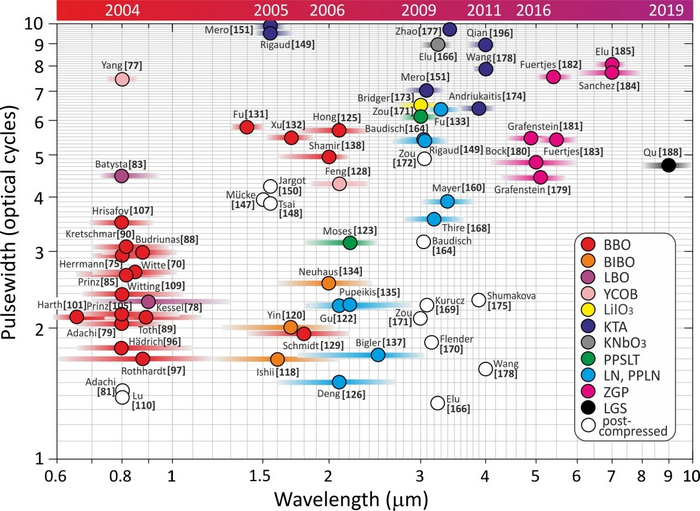
The invention of Chirped Pulse Amplification (CPA) technique in 1985 by D. Strickland and G. Mourou at the University of Rochester marked a new era of ultrafast laser science and technology. CPA solved the long-standing problem of ultrashort pulse amplification that was related to optical damage of the laser amplifier, allowing to boost the energy and power of light pulses to unprecedented level. CPA inspired a tremendous progress of ultrafast solid-state lasers, that in turn facilitated the development of laser-related experimental sciences, opening new areas of physics, technology and multidisciplinary research. In 1992, A. Dubietis, G. Jonušauskas and A. Piskarskas at Vilnius University Laser Research Center demonstrated a “modified CPA” technique, where the laser amplifier was replaced by the optical parametric amplifier. The technique, shortly after named Optical Parametric Chirped Pulse Amplification (OPCPA), favorably combined the advantages of CPA with the advantages of optical parametric amplification, which due to its non-resonant nature, offers very high gain, low thermal load, great wavelength flexibility and intrinsically broad amplification bandwidth. OPCPA was quickly considered as a very promising technique for producing ultrashort light pulses with ultrahigh peak power. By present-day, OPCPA alongside CPA are the key techniques providing the conceptual basis of petawatt laser facilities. However, and quite surprisingly, it took time (more than 10 years) to recognize the potential of OPCPA for the development of compact, table-top systems. A tremendous progress in this direction is witnessed since, especially over the past decade, when table-top OPCPA systems reached high level of maturity, evolving into a unique class of high power ultrafast light sources, which amplify octave-spanning spectra and produce the shortest pulses in the optical range with multi-gigawatt to multi-terawatt peak powers and multi-watt average powers, with carrier wavelengths reaching far beyond those afforded by currently existing solid-state laser amplifiers.
In 2022, OPCPA celebrates its 30th anniversary and the authors of this article share their views at these fascinating developments from historical and technological perspectives, giving a comprehensive account on the state of the art of table-top OPCPA systems, addressing their relevant scientific and technological aspects, design concepts, performance characteristics and growing practical applications in diverse fields of ultrafast science.
Article reference: Dubietis A, Matijošius A. Table-top optical parametric chirped pulse amplifiers: past and present. Opto-Electron Adv 6, 220046 (2023). doi: 10.29026/oea.2023.220046
Keywords: optical parametric amplification / post-compression / ultrafast nonlinear optics / high harmonic generation
# # # # # #
Audrius Dubietis is a distinguished professor at Laser Research Center, Vilnius University, and a member of the Lithuanian Academy of Sciences. Prof. A. Dubietis is one of the inventors of OPCPA (together with prof. A. Piskarskas and dr. G. Jonušauskas) in 1992. He currently leads the research group at the laboratory of Ultrafast Nonlinear Optics, and his research interests include optical parametric amplification, laser-matter interactions and femtosecond filamentation phenomena in transparent solids.
Aidas Matijošius is a professor and director of Laser Research Center, Vilnius University, Lithuania. His research interests include optical parametric amplification, light-matter interactions and optical vortex beams. He leads Vilnius University part of the international 7th EU Framework Program project Laserlab-Europe V and is an official representative of Lithuania in the world’s leading consortium of laser research infrastructures ELI ERIC.
# # # # # #
Opto-Electronic Advances (OEA) is a high-impact, open access, peer reviewed monthly SCI journal with an impact factor of 8.933 (Journal Citation Reports for IF2021). Since its launch in March 2018, OEA has been indexed in SCI, EI, DOAJ, Scopus, CA and ICI databases over the time and expanded its Editorial Board to 36 members from 17 countries and regions (average h-index 49).
The journal is published by The Institute of Optics and Electronics, Chinese Academy of Sciences, aiming at providing a platform for researchers, academicians, professionals, practitioners, and students to impart and share knowledge in the form of high quality empirical and theoretical research papers covering the topics of optics, photonics and optoelectronics.
# # # # # #
More information: http://www.oejournal.org/oea
Editorial Board: http://www.oejournal.org/oea/editorialboard/list
All issues available in the online archive (http://www.oejournal.org/oea/archive).
Submissions to OEA may be made using ScholarOne (https://mc03.manuscriptcentral.com/oea).
ISSN: 2096-4579
CN: 51-1781/TN
Contact Us: [email protected]
Twitter: @OptoElectronAdv (https://twitter.com/OptoElectronAdv?lang=en)
WeChat: OE_Journal
# # # # # #
Journal
Opto-Electronic Advances
DOI
10.29026/oea.2023.220046