• HOME
  • NEWS
  • EXPLORE
    • CAREER
      • Companies
      • Jobs
    • EVENTS
    • iGEM
      • News
      • Team
    • PHOTOS
    • VIDEO
    • WIKI
  • BLOG
  • COMMUNITY
    • FACEBOOK
    • INSTAGRAM
    • TWITTER
Friday, April 3, 2026
BIOENGINEER.ORG
No Result
View All Result
  • Login
  • HOME
  • NEWS
  • EXPLORE
    • CAREER
      • Companies
      • Jobs
        • Lecturer
        • PhD Studentship
        • Postdoc
        • Research Assistant
    • EVENTS
    • iGEM
      • News
      • Team
    • PHOTOS
    • VIDEO
    • WIKI
  • BLOG
  • COMMUNITY
    • FACEBOOK
    • INSTAGRAM
    • TWITTER
  • HOME
  • NEWS
  • EXPLORE
    • CAREER
      • Companies
      • Jobs
        • Lecturer
        • PhD Studentship
        • Postdoc
        • Research Assistant
    • EVENTS
    • iGEM
      • News
      • Team
    • PHOTOS
    • VIDEO
    • WIKI
  • BLOG
  • COMMUNITY
    • FACEBOOK
    • INSTAGRAM
    • TWITTER
No Result
View All Result
Bioengineer.org
No Result
View All Result
Home NEWS Science News Chemistry

Thermal siphon effect: heat flows from low temperature to high temperature

Bioengineer by Bioengineer
September 27, 2019
in Chemistry
Reading Time: 2 mins read
0
IMAGE
Share on FacebookShare on TwitterShare on LinkedinShare on RedditShare on Telegram

IMAGE

Credit: ©Science China Press

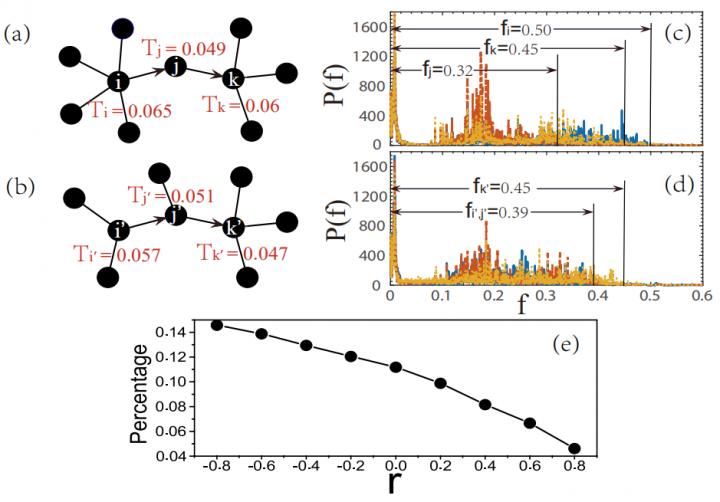
Heat energy spontaneously goes from higher temperature to lower temperature. However, recently, a team from China and the USA (Kezhao Xiong and Zonghua Liu from East China Normal University, Chunhua Zeng from Kunming University of Science and Technology, and Baowen Li from University of Colorado Boulder) revealed that in some complex network structures, heat energy can transfer from a node with lower temperature to another node with higher temperature, which we call thermal siphon effect. The team even discovered that this effect becomes more evident with the decrease of network assortativity.

To understand this abnormal phenomenon (Figure a), the team studied power spectra of the nodes (Fig c and d), and the transport of the energy within the spectra range. They found that, within the power spectrum range, heat energy still transfers from (effective) high temperature node to (effective) low temperature node.

Moreover, an optimal network structure is discovered, that displays a small thermal conductance and a large electrical conductance simultaneously.

It is well known that realistic systems for heat management and control are not regular lattices but complex networks such as the thermal devices of nanotube and nanowire networks, whose topologies are fundamentally different from the cases of 1D and 2D lattices. In particular, the ideal materials for thermoelectric applications are phonon glass and electric crystal, namely good electric conduction and poor thermal conduction.

Therefore, the study may shed a new light on the search of good thermoelectric materials.

###

See the article:

Thermal siphon phenomenon and thermal/electric conduction in complex networks

Kezhao Xiong, Zonghua Liu, Chunhua Zeng, Baowen Li

Natl Sci Rev, 2019, doi: 10.1093/nsr/nwz128

https://doi.org/10.1093/nsr/nwz128

Media Contact
YAN Bei
[email protected]

Related Journal Article

http://dx.doi.org/10.1093/nsr/nwz128

Tags: Chemistry/Physics/Materials Sciences
Share12Tweet8Share2ShareShareShare2

Related Posts

Engineered Biochar Harnesses Soil Chemistry to Degrade Antibiotic Pollution

Engineered Biochar Harnesses Soil Chemistry to Degrade Antibiotic Pollution

April 2, 2026
From Coffee Waste to Cutting-Edge Biodegradable Insulation: A Green Innovation

From Coffee Waste to Cutting-Edge Biodegradable Insulation: A Green Innovation

April 2, 2026

Study Uncovers Early Origins of Atypical Alterations in Dalí’s The Temptation of St. Anthony (1946), Highlighting Crucial Roles of Amber and Zinc White

April 2, 2026

Racetrack-Shaped Lasers Revolutionize Bright and Stable Frequency Combs

April 2, 2026
Please login to join discussion

POPULAR NEWS

  • blank

    Revolutionary AI Model Enhances Precision in Detecting Food Contamination

    96 shares
    Share 38 Tweet 24
  • Imagine a Social Media Feed That Challenges Your Views Instead of Reinforcing Them

    1007 shares
    Share 398 Tweet 249
  • Promising Outcomes from First Clinical Trials of Gene Regulation in Epilepsy

    51 shares
    Share 20 Tweet 13
  • Popular Anti-Aging Compound Linked to Damage in Corpus Callosum, Study Finds

    44 shares
    Share 18 Tweet 11

About

We bring you the latest biotechnology news from best research centers and universities around the world. Check our website.

Follow us

Recent News

Revolutionizing the Body from Within: The Rise of ‘Transformation Electrodes’

Levothyroxine Shows No Benefit in Older Adults

National Dust Storm Impact on Tourism and Infrastructure

Subscribe to Blog via Email

Success! An email was just sent to confirm your subscription. Please find the email now and click 'Confirm' to start subscribing.

Join 78 other subscribers
  • Contact Us

Bioengineer.org © Copyright 2023 All Rights Reserved.

Welcome Back!

Login to your account below

Forgotten Password?

Retrieve your password

Please enter your username or email address to reset your password.

Log In
No Result
View All Result
  • Homepages
    • Home Page 1
    • Home Page 2
  • News
  • National
  • Business
  • Health
  • Lifestyle
  • Science

Bioengineer.org © Copyright 2023 All Rights Reserved.