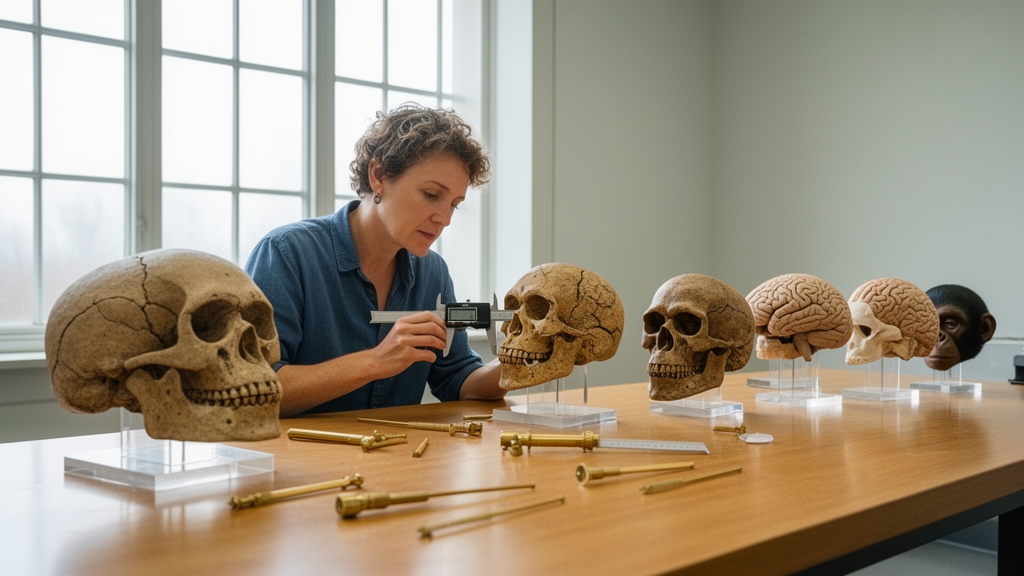
Reconstructing the deep evolutionary timeline of human cognition poses a foundational challenge for evolutionary theorists, who frequently rely on subjective plausibility judgments when hard paleoanthropological evidence is scarce. In a theoretical analysis published in the journal Biology and Philosophy, philosopher of science Margaret E. Farrell argues that researchers attempting to explain the origins of uniquely human cognitive traits systematically misstep by treating their own intuitive sense of plausibility as evidential support. When scholars construct evolutionary scenarios, they frequently evaluate whether a novel cognitive transition would feel easy, natural, or obvious to an ancestral hominin endowed with a specific baseline suite of mental tools. Farrell demonstrates that this intuitive sense of cognitive ease is fundamentally circular and misleading because it is generated by the very modern cognitive adaptations whose evolutionary emergence the theorist is attempting to explain in the first place.
The central difficulty stems from the epistemic structure of historical cognitive science, where physical traces of ancestral mental life are extraordinarily rare and difficult to interpret. When theorists seek to explain uniquely human traits such as theory of mind, complex moral psychology, and hyper-cooperative sociality, they generally pursue broad causal narratives that link selective pressures to novel mental adaptations across the hominin lineage. Within these narrative frameworks, researchers regularly make two specific types of intuitive claims: that a target cognitive capacity is closely associated with an ancestral capacity, or that the novel capacity could readily emerge in an ancestral population already possessing certain foundational abilities. While formally structured as standard evolutionary inferences, Farrell points out that these steps are often defended not through independent functional or phylogenetic justification, but through an investigator’s intuitive feeling that two distinct cognitive tasks are conceptually adjacent or functionally continuous.
To expose the operational mechanics of this reasoning, Farrell analyzes Michael Tomasello’s Shared Intentionality Hypothesis, which charts hominin evolution across three successive stages: individual intentionality, joint intentionality, and collective intentionality. In illustrating how early humans might have bridged the gap toward abstract multiunit linguistic constructions, Tomasello introduces an explicit thought experiment involving an ancestral hominin who combines an established gesture for eating with an unrelated gesture for berry foraging. Tomasello suggests that it would not take an intellectual genius in that situation to string those gestures together to request berries, comparing the step to the linguistic generalizations observed in modern human toddlers. Farrell emphasizes that modern humans perceive this combination as obvious precisely because our modern minds already possess fully evolved linguistic and compositional faculties. Without those modern adaptations already active, there is no evolutionary guarantee that combining distinct single-unit communicative conventions constitutes a small, accessible, or readily achievable cognitive leap for an ancestral hominin.
Farrell identifies an analogous intuitive leap in Tomasello’s subsequent work on the origins of human moral psychology, which posits that second-personal morality emerged directly from dyads coordinating joint intentional activities. According to Tomasello’s model, ancestral partners recognizing their equal, interchangeable standing in collaborative ventures would naturally experience a mutual sense of deservingness, respect, and felt obligation. However, drawing on philosophical critiques by P. Kyle Stanford, Farrell points out that the coordination of joint activities strictly requires only instrumental norms and strategic calculations, rather than an internalized sense of moral duty. To illustrate this distinction, Farrell describes modern shoppers who agree to hold a ladder for one another to reach high items in a grocery aisle, noting that while the physical task is purely instrumental, modern humans automatically experience a deep sense of moral betrayal if one person absconds with the entire reward. This immediate sense of moral outrage reflects the modern operation of our fully evolved moral psychology rather than the evolutionary pathway through which moral obligation first arose.
The critique further scrutinizes cognitive evolutionary accounts that attempt to align with minimum-capacity inferences, an established methodology within cognitive archaeology. As formulated by philosophers Adrian Currie and Anton Killin, standard minimum-capacity inferences examine preserved material traces, such as Acheulean stone tools, and establish the minimal cognitive requirements, such as forward planning or mental time travel, strictly necessary to manufacture those physical artifacts. Farrell emphasizes that Tomasello’s thought experiments depart significantly from this archaeological standard by attempting to link hypothetical cognitive capacities directly to other cognitive capacities, rather than grounding them in tangible material remains. Demonstrating that two cognitive abilities are interdependent or mutually reinforcing in modern humans does not provide the rigorous necessity relation required by historical reconstructions, because abilities that are structurally linked today may have originated through entirely separate evolutionary trajectories and selective pressures.
Moving beyond explicit thought experiments, Farrell examines how evolutionarily biased intuitions can distort hypotheses that ostensibly rely on extensive modern experimental data, focusing on Kyle Stanford’s correlated interaction account of moral externalization. Stanford argues that moral externalization evolved specifically to ensure correlated interaction among cooperative partners by binding two distinct functional tasks: motivating personal conformity to shared norms and directing the social exclusion of non-conforming group members. To support this evolutionary model, Stanford draws upon contemporary psychological research, such as studies by Linda Skitka and colleagues demonstrating that modern individuals who externalize moral norms are significantly more inclined to socially exclude norm violators. Farrell contends that while this empirical evidence robustly characterizes the integrated architecture of modern human moral psychology, it cannot demonstrate that these two behavioral motivations emerged simultaneously in hominin history. Projecting this observed modern correlation backward into deep time presumes that an emerging sense of externality must have united both motivations from its inception, an assumption driven by how intuitively inseparable they appear to modern minds.
Farrell identifies a third distinct manifestation of intuitive reasoning in Kim Sterelny’s apprentice model of human cognitive evolution, which centers on dynamic feedback loops linking expertise, organized learning environments, and extended life history. Sterelny posits that apprentice learning could have been incrementally assembled through gradual evolution, driven by accidental environmental enrichments that accumulated across generations without requiring initial capacities for explicit teaching. However, to get this expansive feedback engine running, Sterelny assumes that ancestral hominin populations experienced two simple motivational shifts: young hominins developed heightened curiosity regarding adult activities, and adults developed increased tolerance toward the presence and experimentation of juveniles. Sterelny explicitly treats these shifts as straightforward, minimal departures from the ancestral baseline that can be granted by assumption. Farrell argues that characterizing these vital behavioral shifts as simple represents an intuitive judgment that sidesteps the fundamental explanatory question of why these motivational changes emerged exclusively in the hominin lineage rather than in closely related ape lineages.
By treating these foundational motivational innovations as intuitive starting assumptions, Sterelny effectively alters the explanatory target articulated by evolutionary anthropologists like Sarah Blaffer Hrdy, who frame the central puzzle of hominin evolution around the question of why modern human capacities arose in our lineage and not in other primates. While Sterelny successfully demonstrates that subsequent cognitive feedback loops could operate powerfully once established, the specific conditions and mechanisms that initially sparked the process remain unaddressed. Farrell observes that this adjustment reflects an epistemological compromise shaped by the profound scarcity of direct physical evidence from the earliest phases of hominin divergence. Rather than proving through empirical data that parental tolerance and juvenile curiosity were evolutionarily simple or likely to co-occur, the apprentice model relies on intuitive plausibility to bridge the gap at the critical starting point of its evolutionary narrative.
Farrell contextualizes these theoretical pitfalls by comparing them to ongoing debates surrounding the ethnographic analogy in paleoanthropology and anthropomorphism in comparative animal psychology. Methodological discussions by Alison Wylie and Adrian Currie have demonstrated that analogical reasoning based on modern human groups can be legitimate when carefully constrained by explicit middle-range theories and phylogenetic controls. However, Farrell maintains that evolutionarily biased intuitions regarding cognitive ease cannot simply be corrected with added constraints, because the subjective feeling that a mental transition was easy is an intrinsic artifact of the researcher’s own evolved psychology. While comparative psychologists studying theory of mind in living chimpanzees can continually refine experimental designs using autonomous animal subjects to test alternative hypotheses, paleoanthropologists constructing thought experiments about imaginary ancestral hominins lack living subjects. In these theoretical models, the imagined hominins are entirely under the theorist’s imaginative control, making intuitive projection far more difficult to isolate and detect.
This epistemic vulnerability is further compounded by the role of behavioral and cognitive plasticity in hominin evolution, particularly within frameworks invoking the Zone of Latent Solutions discussed by Sterelny. Comparative psychologists utilize the Zone of Latent Solutions to define the counterfactual boundaries of what a species can achieve when placed in novel environmental circumstances, providing the potential substrate for genetic assimilation. While phenotypic plasticity almost certainly played an indispensable role in shaping early hominin adaptations, Farrell highlights that the outer boundaries of ancestral plasticity are exceptionally difficult to reconstruct empirically. Attempting to deduce the plastic potential of extinct hominin species tempts theorists to fill explanatory gaps with their own intuitions about what an ancestor might have found accessible, precisely where human intuition is least reliable as an epistemic guide.
Ultimately, Farrell argues that overcoming the influence of evolutionarily biased intuitions requires cognitive paleoanthropologists to adopt heightened skepticism toward speculative thought experiments and intuitive plausibility claims. Corrective techniques borrowed from experimental psychology, such as cognitive priming exercises proposed by scholars like Marcus Dacey, are fundamentally insufficient for evolutionary reconstructions because the phases of hypothesis generation and evidential evaluation are deeply intertwined across broad historical syntheses. Theorists must actively anticipate that they will inadvertently rely on their own modern mental experiences when envisioning the inner lives of extinct ancestors. Rather than abandoning the reconstruction of human cognitive evolution, Farrell urges the scientific community to acknowledge the structural limits of intuitive reasoning, abandon appeals to perceived cognitive ease, and maintain rigorous evidential standards grounded in verifiable archaeological, comparative, and developmental data.
Subject of Research: Evidential unreliability of intuitive plausibility and thought experiments in human cognitive evolution
Article Title: What would imaginary ancestors do? Thought experiments and intuitive plausibility in human cognitive evolution
Article References: Farrell, M. E. (2025). What would imaginary ancestors do? Thought experiments and intuitive plausibility in human cognitive evolution. Biology & Philosophy, 40(4), Article 14. https://doi.org/10.1007/s10539-025-09986-0
Image Credits: AI Generated
DOI: 10.1007/s10539-025-09986-0
Keywords: cognitive evolution, hominin cognition, evolutionary theory, intuitive plausibility, thought experiments, Michael Tomasello, Kyle Stanford, Kim Sterelny, shared intentionality, moral psychology, apprentice model, cognitive archaeology, minimum capacity inference, paleoanthropology, anthropomorphism, philosophical analysis, epistemology, theory of mind
News Source: Gavin Prescott. (November 25, 2026). Theorists Risk Bias When Using Intuition to Model Human Cognitive Evolution. Scienmag.