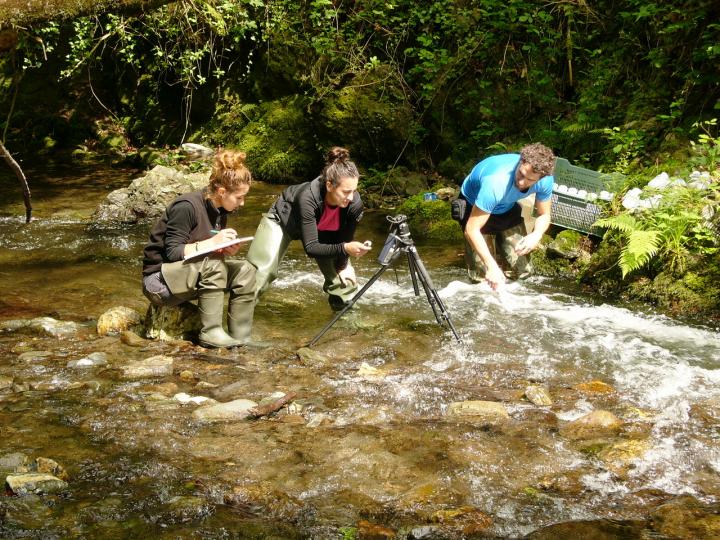

Credit: Arturo Elosegi / UPV/EHU
The Ecología de ríos/Stream Ecology research group of the UPV/EHU's Department of Plant Biology and Ecology is a group that specialises in the study of the way rivers function; it comprises experts from numerous areas who have combined their knowledge with a broad range of bibliographical information in the context of the European Globaqua Project in which more than 10 European institutions are participating. One outcome of such a broad piece of work is a long article "in which we synthesize and classify all the processes that can be measured in rivers; we explain how the measurements can be made (methods existing in the literature), how these processes respond to various environmental stressors, etc.", explained Daniel von Schiller, one of the authors of the article. It is a "proposal that puts forward a new, highly appropriate working framework for both researchers and managers," he pointed out.
As the article states, "the Water Framework Directive stipulates that river ecosystems need to be assessed not only from the point of view of their structure but also from that of the way they function, because that way it is possible to obtain a better estimate of a river's ecological status". The researcher draws an analogy with the human body: "If a patient is only checked to see whether he/she actually has a heart, lungs and kidneys, while the heart rate, the volume of air breathed and what the kidneys filter are not measured, the health status of the patient is not being properly assessed or, as in our case, the ecological status of the ecosystem being measured".
A catalogue of measurements, criteria of use and sensitivity to stressors
Right now, the measurements stipulated by the protocols to find out what the ecological status of the rivers is are structural ones (related to the shape of the channel, water quality or the composition of the biological communities): measurements of communities, pollutants, temperature, concentration of nutrients, etc. Yet the way an ecosystem functions is defined as the set of processes that regulate both matter fluxes and energy fluxes within an ecosystem. In this respect, the researchers are proposing a raft of complementary measurements of function relating to metabolism processes, the decomposition of organic matter, nutrient cycling, pollutant dynamics and river community dynamics.
In this respect, besides gathering measuring methods of the various processes found in the bibliography, these methods have been classified in terms of variables such as difficulty, complexity, costs, spatial and temporal scales of measurement, etc. "Finally," explained Daniel von Schiller, "we have conducted an exhaustive study into the literature on the responses of the various processes to environmental stressors of an anthropogenic origin (such as pollution, channelling work, acidity, etc.)".
By way of conclusion, the researcher pointed out that "this is the first time that everything that can be measured in terms of processes in rivers has been synthesised, and we are not only presenting what can be measured, we are also presenting why, how and what advantages are offered by one process over another, in addition to how it responds to stressors". The researchers set out to produce a tool that both researchers and managers can use for their work. The team is also already in contact with various players and bodies linked to water control, including URA-The Basque Water Board, to set up an innovative project to implement river measurements and functional indices.
###
Additional information
Dr Daniel von Schiller, an expert in river biogeochemistry, is the lead author of the article published in the prestigious scientific journal Science of the Total Environment. The study is the outcome of the collaboration of researchers in the Ecología de ríos/Stream Ecology group in the Department of Plant Biology and Ecology of the UPV/EHU's Faculty of Science and Technology. The group is led by Dr Arturo Elosegi. The information contained in the article is expanded on the website of the European Globaqua Project.
Bibliographical reference
Von Schiller et al. (2017). "River ecosystem processes: A synthesis of approaches, criteria of use and sensitivity to environmental stressors". Science of the Total Environment. Vol. 596-597. Pages 465-480. https://doi.org/10.1016/j.scitotenv.2017.04.081
Media Contact
Matxalen Sotillo
[email protected]
34-688-673-770
@upvehu
http://www.ehu.es
Related Journal Article
http://dx.doi.org/10.1016/j.scitotenv.2017.04.081