• HOME
  • NEWS
  • EXPLORE
    • CAREER
      • Companies
      • Jobs
    • EVENTS
    • iGEM
      • News
      • Team
    • PHOTOS
    • VIDEO
    • WIKI
  • BLOG
  • COMMUNITY
    • FACEBOOK
    • INSTAGRAM
    • TWITTER
Friday, January 16, 2026
BIOENGINEER.ORG
No Result
View All Result
  • Login
  • HOME
  • NEWS
  • EXPLORE
    • CAREER
      • Companies
      • Jobs
        • Lecturer
        • PhD Studentship
        • Postdoc
        • Research Assistant
    • EVENTS
    • iGEM
      • News
      • Team
    • PHOTOS
    • VIDEO
    • WIKI
  • BLOG
  • COMMUNITY
    • FACEBOOK
    • INSTAGRAM
    • TWITTER
  • HOME
  • NEWS
  • EXPLORE
    • CAREER
      • Companies
      • Jobs
        • Lecturer
        • PhD Studentship
        • Postdoc
        • Research Assistant
    • EVENTS
    • iGEM
      • News
      • Team
    • PHOTOS
    • VIDEO
    • WIKI
  • BLOG
  • COMMUNITY
    • FACEBOOK
    • INSTAGRAM
    • TWITTER
No Result
View All Result
Bioengineer.org
No Result
View All Result
Home NEWS Science News Health

The secret connection between anxiety and sleep

Bioengineer by Bioengineer
July 3, 2017
in Health
Reading Time: 2 mins read
0
Share on FacebookShare on TwitterShare on LinkedinShare on RedditShare on Telegram
IMAGE

Credit: Univetsity of Tsukuba

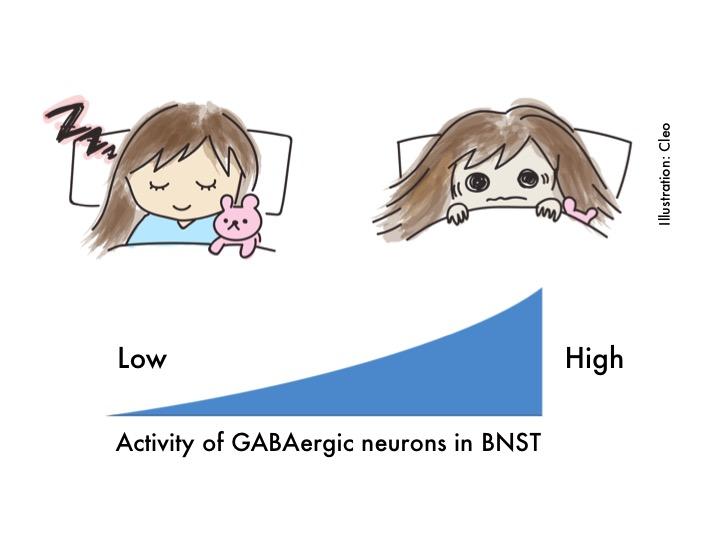
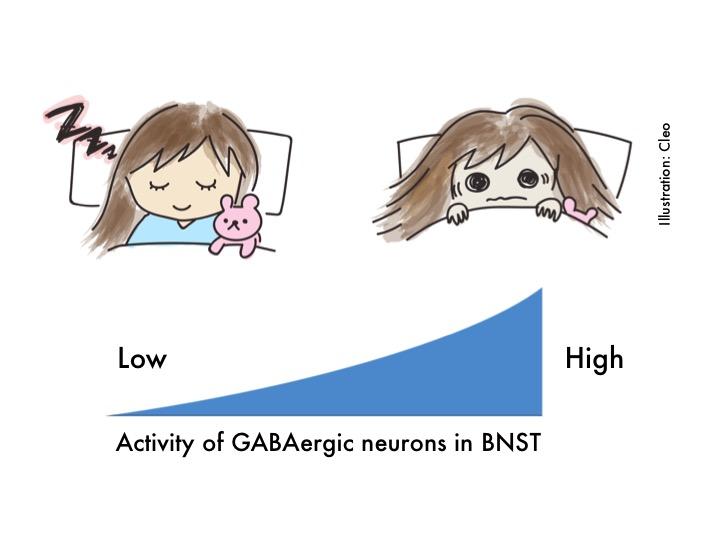
You may have experienced sleepless nights when you were anxious, stressed or too excited. Such emotions are well-known to affect wakefulness and can even cause insomnia, though the underlying mechanisms in our brain have still been unclear. Scientists in the Sleep Institute in Japan spotted neurons that play crucial roles in connecting emotions and sleep, shedding light on the future discovery of drug targets for anxiety disorder and/or sleep disorders.

Encountering predators, adapting to a novel environment or expecting a reward ? these stressful or emotionally-salient situations require animals to shift their behavior to a vigilant state, altering their physiological conditions through modulation of autonomic and endocrine functions.

The bed nucleus of the stria terminalis (BNST) is a part of the extended amygdala, which is generally considered as a key player in stress response, fear and anxiety. Through projections to various brain regions including relay nuclei of the autonomic nervous system, hypothalamic regions and the central nucleus of the amygdala, the BNST controls endocrine and autonomic reactions in response to emotionally-salient stimuli, along with behavioral expression of anxiety and fear.

A group of researchers led by Takeshi Sakurai, Vice Director of the International Institute for Integrative Sleep Medicine (WPI-IIIS), University of Tsukuba, found that acute optogenetic excitation of GABAergic neurons in BNST during non-rapid eye movement (NREM) sleep in mice resulted in immediate transition to a wakefulness state without the function of orexins, highly important neuropeptides for maintaining wakefulness. Notably, stimulation of the same neurons during REM sleep did not show any effects on sleep/wakefulness states.

Prolonged excitation of GABAergic neurons in BNST by a chemogenetic method evoked a longer-lasting, sustained wakefulness state, and it was abolished by administering a dual orexin receptor blocker (antagonist) DORA 22 in advance, meaning that orexins are involved in this phenomenon.

"Our study revealed a role of the BNST GABAergic system in sleep/wakefulness control, especially in shifting animals' behavioral states from NREM sleep to wakefulness. It also provides an important insight into the pathophysiology of insomnia and the role of orexin in arousal regulation, which will hopefully lead to the first step to develop remedies for sleep disorders," Sakurai says.

###

Media Contact

Masataka Sasabe
[email protected]
029-853-5857

Original Source

http://www.tsukuba.ac.jp/en/research-list/p201706301550 http://dx.doi.org/10.1523/JNEUROSCI.0245-17.2017

############

Story Source: Materials provided by Scienmag

Share12Tweet8Share2ShareShareShare2

Related Posts

Urban-Rural Gaps in Perceived Quality of Aging Services

January 15, 2026

Tirzepatide Resolves MASH Without Worsening Fibrosis

January 15, 2026

PPM1A Dysfunction Intensifies DPN via NF-κB/NLRP3 Pathway

January 15, 2026

Nature-Inspired Medical Devices: Scaffolding Inquiry-Based Learning

January 15, 2026
Please login to join discussion

POPULAR NEWS

  • Enhancing Spiritual Care Education in Nursing Programs

    155 shares
    Share 62 Tweet 39
  • PTSD, Depression, Anxiety in Childhood Cancer Survivors, Parents

    147 shares
    Share 59 Tweet 37
  • Robotic Ureteral Reconstruction: A Novel Approach

    76 shares
    Share 30 Tweet 19
  • Study Reveals Lipid Accumulation in ME/CFS Cells

    53 shares
    Share 21 Tweet 13

About

BIOENGINEER.ORG

We bring you the latest biotechnology news from best research centers and universities around the world. Check our website.

Follow us

Recent News

Neonatal Neuroplasticity: Linking Brain Science to Care

Urban-Rural Gaps in Perceived Quality of Aging Services

Tirzepatide Resolves MASH Without Worsening Fibrosis

Subscribe to Blog via Email

Enter your email address to subscribe to this blog and receive notifications of new posts by email.

Join 71 other subscribers
  • Contact Us

Bioengineer.org © Copyright 2023 All Rights Reserved.

Welcome Back!

Login to your account below

Forgotten Password?

Retrieve your password

Please enter your username or email address to reset your password.

Log In
No Result
View All Result
  • Homepages
    • Home Page 1
    • Home Page 2
  • News
  • National
  • Business
  • Health
  • Lifestyle
  • Science

Bioengineer.org © Copyright 2023 All Rights Reserved.