• HOME
  • NEWS
  • EXPLORE
    • CAREER
      • Companies
      • Jobs
    • EVENTS
    • iGEM
      • News
      • Team
    • PHOTOS
    • VIDEO
    • WIKI
  • BLOG
  • COMMUNITY
    • FACEBOOK
    • INSTAGRAM
    • TWITTER
Sunday, December 21, 2025
BIOENGINEER.ORG
No Result
View All Result
  • Login
  • HOME
  • NEWS
  • EXPLORE
    • CAREER
      • Companies
      • Jobs
        • Lecturer
        • PhD Studentship
        • Postdoc
        • Research Assistant
    • EVENTS
    • iGEM
      • News
      • Team
    • PHOTOS
    • VIDEO
    • WIKI
  • BLOG
  • COMMUNITY
    • FACEBOOK
    • INSTAGRAM
    • TWITTER
  • HOME
  • NEWS
  • EXPLORE
    • CAREER
      • Companies
      • Jobs
        • Lecturer
        • PhD Studentship
        • Postdoc
        • Research Assistant
    • EVENTS
    • iGEM
      • News
      • Team
    • PHOTOS
    • VIDEO
    • WIKI
  • BLOG
  • COMMUNITY
    • FACEBOOK
    • INSTAGRAM
    • TWITTER
No Result
View All Result
Bioengineer.org
No Result
View All Result
Home NEWS Science News Chemistry

The scientists developed a new method for improving the efficiency of air purifiers

Bioengineer by Bioengineer
April 23, 2019
in Chemistry
Reading Time: 2 mins read
0
IMAGE
Share on FacebookShare on TwitterShare on LinkedinShare on RedditShare on Telegram

IMAGE

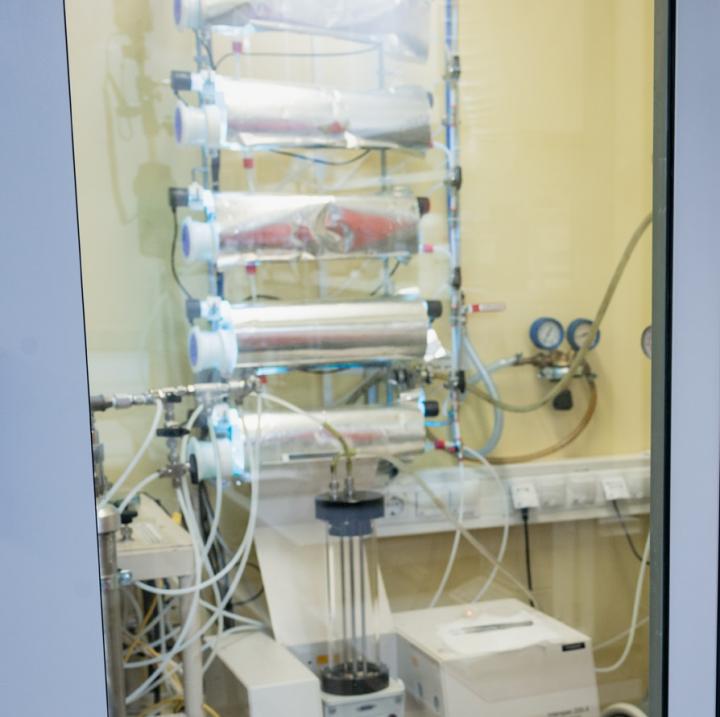
Credit: Sergei Preis, TalTech

Clean air is something that we are continuously proud of in our little Estonia, and it has been called, partly in jest, one of the most important export articles of Estonia. Unfortunately, the environment, including the air, around us is becoming increasingly polluted.

Scientists have to develop further various air purification methods. In March 2019, the article “Acquisition of O2 adsorption isotherms as thorough characterization of nanocrystalline titanium dioxide photocatalysts” written by TalTech scientists was published in the high-impact professional journal Surfaces and Interfaces.

One of the co-authors of the article, Professor at the TalTech Laboratory of Environmental Technology Sergei Preis says, “Our indoor climate, i.e. air in the rooms we are staying in, is increasingly being polluted by volatile toxic substances from furniture and cleaning agents. The growing chemical-based production creates the need for more efficient air purifiers.”

The most important component of air purifiers is a photocatalyst, the role of which is to find and capture numerous toxic compounds in the air we inhale indoors. So far, there has been a deeply-rooted view among the scientific circles that UV-radiation plays a crucial role in a photocatalyst. The presence of oxygen has so far been considered secondary.

Professor Preis says, “At Tallinn University of Technology, photocatalysts of air purifiers have been studied over the last 20 years. What makes our research unique is its specific method. The photocatalysts developed so far have been characterized by adsorption of volatile organic substances. Adsorption is a process, in the course of which harmful molecules of gases adhere onto the surface of a solid substrate (adsorbent), where they are partially or fully oxidized and become harmless. This is how the photocatalytic method works: harmful molecules accumulate on the surface, where active oxidisers are produced (from oxygen in the air and light) that will ultimately destroy harmful molecules.

So far, no particular attention has been paid to oxygen adsorption; oxygen adsorption has been studied only under vacuum. We, however, conducted our analysis under normal conditions (not under vacuum). Such analysis has never been carried out before.”

The results of the tests indicate that alongside UV radiation, the role of oxygen in the in photocatalytic process has been significantly underestimated.

“We can claim that the current method for characterization of photocatalytic materials is no longer up to date. When developing photocatalytic air purifiers, it is useful to determine the adsorption capacity of oxygen, which is a very important quality indicator in characterization of nanocrystalline photocatalysts, besides the analysis used so far,” Sergei Preis says.

###

Surfaces and Interfaces

Additional information: Professor at the Department of Material and Environmental Technology, the Laboratory of Environmental Technology, Sergei Preis, [email protected]

Media Contact
Sergei Preis
[email protected]

Related Journal Article

http://dx.doi.org/10.1016/j.surfin.2018.11.003

Tags: Chemistry/Physics/Materials Sciences
Share12Tweet8Share2ShareShareShare2

Related Posts

Cutting Electrolyte Reduction Boosts High-Energy Battery Performance

Cutting Electrolyte Reduction Boosts High-Energy Battery Performance

December 19, 2025
Microenvironment Shapes Gold-Catalysed CO2 Electroreduction

Microenvironment Shapes Gold-Catalysed CO2 Electroreduction

December 11, 2025

Photoswitchable Olefins Enable Controlled Polymerization

December 11, 2025

Cation Hydration Entropy Controls Chloride Ion Diffusion

December 10, 2025
Please login to join discussion

POPULAR NEWS

  • Nurses’ Views on Online Learning: Effects on Performance

    Nurses’ Views on Online Learning: Effects on Performance

    70 shares
    Share 28 Tweet 18
  • NSF funds machine-learning research at UNO and UNL to study energy requirements of walking in older adults

    71 shares
    Share 28 Tweet 18
  • Unraveling Levofloxacin’s Impact on Brain Function

    53 shares
    Share 21 Tweet 13
  • Exploring Audiology Accessibility in Johannesburg, South Africa

    51 shares
    Share 20 Tweet 13
div>

About

We bring you the latest biotechnology news from best research centers and universities around the world. Check our website.

Follow us

Recent News

Gene Variations Enhance Beef Cattle Efficiency and Immunity

Reassessing Dissociated Memories During Psilocybin Therapy

LRRK2 Mutation Causes Neurodegeneration via Microglial Inflammation

Subscribe to Blog via Email

Enter your email address to subscribe to this blog and receive notifications of new posts by email.

Join 70 other subscribers
  • Contact Us

Bioengineer.org © Copyright 2023 All Rights Reserved.

Welcome Back!

Login to your account below

Forgotten Password?

Retrieve your password

Please enter your username or email address to reset your password.

Log In
No Result
View All Result
  • Homepages
    • Home Page 1
    • Home Page 2
  • News
  • National
  • Business
  • Health
  • Lifestyle
  • Science

Bioengineer.org © Copyright 2023 All Rights Reserved.