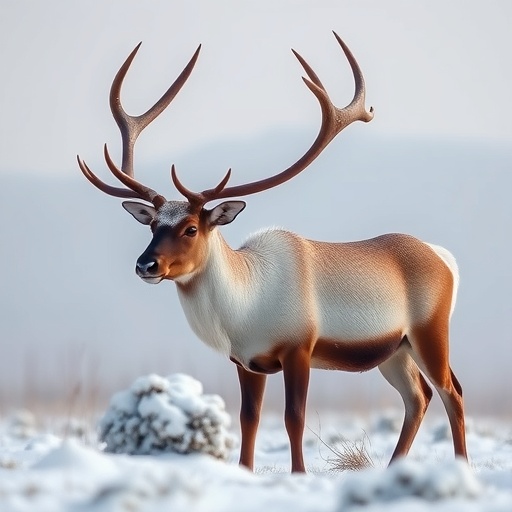
For decades, biologists have been intrigued by a peculiar trait that sets caribou apart from all other deer species: both females and males grow antlers. While males grow large, imposing antlers primarily used in mating competitions, the presence of antlers on females has remained an evolutionary mystery. A groundbreaking study conducted by University of Cincinnati researchers is shedding new light on this enigma by revealing a novel role for antlers among female caribou, especially during the critical calving period.
The research team, led by Associate Professor Joshua Miller and doctoral graduate Madison Gaetano, focused their efforts on the Arctic National Wildlife Refuge in Alaska, home to the famed Porcupine Caribou Herd. This herd embarks on an arduous 1,500-mile round-trip migration annually, traversing some of the harshest and most nutrient-scarce landscapes on the planet. The journey puts tremendous physiological demands on female caribou, particularly new mothers who must nourish their calves in one of the coldest and most unforgiving environments on Earth.
Central to the study were shed antlers collected from these calving grounds, where female caribou give birth and subsequently shed their antlers. These antlers, made of dense bone material rich in essential minerals like calcium and phosphorus, often remain intact in the cold Arctic tundra for centuries. The team hypothesized that these shed antlers might serve a critical dietary function, supplementing the nutrient-poor diets of caribou during key times in their life cycle.
Miller’s team undertook numerous scientific expeditions between 2010 and 2018 to collect antlers and skeletal remains, braving the Arctic wilderness in specialized inflatable rafts and establishing camps fortified with electric fencing to guard against predatory bears. These expeditions enabled meticulous field observations of antler usage and wear, revealing that the majority of shed antlers bore gnaw marks. The pressing question: which animals were responsible for consuming these mineral-rich resources?
Back in the University of Cincinnati’s laboratories, the researchers employed detailed forensic analyses on the tooth marks found on antlers and bones. Differentiating between the chewing patterns of carnivores such as bears and wolves, rodents like lemmings, and ungulates themselves required careful, methodical examination. Surprisingly, the results indicated that caribou — not rodents or carnivores — were the principal gnawers. Starting at the tips of antler tines, caribou systematically gnawed on these shed antlers, effectively harvesting critical minerals one bite at a time.
The study’s quantitative data are striking: 86% of the 1,567 examined antlers showed gnawing, with 99% of all gnaw marks attributable to caribou. Rodents accounted for less than 4% of marks, while carnivore marks were conspicuously absent from the antlers. This overturns longstanding assumptions that rodents or carnivores primarily exploited these bone resources. Instead, it places female caribou feeding behavior under a new lens, suggesting these animals actively exploit mineral reserves in their environment.
In contrast, the teams’ analysis of 224 skeletal bones collected from caribou, moose, and musk ox revealed a more complex interaction between predator and scavenger animals. Carnivores left distinctive gnaw marks on many bones, whereas caribou contributed marks on roughly 12% of them, and rodents only 1%. This highlights the selective use of antlers by caribou as opposed to bones, which are more broadly scavenged by multiple species.
One particularly fascinating insight from the study challenges the common belief that female caribou use their antlers primarily as weapons to defend against predators or to secure optimal grazing territory. Gaetano emphasizes that female caribou tend to rely on their powerful hooves as their primary defense mechanism, trampling or kicking when threatened. Furthermore, the typically smaller size of female antlers, combined with the fact that females shed them around the time of giving birth, renders antlers an unlikely frontline weapon when newborn calves are most vulnerable.
The timing of antler shedding, synchronized with calving, suggests a dual function. By shedding antlers just days after giving birth, females effectively deposit concentrated mineral stores directly in the calving grounds, creating localized nutrient hotspots. These antlers then serve as an accessible mineral supplement, repeatedly exploited by mothers and other caribou as they continue their migration and nursing duties. Over centuries, mineral leaching from these antlers enriches the soil and supports growth of key forage plants such as sedges, grasses, and lichens essential to caribou survival.
This ecological engineering function underscores a unique nutrient recycling system whereby caribou actively transport and deposit vital minerals like phosphorus at critical life stages and locations. Phosphorus is particularly crucial for female caribou, fueling the production of nutrient-dense milk necessary for calf growth and survival in an environment where nutrient shortages can be severe and consequential.
Widening the lens, Miller notes that supplementing diets with bone material, clay, or mineral-rich resources is widespread among mammals. Across diverse ecosystems, herbivores employ creative strategies to meet their dietary mineral requirements, from gnawing on bones to drinking from mineral deposits. His observation of a kangaroo feeding on a dead bird in Australia serves as a vivid reminder of just how versatile and resourceful animal foraging behaviors can be under nutritional stress.
This study fundamentally reframes our understanding of female caribou antlers, revealing their critical role not just as ornamental or combative structures but as living nutritional repositories finely attuned to the challenges of Arctic life. In so doing, it also highlights the intricate connections linking behavior, physiology, and ecosystem nutrient cycling — connections that are essential for conserving these iconic animals amid rapidly changing Arctic environments.
Future research avenues beckon as this novel perspective raises questions about how changing climate and human activities might disrupt these finely balanced nutrient pathways. Understanding how caribou will adapt to shifting access to mineral resources could prove vital for preserving their populations and the ecological systems they engineer. Meanwhile, this study stands as a powerful example of how detailed ecological and behavioral research can unravel evolutionary mysteries and reveal nature’s subtle strategies for survival.
Subject of Research: Animals
Article Title: A Gnawing Question: How Do Caribou and Other Arctic Mammals Exploit Shared Bone Resources?
News Publication Date: 24-Feb-2026
Web References: http://dx.doi.org/10.1002/ece3.72444
Image Credits: Colleen Kelley
Keywords: Ecology, Evolutionary biology, Behavioral ecology, Evolution, Evolutionary ecology
Tags: antler mineral compositionantlers in deer species comparisonArctic National Wildlife Refuge cariboucalcium and phosphorus in antlerscaribou adaptation to harsh environmentscaribou calving period adaptationsevolutionary role of female antlersfemale caribou antler growthfemale caribou maternal investmentphysiological demands of caribou migrationPorcupine Caribou Herd migrationUniversity of Cincinnati caribou study