Credit: Jay Shendure
The Paul G. Allen Frontiers Group announced today the creation of an Allen Discovery Center for Cell Lineage Tracing at UW Medicine, to be directed by Jay Shendure, M.D., Ph.D,, University of Washington professor of Genome Sciences, and co-directed by Michael Elowitz, Ph.D., at the California Institute of Technology, with site director Alex Schier, Ph.D., at Harvard University. The Allen Discovery Center will use newly developed technology to create global maps of development that reveal the relationships between the vast numbers of diverse cells that make up a single organism, with major impacts across developmental biology, neuroscience, cancer biology, regenerative medicine and other fields. The Center is funded at $10 million over four years, with the potential for $30 million over eight years.
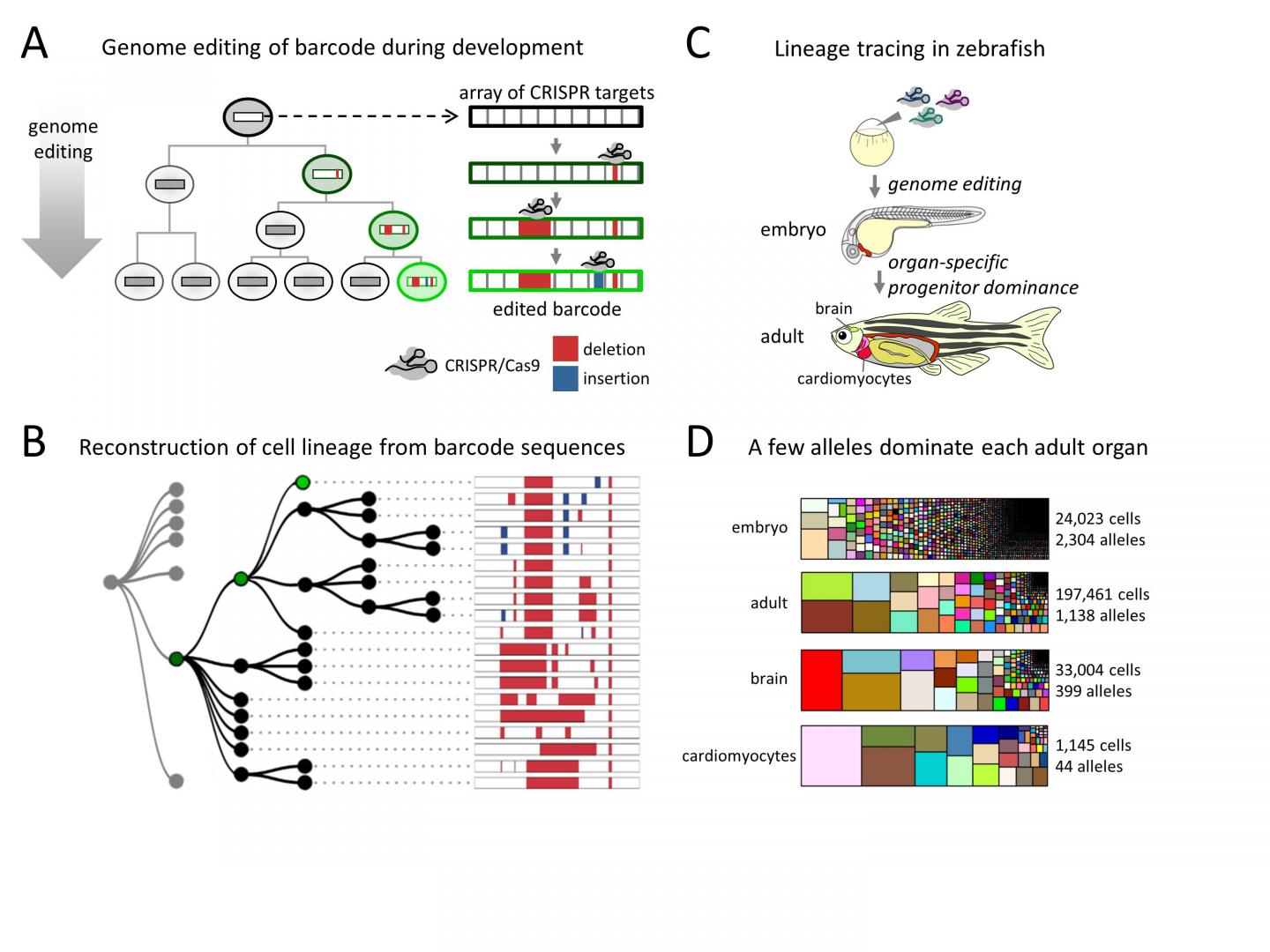
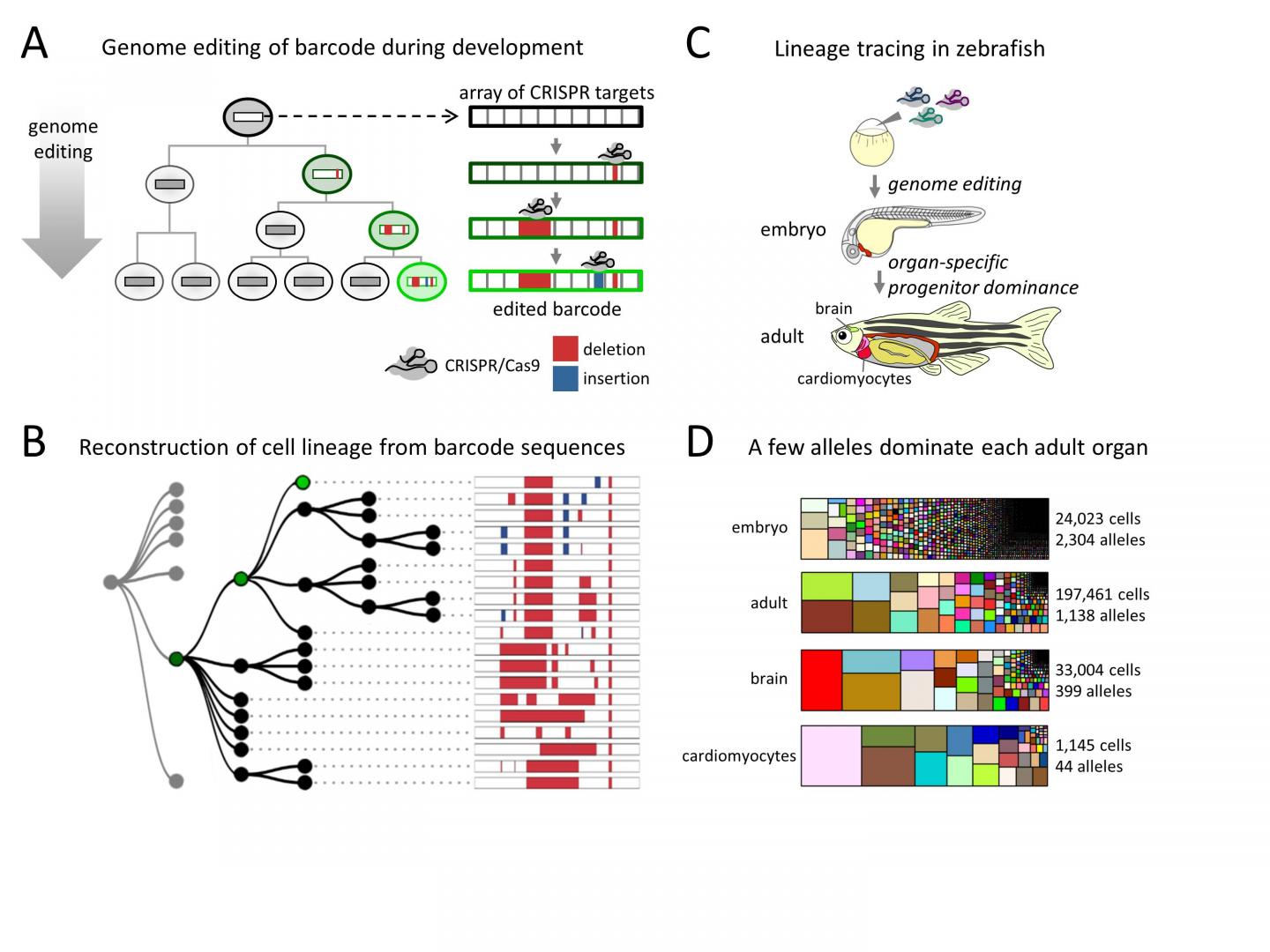
Scientists have been asking questions about the ancestry and lineage of cells for over a century, but tracing the relationships between generations of cells has faced significant technical challenges. In the past several years, teams led by Shendure at the University of Washington, Elowitz and Long Cai, Ph.D. at Caltech and Schier at Harvard have created new technologies that take advantage of modern gene editing methods to effectively trace cells as they divide, move and differentiate throughout an organism's development.
The Allen Discovery Center for Cell Lineage Tracing will use these new technologies and paradigms to develop lineage maps for the zebrafish and mouse – the first global maps of development in any vertebrate. They will also develop genomic systems to record the molecular events that regulate development. The Center's other investigators are Carlos Lois, Ph.D., at Caltech and Marshall Horwitz, M.D., Ph.D., UW professor of Pathology, and Cole Trapnell, Ph.D., UW assistant professor of Genome Sciences.
"For the first time, we have the tools and technology to answer questions that have fascinated developmental biologists for decades," says Shendure. "By inserting 'barcodes' into the genome that mutate throughout development, we can essentially create a family tree for an organism's cells, which tells us each cell's relationships to its ancestors and other cells both near and far. We hope that the generation of technologies that we're developing will enable us to gain the same kind of global view on development that the Human Genome Project provided for our genes."
"An amazing aspect of these technologies is that they should allow each cell to record its own individual molecular history within its own genome," says Elowitz. "Reading out these cellular memoirs will provide new insights into development and disease."
"This application of genome editing and sequencing technologies will allow the study of development at unprecedented scales and create the new field of developmental statistics," says Schier.
"Each of us began as a single cell, which divided and specialized into the trillions of cells that make up an adult human," says Tom Skalak, Ph.D., Executive Director of The Paul G. Allen Frontiers Group. "A fundamental scientific question is how this lineage of cells comes to be. This Allen Discovery Center is poised to produce solutions to this question, which would be transformative for many fields of bioscience."
"We expect this Allen Discovery Center to drive significant change in how we think about and study cell lineage, which is poised to have broad impact in biology," says Ana Mari Cauce, Ph.D., President of the University of Washington. "We are glad for the support of The Paul G. Allen Frontiers Group and their recognition of the incredible work being led by our researchers."
"This collaborative work with scientists at Cal Tech, Harvard and UW Medicine will accelerate our knowledge of cell development in health and disease," says Paul Ramsey, M.D., CEO of UW Medicine and Dean of the UW School of Medicine. "We appreciate the partnership with The Paul G. Allen Frontiers Group and the commitment to advancing work in the biological sciences."
###
Allen Discovery Centers are a new form of funding for leadership-driven, compass-guided research at the frontier of science. Having a comprehensive understanding of how an organism's lineage map would have impact not just on the basic science of developmental biology, but also provide new insights into how cancer cells develop and how to manipulate development for regenerative medicine.
About The Paul G. Allen Frontiers Group
The Paul G. Allen Frontiers Group is dedicated to exploring the landscape of science to identify and fund pioneers with ideas that will advance knowledge and make the world better. Through continuous dialogue with scientists across the world, The Paul G. Allen Frontiers Group seeks opportunities to expand the boundaries of knowledge and solve important problems. Programs include the Allen Discovery Centers at partner institutions for leadership-driven, compass-guided research, and the Allen Distinguished Investigators for frontier explorations with exceptional creativity and potential impact. The Paul G. Allen Frontiers Group was founded in 2016 by philanthropist and visionary Paul G. Allen, and is a division of the Allen Institute, an independent 501(c)(3) medical research organization. For more information, visit allenfrontiersgroup.org.
Media Contact
Rob Piercy
[email protected]
206-548-8486
@Allen_Institute
############
Story Source: Materials provided by Scienmag