

• HOME
  • NEWS
  • EXPLORE
    • CAREER
      • Companies
      • Jobs
    • EVENTS
    • iGEM
      • News
      • Team
    • PHOTOS
    • VIDEO
    • WIKI
  • BLOG
  • COMMUNITY
    • FACEBOOK
    • INSTAGRAM
    • TWITTER
Monday, April 6, 2026
BIOENGINEER.ORG
No Result
View All Result
  • Login
  • HOME
  • NEWS
  • EXPLORE
    • CAREER
      • Companies
      • Jobs
        • Lecturer
        • PhD Studentship
        • Postdoc
        • Research Assistant
    • EVENTS
    • iGEM
      • News
      • Team
    • PHOTOS
    • VIDEO
    • WIKI
  • BLOG
  • COMMUNITY
    • FACEBOOK
    • INSTAGRAM
    • TWITTER
  • HOME
  • NEWS
  • EXPLORE
    • CAREER
      • Companies
      • Jobs
        • Lecturer
        • PhD Studentship
        • Postdoc
        • Research Assistant
    • EVENTS
    • iGEM
      • News
      • Team
    • PHOTOS
    • VIDEO
    • WIKI
  • BLOG
  • COMMUNITY
    • FACEBOOK
    • INSTAGRAM
    • TWITTER
No Result
View All Result
Bioengineer.org
No Result
View All Result
Home NEWS Science News Biology

The molecules that energize babies’ hearts

Bioengineer by Bioengineer
June 14, 2018
in Biology
Reading Time: 2 mins read
0
Share on FacebookShare on TwitterShare on LinkedinShare on RedditShare on Telegram
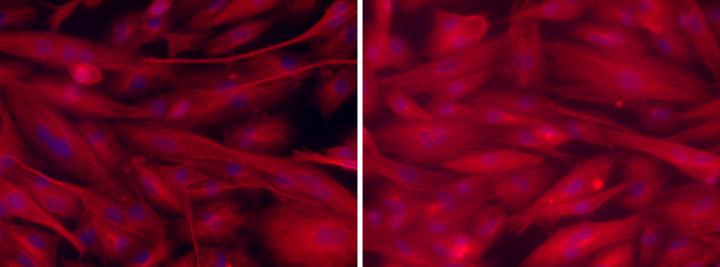
IMAGE

Credit: Fukushima A. et al., The Journal of Clinical Investigation Insight, May 17, 2018

A metabolic process that provides heart muscle with energy fails to mature in newborns with thickened heart walls, according to a Japan-Canada research team.

Hokkaido University cardiologist Arata Fukushima, along with a team of University of Alberta scientists led by Gary Lopaschuk, examined the heart tissue of 84 newborns who had undergone surgery for congenital heart disease. Many patients with the disease develop thickened heart walls, or hypertrophy, which can lead to fatal heart failure even after the surgery.

Before birth, cardiac muscle cells use energy generated by breaking down glucose. Immediately after birth, they rapidly switch to breaking down fatty acids. This switch is hindered in hypertrophied newborn hearts. Fukushima and his team wanted to investigate how this happens at the molecular level.

In the study, published in The Journal of Clinical Investigation Insight, the team compared the biopsy samples taken from normal and thickened right ventricular walls. They found that two enzymes involved in fatty acid break down, called LCAD and βHAD, were 'hyperacetylated' in non-hypertrophied right ventricles. This means that large amounts of acetyl groups were added to the enzyme proteins, increasing their activity levels. This, in turn, led to increased fatty acid metabolism.

In hypertrophied hearts, these two enzymes were not hyperacetylated, leading to reduced fatty acid metabolism in these newborns. The team detected reduced activity of an acetylation promoting gene, called gcn5l1, in hypertrophied hearts.

When the team experimented on cultured hypertrophy-like cardiac muscle cells, they found that turning off the gcn5l1 gene led to decreased acetylation of LCAD and βHAD, and a reduced fatty acid oxidation in the cells. Moreover, the cells lacking gcn5l1 formed thicker muscle fibers comparing to normal cells.

"Our findings show that acetylation of metabolic enzymes plays an important role in controlling the dramatic changes in energy metabolism that occur in newborn hearts immediately after birth," says Arata Fukushima. "The findings also show how hypertrophy can perturb this process by delaying the maturation of fatty acid metabolism, which compromises the ability of the newborn heart to generate energy. Developing drugs that enhance acetylation of the metabolic enzymes could help treat patients with hypertrophy."

###

Media Contact

Naoki Namba
[email protected]
81-117-062-185
@hokkaido_uni

https://www.global.hokudai.ac.jp/

Original Source

https://www.global.hokudai.ac.jp/blog/the-molecules-that-energize-babies-hearts/ http://dx.doi.org/10.1172/jci.insight.99239

Share12Tweet8Share2ShareShareShare2

Related Posts

A Rare Cause of Cryptorchidism: Recognizing Persistent Müllerian Duct Syndrome

A Rare Cause of Cryptorchidism: Recognizing Persistent Müllerian Duct Syndrome

April 6, 2026
Drug–Microbiome Interactions Affect Parkinson’s Medications

Drug–Microbiome Interactions Affect Parkinson’s Medications

April 6, 2026

Damselfly Mating Strategies Shed Light on Reproductive Barriers

April 4, 2026

Custom Biochar Approaches Enhance Alfalfa Growth and Stress Tolerance in Saline Soils

April 3, 2026
Please login to join discussion

POPULAR NEWS

  • blank

    Revolutionary AI Model Enhances Precision in Detecting Food Contamination

    97 shares
    Share 39 Tweet 24
  • Promising Outcomes from First Clinical Trials of Gene Regulation in Epilepsy

    51 shares
    Share 20 Tweet 13
  • Imagine a Social Media Feed That Challenges Your Views Instead of Reinforcing Them

    1009 shares
    Share 399 Tweet 249
  • Popular Anti-Aging Compound Linked to Damage in Corpus Callosum, Study Finds

    44 shares
    Share 18 Tweet 11

About

We bring you the latest biotechnology news from best research centers and universities around the world. Check our website.

Follow us

Recent News

JMIR Publications Highlights Breakthrough in Precision Oncology: Personalized Multi-Drug Regimens Surpass Standard Treatments

Revolutionizing Advanced Healthcare at East Campus Medical Center

Dandelion Polyphenols Combat Inflammation Pathways

Subscribe to Blog via Email

Enter your email address to subscribe to this blog and receive notifications of new posts by email.

Join 78 other subscribers
  • Contact Us

Bioengineer.org © Copyright 2023 All Rights Reserved.

Welcome Back!

Login to your account below

Forgotten Password?

Retrieve your password

Please enter your username or email address to reset your password.

Log In
No Result
View All Result
  • Homepages
    • Home Page 1
    • Home Page 2
  • News
  • National
  • Business
  • Health
  • Lifestyle
  • Science

Bioengineer.org © Copyright 2023 All Rights Reserved.
